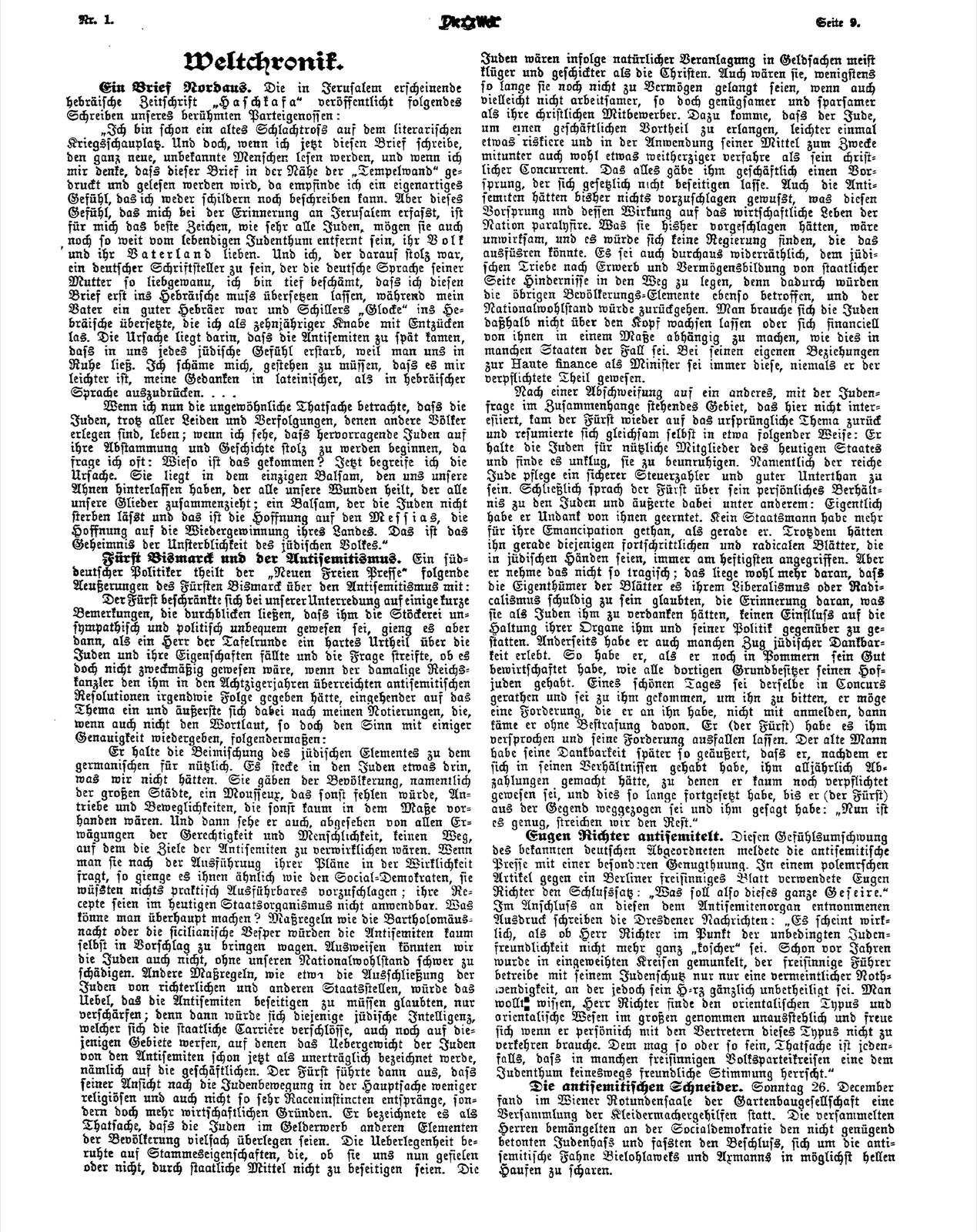
World Chronicle.
A Letter from Nordau. The Hebrew journal "Haschkafa," which appears in Jerusalem, publishes the following letter from our celebrated party comrade:
"I am already an old war-horse on the literary battlefield. And yet, when I now write this letter, which entirely new, unknown people will read, and when I reflect that this letter will be printed and read in the vicinity of the 'Temple Wall,' I feel a peculiar sensation that I can neither depict nor describe. But this feeling, which seizes me at the remembrance of Jerusalem, is for me the best sign of how deeply all Jews — however far removed they may be from living Judaism — love their people and their fatherland. And I, who was proud to be a German writer, who came to love so dearly the German language of my mother, I am deeply ashamed that I must first have this letter translated into Hebrew, while my father was a good Hebraist and translated Schiller's 'Bell' into Hebrew, which I read with delight as a boy of ten. The cause lies in this: that the antisemites came too late, that within us every Jewish feeling grew numb, because we were left in peace. I am ashamed to have to confess that it is easier for me to express my thoughts in Latin than in the Hebrew tongue. . . .
When I now consider the extraordinary fact that the Jews, in spite of all the sufferings and persecutions to which other peoples have succumbed, live on; when I see that eminent Jews are beginning to grow proud of their descent and their history, I often ask: How has this come to pass? Now I comprehend the cause. It lies in the one balm that our forefathers have bequeathed to us, which heals all our wounds, which draws all our limbs together; a balm that does not let the Jews die — and that is the hope in the Messiah, the hope of the recovery of their land. That is the secret of the immortality of the Jewish people."
Prince Bismarck and Antisemitism. A South-German politician communicates to the "Neue Freie Presse" the following utterances of Prince Bismarck on antisemitism:
During our conversation the Prince confined himself to a few brief remarks, which let it be seen that the Stökerei was distasteful to him and politically inconvenient; but then, when a gentleman of the company passed a harsh judgment upon the Jews and their qualities and touched on the question whether it might not, after all, have been expedient had the then Reich Chancellor in some way acted upon the antisemitic resolutions presented to him in the eighties, he entered more thoroughly into the subject, and expressed himself thereupon — according to my notes, which, though not the exact wording, yet reproduce the sense with some accuracy — as follows:
He held the admixture of the Jewish element to the Germanic to be useful. There was something in the Jews that we did not possess. They gave the population, especially that of the great cities, a Mousseur which would otherwise be lacking — impulses and mobilities that would otherwise scarcely be present in such measure. And then, too, apart from all considerations of justice and humanity, he saw no way by which the aims of the antisemites could be realized. If one asked them about the practical execution of their plans in reality, it fared with them much as with the Social Democrats: they knew of nothing practically feasible to propose; their prescriptions were not applicable in the present organism of the State. What, indeed, could one do at all? Measures such as the Bartholomew's Night or the Sicilian Vespers the antisemites would scarcely dare to propose themselves. Neither could we expel the Jews without gravely damaging our national prosperity. Other measures — such as the exclusion of the Jews from judicial and other posts of State — would only aggravate the very evil that the antisemites believed they must remove; for then that Jewish intelligence to which the State career was closed would throw itself all the more upon those fields on which the preponderance of the Jews is already now described by the antisemites as intolerable — namely, the commercial ones. The Prince then set forth that, in his view, the Jewish movement sprang in the main less from religious, and also not so much from racial, instincts, but rather more from economic causes. He described it as a fact that the Jews were in many respects superior to other elements of the population in the acquisition of money. This superiority rested upon tribal characteristics which — whether they pleased us or not — could not be removed by means of the State. By natural disposition the Jews were, in money matters, for the most part cleverer and more skilful than the Christians. They were also — at least so long as they had not yet attained to wealth — if perhaps not more industrious, yet more frugal and thriftier than their Christian competitors. Added to this, that the Jew, in order to gain a business advantage, more readily risks something on occasion, and in the employment of his means to an end sometimes proceeds, too, with somewhat greater latitude than his Christian competitor. All this gave him, in business, an advantage which could not be removed by law. The antisemites, too, had thus far known of nothing to propose that would paralyze this advantage and its effect upon the economic life of the nation. What they had proposed hitherto was ineffectual, and no government would be found that could carry it out. It was, moreover, thoroughly inadvisable to place obstacles from the side of the State in the way of the Jewish drive toward acquisition and the building of wealth; for thereby the remaining elements of the population would be affected just as much, and the national prosperity would decline. One need not on that account let the Jews grow over one's head, or make oneself financially dependent upon them to a degree such as is the case in some States. In his own relations to haute finance as a Minister, it had always been the latter, never he, that was the obligated party. . . . . .
After a digression upon another field connected with the Jewish question, which does not concern us here, the Prince returned to the original theme and, as it were, summed himself up somewhat in the following manner: He held the Jews to be useful members of the present-day State, and thought it unwise to disquiet them. The rich Jew in particular was wont to be a reliable taxpayer and a good subject. Finally the Prince spoke of his personal relation to the Jews, and remarked, among other things: that, in truth, he had reaped ingratitude from them. No statesman had done more for their emancipation than precisely he. Nevertheless, it was precisely those progressive and radical papers that are in Jewish hands which had always attacked him most vehemently. But he did not take that so tragically; it lay, no doubt, rather in this — that the proprietors of the papers believed they owed it to their liberalism or radicalism not to allow the remembrance of what they, as Jews, had to thank him for, to have any influence upon the attitude of their organs toward him and his policy. On the other hand, he had also experienced many a trait of Jewish gratitude. Thus, when he was still managing his estate in Pomerania, he had — like all the landowners there — his court-Jew. One fine day this man had fallen into bankruptcy and had come to him to beg that he would not enter a claim which he held against him, so that he might get off without penalty. He (the Prince) had promised him this, and had let his claim lapse. The old man had afterward shown his gratitude in such wise that, once he had set his circumstances in order again, he made him yearly payments to which he was scarcely any longer bound, and continued this so long, until he (the Prince) had moved away from the district and said to him: "Now it is enough; let us strike out the rest."
Eugen Richter an Antisemite. This surge of feeling on the part of the well-known German deputy was reported by the antisemitic press with especial satisfaction. In a polemical article against a Berlin free-thinking paper, Eugen Richter employed the closing sentence: "What, then, is the use of all this Geseire." In connection with this expression, taken from the antisemitic organ, the Dresdener Nachrichten writes: "It really seems as though Herr Richter, on the point of unconditional friendliness to the Jews, were no longer quite 'kosher.' Already years ago it was whispered in initiated circles that the free-thinking leader pursued his protection of the Jews only as a supposed necessity, in which, however, his heart had no part whatever. It was claimed to be known that Herr Richter finds the Oriental type and Oriental nature, taken in the large, insufferable, and rejoices when he personally need not associate with the representatives of this type. Be that as it may, the fact in any case is that in some free-thinking People's-Party circles a mood by no means friendly to Judaism prevails."
The Antisemitic Tailors. On Sunday, the 26th of December, a meeting of the journeymen clothes-makers took place in the Rotunda Hall of the Horticultural Society in Vienna. The assembled gentlemen found fault with Social Democracy for its insufficiently emphasized hatred of the Jews, and passed the resolution to rally around the antisemitic banner of Bielohlawek and Armann in the greatest possible droves.