Page 8. — "Die Welt" — No. 1.
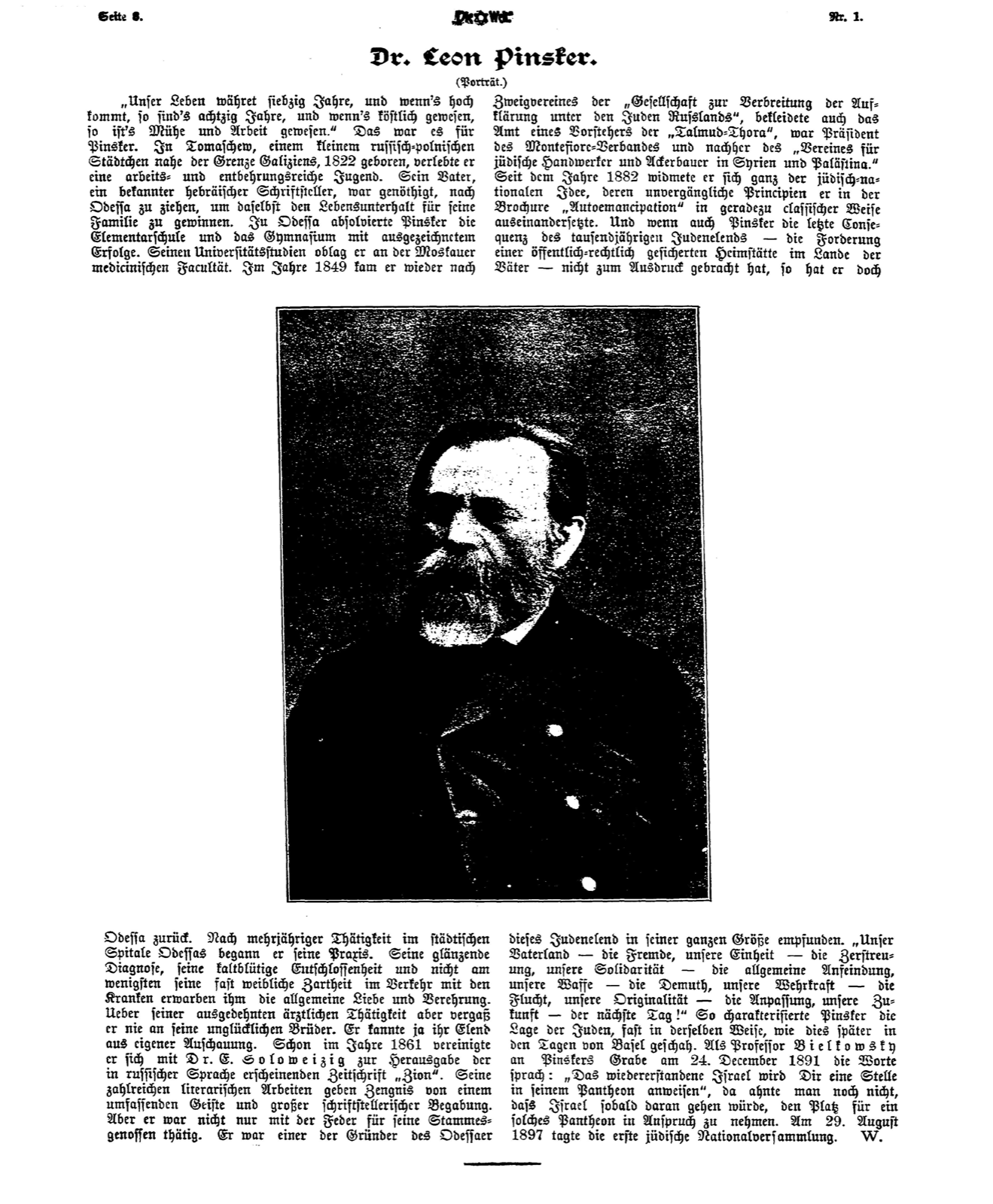
Dr. Leon Pinsker.
(Portrait.)
"Our life endureth seventy years, and at the most it is eighty years, and if it hath been precious, it hath been toil and labour." That it was for Pinsker. Born in 1822 at Tomaschew, a small Russian-Polish town near the frontier of Galicia, he passed a youth rich in labour and privation. His father, a well-known Hebrew writer, was compelled to remove to Odessa, in order to earn there the livelihood of his family. In Odessa Pinsker completed the elementary school and the gymnasium with excellent success. His university studies he pursued at the Moscow medical faculty. In the year 1849 he returned once more to
branch society of the "Society for the Diffusion of Enlightenment among the Jews of Russia," he also held the office of a warden of the "Talmud-Thora," was president of the Montefiore Association and afterwards of the "Society for Jewish Craftsmen and Agriculturists in Syria and Palestine." From the year 1882 onward he devoted himself wholly to the Jewish-national idea, whose imperishable principles he set forth in a positively classic manner in the brochure "Autoemancipation." And even though Pinsker did not bring to expression the ultimate consequence of the thousand-year Jewish misery — the demand for a publicly and legally secured homestead in the land of the fathers — yet he did
Odessa. After several years' activity in the municipal hospital of Odessa he began his practice. His brilliant diagnosis, his cold-blooded resolution, and not least his almost womanly tenderness in intercourse with the sick, won for him universal love and veneration. But amid his extensive medical activity he never forgot his unhappy brethren. He knew their misery, indeed, from his own observation. Already in the year 1861 he joined with Dr. E. Soloweizig in the publication of the journal "Zion," which appeared in the Russian language. His numerous literary labours bear witness to a comprehensive mind and a great gift for writing. But he was not active for his fellow-tribesmen with the pen alone. He was one of the founders of the Odessa
feel this Jewish misery in its whole magnitude. "Our fatherland — the alien land, our unity — the dispersion, our solidarity — the general hostility, our weapon — humility, our defensive strength — flight, our originality — adaptation, our future — the next day!" Thus did Pinsker characterise the situation of the Jews, almost in the same manner in which this afterwards came to pass in the days of Basle. When Professor Bielkowsky, at Pinsker's grave on the 24th of December 1891, spoke the words: "The risen Israel will assign thee a place in its Pantheon," it was not yet surmised that Israel would so soon set about laying claim to the site for such a Pantheon. On the 29th of August 1897 the first Jewish National Assembly met. W.