No. 28. — "Die Welt" — Page 7.
(continued from page 6)
…for the future of himself and of his dependents. The State, to be sure, likewise depends upon men, only these need not always be thinking of the dividend, and can therefore the more readily let the worker, too, be a human being. One has but to recall the great sacrifices that the European States made at the beginning of this century in order to establish industry. The export trade, moreover, may quite well be left to private speculation, and concessions granted to it in return. So long, then, as the recruitment of workers belongs within the Bank's sphere of action, the Bank must be held to proceed according to a labour contract approved by the leadership, one that would have to rest upon the foregoing conditions. It is to be hoped that the workers themselves will be consulted in the drawing-up of the draft contract, and indeed that even now they will voice their views here in these columns; for though many of them still stand under the spell of Socialism, there are nonetheless numerous workers of Jewish stock who would gladly renounce the International if they could gain a homeland of their own and a secured existence.
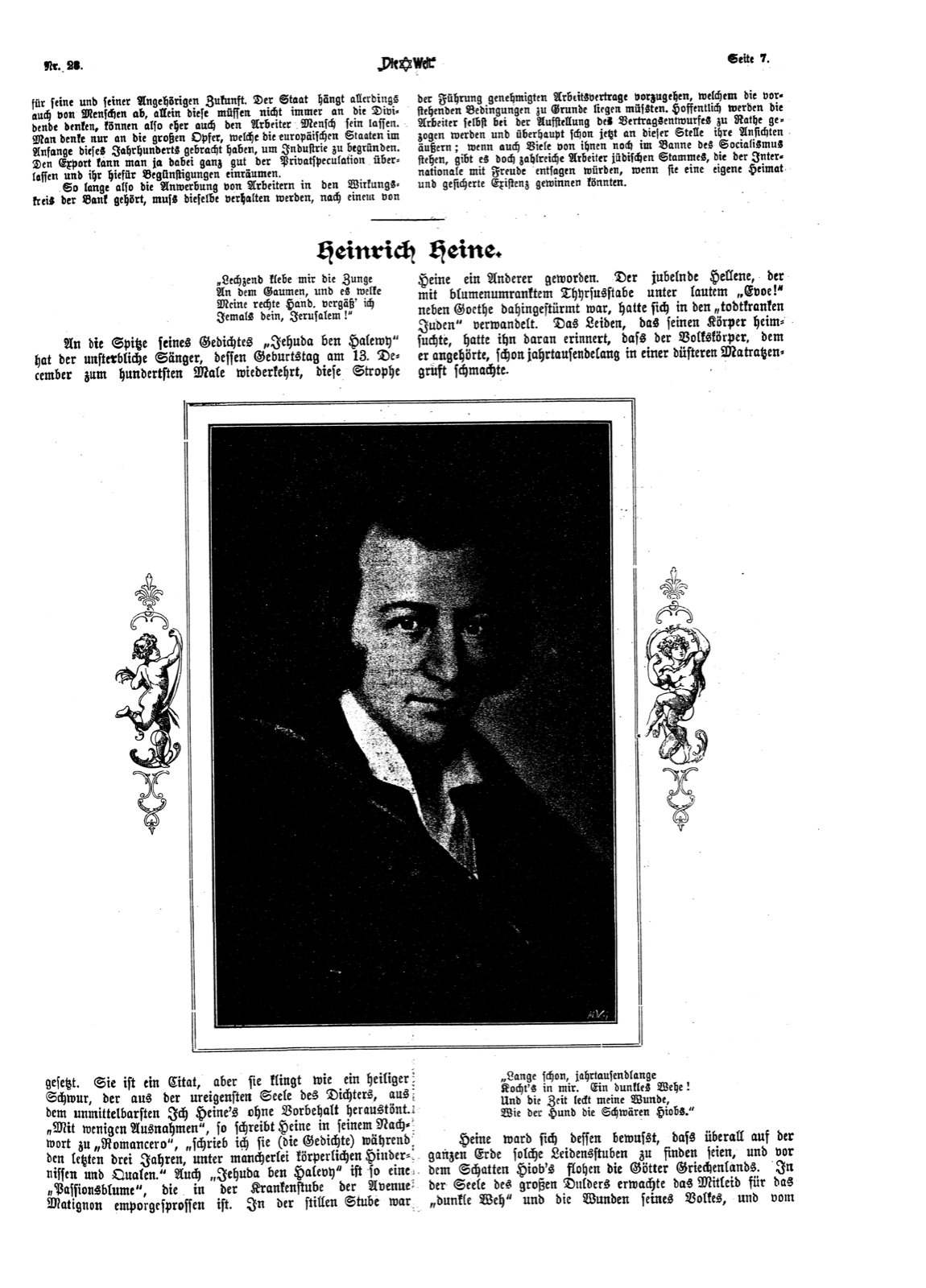
Heinrich Heine.
"Languishing, my tongue shall cleave Unto my palate, and shall wither My right hand, should I forget Thee ever, O Jerusalem!"
At the head of his poem "Jehuda ben Halewy" the immortal singer, whose birthday recurs for the hundredth time on the 13th of December, this strophe Heine had become another man. The jubilant Hellene, who with flower-wreathed thyrsus-staff had stormed onward at Goethe's side amid loud cries of "Evoe!", had transformed himself into the "mortally sick Jew." The suffering that visited his body had reminded him that the body of the people to which he belonged had for thousands of years already been languishing in a gloomy mattress-grave.
set. It is a quotation, yet it rings like a sacred oath, one that sounds forth without reserve from the poet's inmost soul, from Heine's most immediate self. "With few exceptions," Heine writes in his afterword to "Romancero," "I wrote them (the poems) during the last three years, amid sundry bodily hindrances and torments." "Jehuda ben Halewy," too, is such a "passion-flower," one that sprouted up in the sickroom of the Avenue Matignon. In the quiet chamber was
"Long already, for a thousand years, It seethes in me. A darkling woe! And time is licking at my wound, As the hound the sores of Job."
Heine became aware that such chambers of suffering are to be found everywhere upon the whole earth, and before the shadow of Job the gods of Greece took flight. In the soul of the great sufferer there awoke compassion for the "dark woe" and the wounds of his people, and from the