No. 19. — "Die Welt" — Page 7.
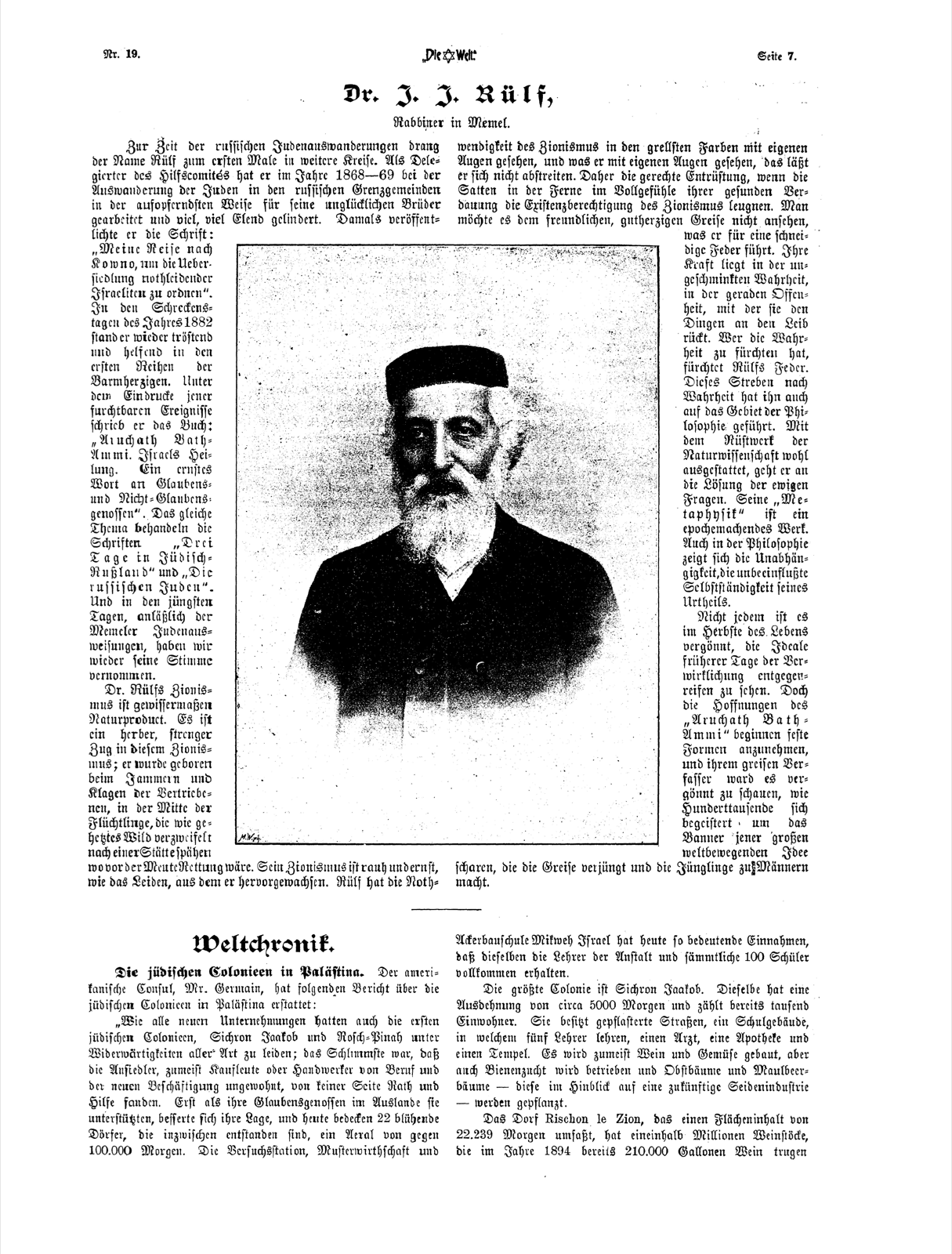
Dr. I. I. Rülf,
Rabbi in Memel.
At the time of the Russian Jewish emigrations the name of Rülf first penetrated to wider circles. As delegate of the Relief Committee he laboured in the years 1868—69, during the emigration of the Jews in the Russian border communities, in the most self-sacrificing manner for his unhappy brethren, and alleviated much, very much misery. In those days he published the tract: "My Journey to Kowno, to Organise the Removal of Israelites in Distress". In the days of terror of the year 1882 he stood once more in the foremost ranks of the merciful, comforting and helping. Under the impression of those frightful events he wrote the book: "Aruchath Bath-Ammi. Israel's Healing. A Serious Word to Fellow-Believers and Non-Believers". The same theme is treated in the writings "Three Days in Jewish Russia" and "The Russian Jews". And in these latest days, on the occasion of the Memel expulsions of Jews, we have heard his voice again.
Dr. Rülf's Zionism is in a certain sense a product of nature. There is a harsh, severe strain in this Zionism; it was born amid the lamentation and wailing of the expelled, in the midst of the fugitives who, like hunted game, peer about in despair for a place where there might be rescue from the pack. His Zionism is rough and earnest, like the suffering out of which it has grown. Rülf has seen the necessity of Zionism with his own eyes in the most glaring colours, and what he has seen with his own eyes he will not suffer to be denied him. Hence the righteous indignation when the well-fed at a distance, in the full sense of their sound digestion, deny Zionism its right to exist. One would not guess, to look at the kindly, good-hearted old man, what a trenchant pen he wields. Its strength lies in the unvarnished truth, in the straightforward candour with which it comes to close quarters with things. Whoever has cause to fear the truth fears Rülf's pen. This striving after truth has led him also into the field of philosophy. Well equipped with the armoury of natural science, he sets about the solution of the eternal questions. His "Metaphysics" is an epoch-making work. In philosophy too there appears the independence, the uninfluenced self-reliance of his judgment.
It is not granted to every man in the autumn of life to see the ideals of earlier days ripening toward fulfilment. Yet the hopes of the "Aruchath Bath-Ammi" are beginning to take firm shape, and to its aged author it has been granted to behold how hundreds of thousands gather in enthusiasm about the banner of that great world-moving idea which makes the aged young again and the youths into men.
World Chronicle.
The Jewish Colonies in Palestine. The American Consul, Mr. Germain, has rendered the following report upon the Jewish colonies in Palestine:
"Like all new undertakings, the first Jewish colonies, Sichron Jaakob and Rosch-Pinah, had also to suffer from adversities of every kind; the worst was that the settlers, for the most part merchants or artisans by calling and unaccustomed to their new occupation, found counsel and help from no quarter. Only when their co-religionists abroad supported them did their situation improve, and to-day 22 flourishing villages, which have arisen in the meantime, cover an area of nearly 100,000 Morgen. The experimental station, model farm and agricultural school Mikweh Israel has to-day so considerable an income that it entirely maintains the teachers of the institution and all its 100 pupils.
The largest colony is Sichron Jaakob. It has an extent of about 5000 Morgen and already numbers a thousand inhabitants. It possesses paved streets, a school building in which five teachers teach, a physician, an apothecary's shop and a temple. Wine and vegetables are chiefly raised, but bee-keeping is also carried on, and fruit trees and mulberry trees — the latter with a view to a future silk industry — are planted.
The village of Rischon le Zion, which comprises an area of 22,239 Morgen, has a million and a half vine-stocks, which in the year 1894 already bore 210,000 gallons of wine