— 111 —
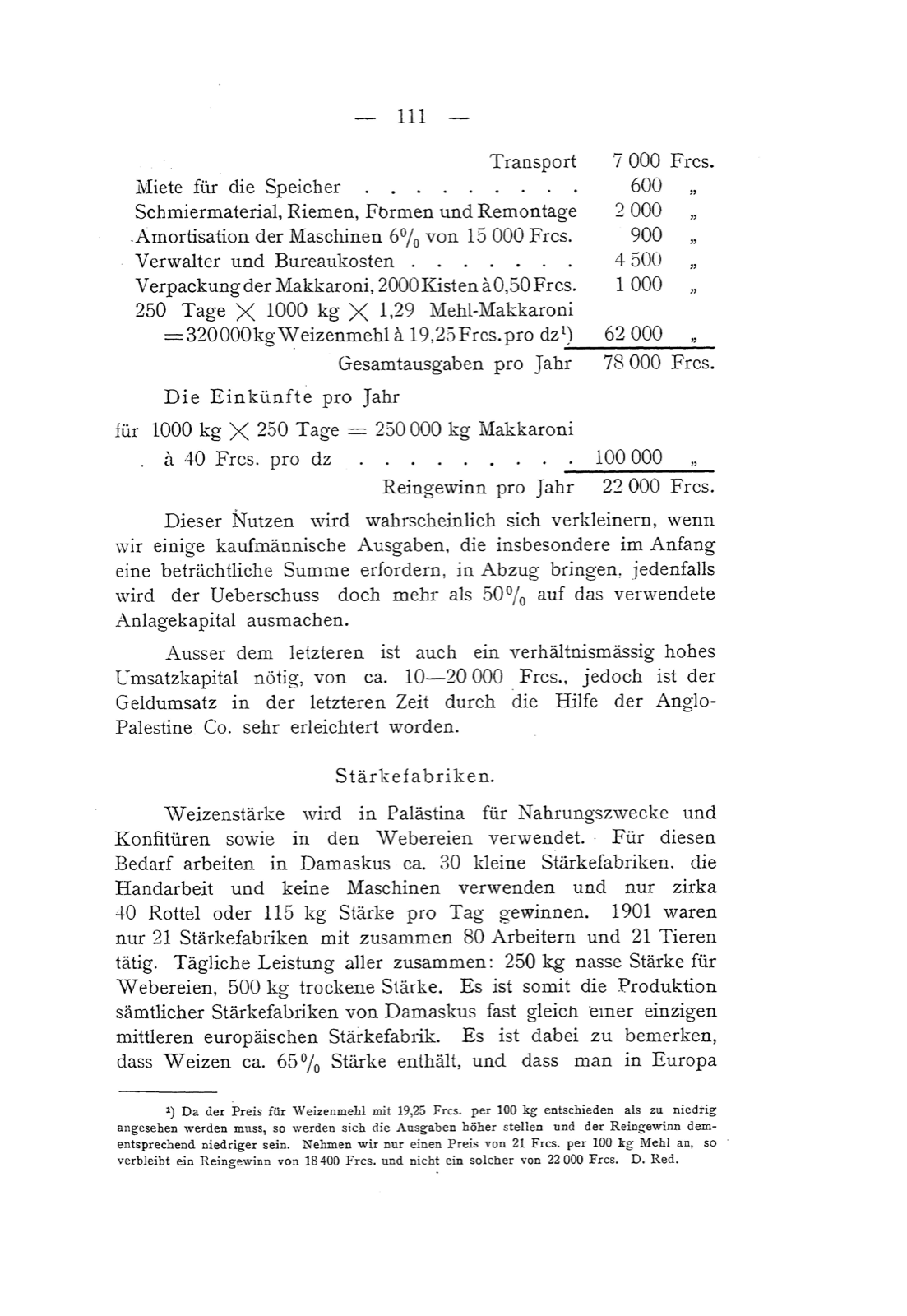
Brought forward — 7,000 Frcs. Rent for the warehouses . . . . . . . . . 600 „ Lubricating material, belting, moulds, and re-erection 2,000 „ Amortization of the machines, 6 % of 15,000 Frcs. 900 „ Manager and office costs . . . . . . . 4,500 „ Packing of the macaroni, 2000 cases at 0,50 Frcs. 1,000 „ 250 days × 1000 kg × 1,29 flour-macaroni = 320,000 kg wheat flour at 19,25 Frcs. per dz¹) 62,000 „
Total expenses per year — 78,000 Frcs.
The receipts per year: for 1000 kg × 250 days = 250,000 kg of macaroni at 40 Frcs. per dz . . . . . . . . . 100,000 „
Net profit per year — 22,000 Frcs.
This profit will probably grow smaller if we bring into deduction certain commercial expenses, which especially at the beginning require a considerable sum; in any case the surplus will yet amount to more than 50 % on the installation capital employed.
Besides the latter, a comparatively high working capital is also necessary, of about 10—20,000 Frcs.; however, the circulation of money has of late been much facilitated through the help of the Anglo-Palestine Co.
Starch Factories.
Wheat starch is employed in Palestine for purposes of nourishment and for confections, as well as in the weaving-mills. For this demand there work in Damascus about 30 small starch factories, which employ hand labour and no machines, and win only some 40 rottel, or 115 kg, of starch per day. In 1901 only 21 starch factories were active, with in all 80 workers and 21 animals. Daily output of all together: 250 kg of wet starch for weaving-mills, 500 kg of dry starch. Thus the production of all the starch factories of Damascus is almost equal to that of a single middle-sized European starch factory. It is thereby to be remarked that wheat contains about 65 % starch, and that in Europe
¹) Since the price for wheat flour at 19,25 Frcs. per 100 kg must decidedly be regarded as too low, the expenses will stand higher and the net profit correspondingly lower. If we assume only a price of 21 Frcs. per 100 kg of flour, there remains a net profit of 18,400 Frcs., and not one of 22,000 Frcs. The Editors.