— 110 —
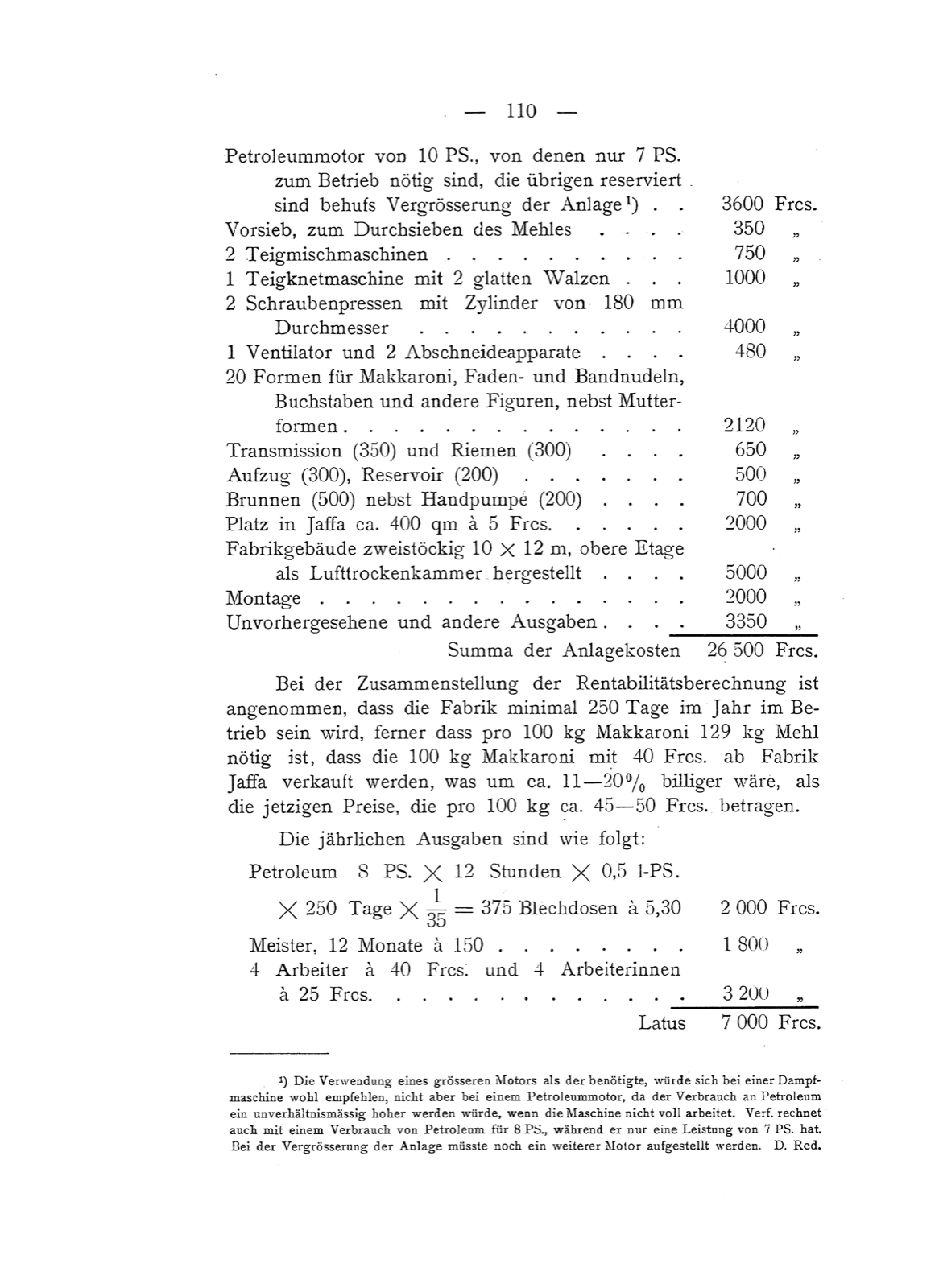
Petroleum motor of 10 h.p., of which only 7 h.p. are needed for operation, the rest being reserved for the enlargement of the installation¹) . . 3600 Frcs. Sifting apparatus, for the sifting of the flour . . . 350 „ 2 dough-mixing machines . . . . . . . . . 750 „ 1 dough-kneading machine with 2 smooth rollers . . 1000 „ 2 screw presses with cylinders of 180 mm diameter . . . . . . . . . . . 4000 „ 1 ventilator and 2 cutting-off apparatus . . . . 480 „ 20 moulds for macaroni, thread and ribbon noodles, letters and other figures, together with matrix moulds . . . . . . . . . . . . . 2120 „ Transmission (350) and belting (300) . . . . 650 „ Hoist (300), reservoir (200) . . . . . . . 500 „ Well (500) together with hand pump (200) . . . . 700 „ Site in Jaffa, about 400 sq. m at 5 Frcs. . . . . . 2000 „ Factory building of two storeys, 10 × 12 m, the upper storey fitted up as an air-drying chamber . . . . 5000 „ Erection . . . . . . . . . . . . . . . 2000 „ Unforeseen and other expenses . . . . 3350 „
Sum of the installation costs — 26,500 Frcs.
In drawing up the calculation of profitableness it is assumed that the factory will be in operation at least 250 days in the year; further, that per 100 kg of macaroni 129 kg of flour are necessary; that the 100 kg of macaroni will be sold at 40 Frcs. ex factory Jaffa, which would be about 11—20 % cheaper than the present prices, which amount to about 45—50 Frcs. per 100 kg.
The yearly expenses are as follows:
Petroleum: 8 h.p. × 12 hours × 0.5 l-h.p. × 250 days × 1/35 = 375 tins at 5,30 — 2,000 Frcs.
Foreman, 12 months at 150 . . . . . . . . 1,800 „ 4 workmen at 40 Frcs. and 4 workwomen at 25 Frcs. . . . . . . . . . . . . 3,200 „
Carried forward — 7,000 Frcs.
¹) The employment of a larger motor than the one required would no doubt commend itself in the case of a steam engine, but not with a petroleum motor, since the consumption of petroleum would become disproportionately high if the machine does not work at full load. The author reckons, moreover, with a consumption of petroleum for 8 h.p., while he has an output of only 7 h.p. On the enlargement of the installation a further motor would have to be set up. The Editors.