— 61 —
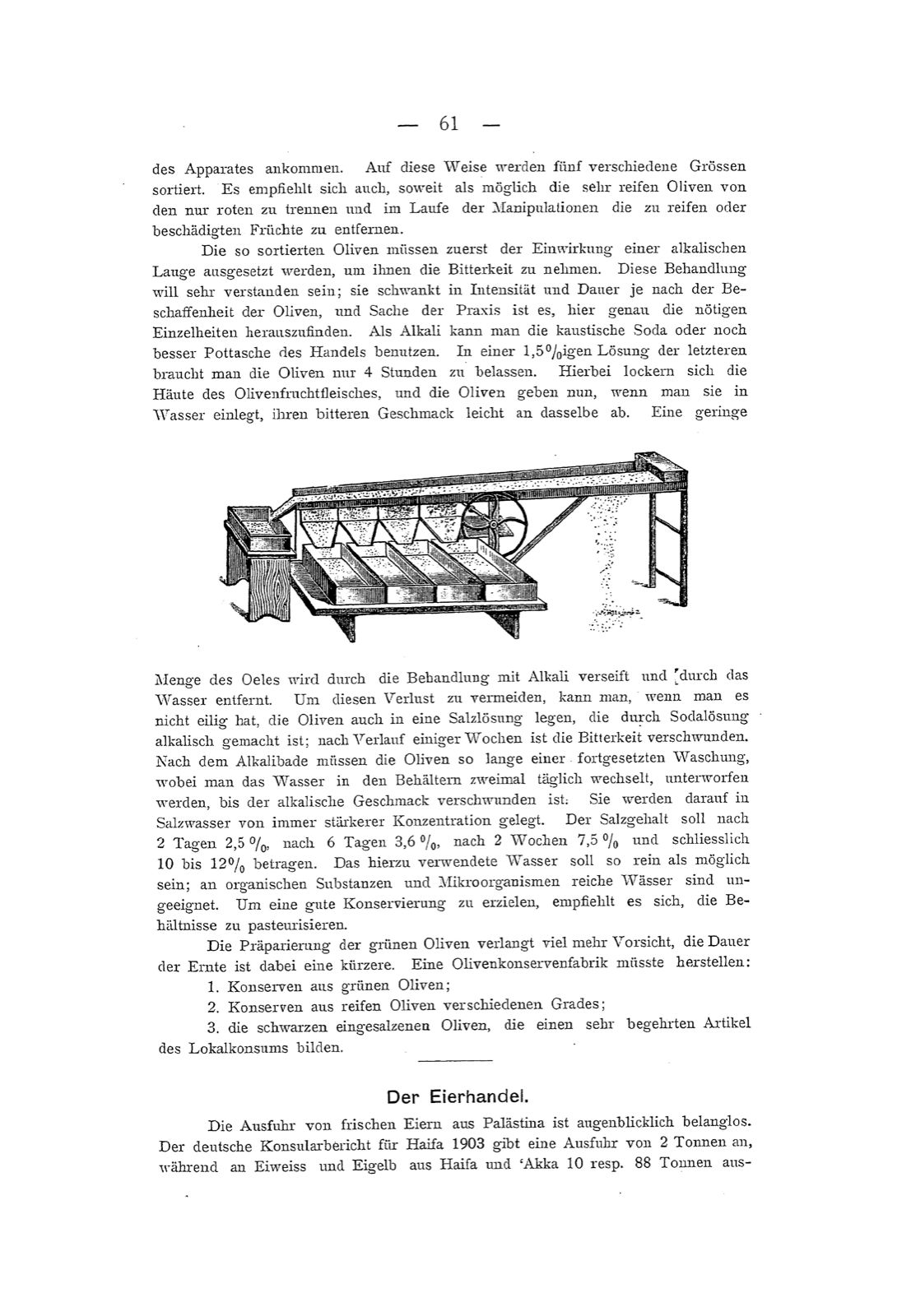
of the apparatus. In this way five different sizes are sorted. It is advisable also, as far as possible, to separate the very ripe olives from those merely red, and in the course of the manipulations to remove the over-ripe or damaged fruits.
The olives thus sorted must first be exposed to the action of an alkaline lye, in order to take from them their bitterness. This treatment requires to be well understood; it varies in intensity and duration according to the con- dition of the olives, and it is a matter of practice to find out exactly the necessary details here. As alkali one may use caustic soda or, still better, potash of commerce. In a 1.5% solution of the latter the olives need be left only 4 hours. Hereby the skins of the olive flesh are loosened, and the olives now, when laid in water, readily give up their bitter taste to it. A small
[Figure: An unlabelled engraving of the olive-sorting apparatus — an inclined, slotted sorting trough fed from a hopper at the left, driven by a belt-wheel, with a row of graduated collecting boxes beneath and a discharge at the raised right-hand end.]
quantity of the oil is saponified by the treatment with alkali and removed by the water. To avoid this loss, one may, if one is not in a hurry, also lay the olives in a salt solution which has been made alkaline by a solution of soda; after the lapse of some weeks the bitterness has disappeared. After the alkali bath the olives must be subjected to a continued washing, the water in the vessels being changed twice daily, until the alkaline taste has disappeared. They are thereupon laid in salt water of ever stronger concentration. The salt content should after 2 days amount to 2.5%, after 6 days 3.6%, after 2 weeks 7.5%, and finally 10 to 12%. The water used for this should be as pure as possible; waters rich in organic substances and micro-organisms are un- suitable. In order to attain a good preservation, it is advisable to pasteurize the vessels.
The preparation of the green olives demands much more caution, and the duration of the harvest is in that case shorter. An olive-preserving factory would have to produce:
- preserves of green olives;
- preserves of ripe olives of various degrees;
- the black salted olives, which form a much sought-after article of local consumption.
The Egg Trade.
The export of fresh eggs from Palestine is at the moment insignificant. The German consular report for Haifa 1903 gives an export of 2 tons, while of white and yolk of egg 10 and 88 tons respectively were ex-