— 49 —
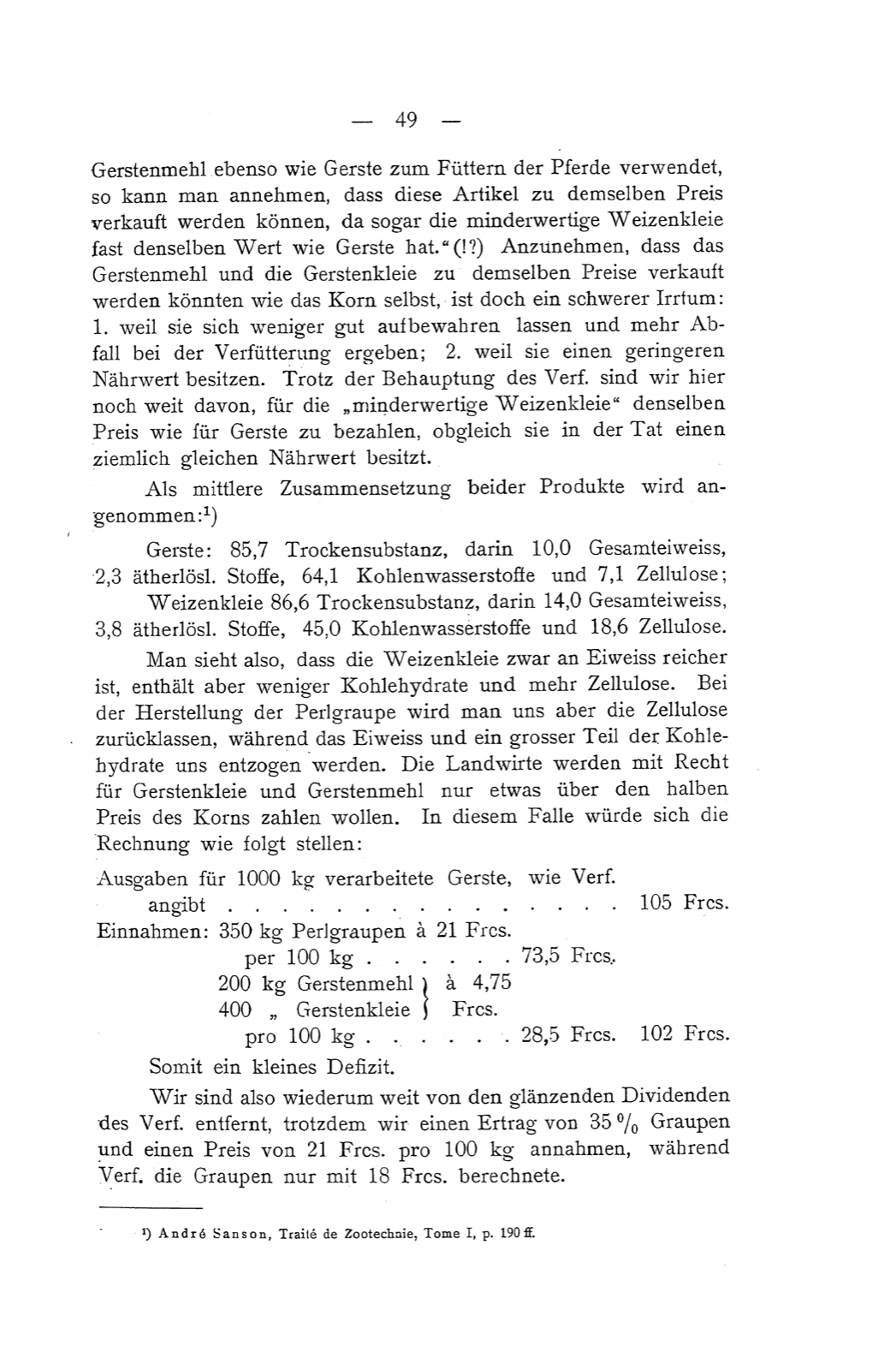
barley meal, just like barley, are used for feeding horses, it may be assumed that these articles can be sold at the same price, since even the inferior wheat bran has almost the same value as barley." (!?) To assume that barley meal and barley bran could be sold at the same price as the grain itself is surely a grave error:
- because they keep less well and yield more waste in feeding; 2. because they possess a lower nutritive value. Despite the author's assertion, we are here still far from paying for the "inferior wheat bran" the same price as for barley, although it does in fact possess a fairly equal nutritive value.
As the average composition of the two products is assumed:¹)
Barley: 85.7 dry substance, therein 10.0 total albumen, 2.3 ether-soluble matters, 64.1 carbohydrates, and 7.1 cellulose; wheat bran: 86.6 dry substance, therein 14.0 total albumen, 3.8 ether-soluble matters, 45.0 carbohydrates, and 18.6 cellulose.
One sees, then, that wheat bran is indeed richer in albumen, but contains fewer carbohydrates and more cellulose. In the production of pearl barley, however, the cellulose will be left to us, while the albumen and a great part of the carbo- hydrates are withdrawn from us. The farmers will rightly be willing to pay for barley bran and barley meal only somewhat over half the price of the grain. In this case the account would stand as follows:
Expenses for 1000 kg of barley worked up, as the author states . . . . . . . . . . . . . . . 105 Frcs.
Receipts: 350 kg pearl barley at 21 Frcs. per 100 kg . . . . . . . 73.5 Frcs., 200 kg barley meal } at 4.75 400 „ barley bran } Frcs. per 100 kg . . . . . . . 28.5 Frcs. 102 Frcs. Thus a small deficit.
We are thus once again far removed from the brilliant dividends of the author, although we assumed a yield of 35% groats and a price of 21 Frcs. per 100 kg, while the author reckoned the groats at only 18 Frcs.
¹) André Sanson, Traité de Zootechnie, Tome I, p. 190 ff.