— 309 —
The year 1903 was, for the district on this side, in commercial-political respect not an unfavourable one. The harvest, it is true, in consequence of too much rain, which lasted beyond its time and did considerable damage to the winter and summer sowings, fell short of the previous year's by 23½ per cent., but influenced the general position of the market little. Further, the quarantine imposed upon the harbour acted as a check. On its account the eastern regions, such as the Hauran mountains, Merj-Ibn-'Amir, and Ghor-Besan, delivered their products predominantly to Akka, while the Nablus district in the west preferred Jaffa and Gaza.
Nevertheless the winter goods arrived this time in good time, so that after the lifting of the quarantine the dealers tolerably emptied their stores, and, in spite of the mild winter, only a comparatively small stock of winter goods had to be carried over into the new year. This the merchant owes chiefly to the railway construction Haifa–Damascus, through which Haifa received a perceptible increase of people, who for the most part find employment on the railway line and meet the needs of their livelihood on the spot.
The economic conditions of our region go back more and more from year to year. On the one hand, through the continual emigration of the inhabitants of Galilee to other parts of the world, the labour-forces are withdrawn from the land, and on the other hand agriculture, in spite of the fertility of the soil, is by no means in a thriving state. The European settlements achieve, however, through cultivation after more modern methods, fairly rich harvest results. Cattle-breeding is for the farmer only of subordinate importance; it has no remunerative results, because the feeding of the cattle, owing to the lack of good pasturing-places, offers difficulties and hinders every advance.
For the reason already mentioned at the outset, the harvest of the year under report had for Haifa, with the same area under cultivation as in 1902, a shortfall of 17 per cent. The total yield amounted to 17,718 tons with a tax revenue of 244,762½ Francs.
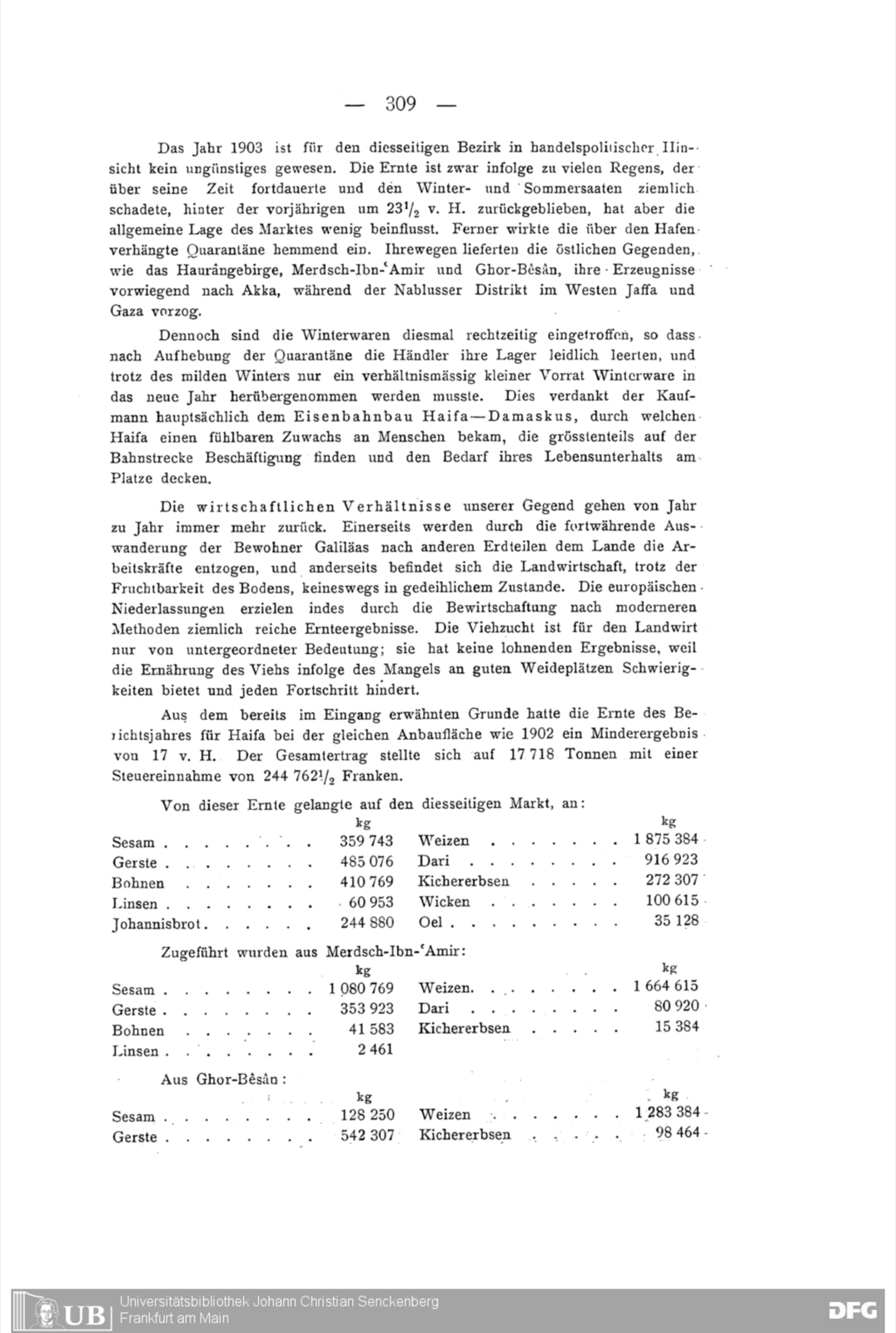
Of this harvest there reached the market on this side, of:
| kg | kg | ||
|---|---|---|---|
| Sesame | 359,743 | Wheat | 1,875,384 |
| Barley | 485,076 | Durra | 916,923 |
| Beans | 410,769 | Chickpeas | 272,307 |
| Lentils | 60,953 | Vetches | 100,615 |
| Carob | 244,880 | Oil | 35,128 |
There were brought in from Merj-Ibn-'Amir:
| kg | kg | ||
|---|---|---|---|
| Sesame | 1,080,769 | Wheat | 1,664,615 |
| Barley | 353,923 | Durra | 80,920 |
| Beans | 41,583 | Chickpeas | 15,384 |
| Lentils | 2,461 |
From Ghor-Besan:
| kg | kg | ||
|---|---|---|---|
| Sesame | 128,250 | Wheat | 1,283,384 |
| Barley | 542,307 | Chickpeas | 98,464 |