Additions to the Essay on Holy Things 44
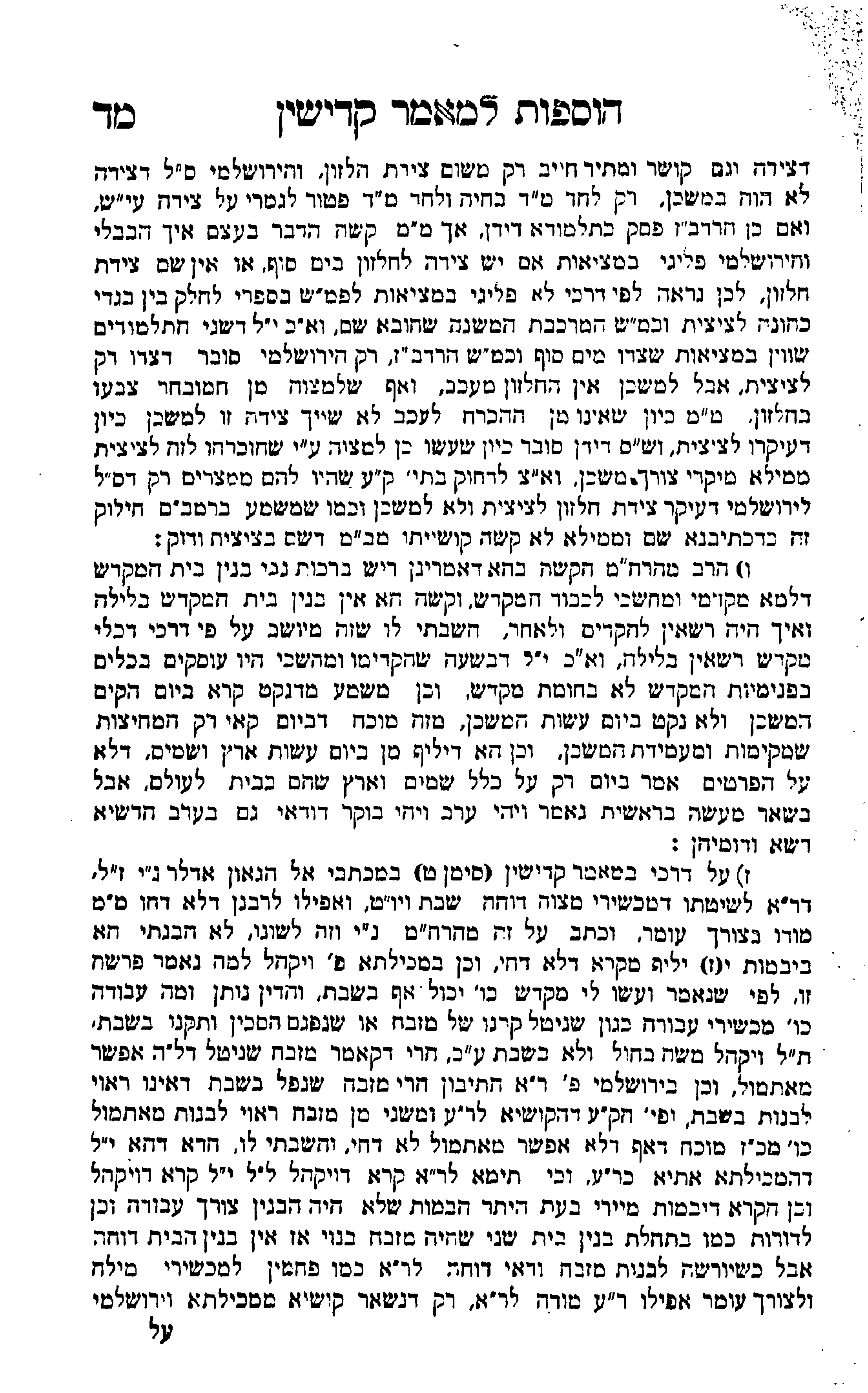
…that trapping, and also tying and untying, one is liable for only on account of the trapping of the chilazon (the shellfish of the blue dye); and the Jerusalem Talmud holds that trapping was not in the Tabernacle, only according to one opinion with a wild animal, and according to one opinion one is entirely exempt for trapping; see there. And if so, the Radbaz ruled according to our Talmud. But nevertheless the thing is difficult in itself: how could the Babylonian Talmud and the Jerusalem Talmud disagree about a matter of fact, whether there is trapping of the chilazon in the Red Sea or there is no trapping of the chilazon there? Therefore it seems, according to my way, that they do not disagree about the fact, according to what I wrote in my book to distinguish between the priestly garments and the fringes, and as the Mirkevet ha-Mishneh wrote, which is cited there. And if so, it may be said that both Talmuds are agreed on the fact that they trapped from the Red Sea, as the Radbaz wrote; only the Jerusalem Talmud holds that they trapped only for the fringes, but for the Tabernacle the chilazon is not indispensable; and although for the choicest fulfilment of the commandment they dyed with the chilazon, nevertheless, since it is not of necessity so as to be indispensable, this trapping does not pertain to the Tabernacle, since its chief purpose is for the fringes. And our Talmud holds that since they did so for the sake of the commandment, because they were compelled to this for the fringes, of itself it is called a need of the Tabernacle. And there is no need to strain after the answer of the Korban ha-Edah, that they had it from Egypt; only the Jerusalem Talmud holds that the chief trapping of the chilazon is for the fringes and not for the Tabernacle, and as this distinction is implied in Maimonides, as I have written there; and of itself his difficulty from Maimonides is not difficult, for there it is about the fringes. And examine carefully.
-
The Rabbi, our teacher Rabbi Hayyim Mordekhai, raised a difficulty on what we say at the beginning of Berakhot concerning the building of the Temple, "perhaps they came early and stayed late in honour of the Sanctuary"; and it is difficult, for there is no building of the Temple at night, and how were they permitted to come early and stay late? I replied to him that this is settled according to my way, that with the vessels of the Sanctuary they are permitted at night; and if so, it may be said that at the time when they came early and stayed late they were occupied with the vessels in the interior of the Sanctuary, not with the wall of the Sanctuary. And so it is implied from the verse taking "on the day the Tabernacle was set up" and not taking "on the day of making the Tabernacle"; from this it is proven that "on the day" refers only to the partitions, which set up and make the Tabernacle stand. And likewise that which is derived from "on the day of making earth and heavens": that "on the day" was not said of the particulars, but only of heaven and earth as a whole, which are as a house for the world; but of the rest of the work of Creation it is said, "and there was evening and there was morning", for certainly in the evening too it put forth grass, and the like.
-
On my way in the Essay on Holy Things (section 9), in my letter to the Gaon Adler, may his light shine, this is its language: that Rabbi Eliezer, according to his own view, holds that the preparations for a commandment override the Sabbath and the festival; and even according to the Rabbis, who do not override, nevertheless they concede in the case of the need of the Omer. And on this our teacher Rabbi Hayyim Mordekhai, may his light shine, wrote, and this is his language: "I did not understand: behold, in Yevamot 10 (7) it is derived from a verse that it does not override; and likewise in the Mekhilta, portion Vayakhel: 'Why is this section stated? Because it is said, And let them make me a sanctuary, etc., I might think even on the Sabbath; and logic gives it: if the Service, etc., the preparations for the Service, such as when the horn of the altar was broken off or the knife was nicked and he repaired it on the Sabbath — Scripture says, And Moses assembled: on a weekday and not on the Sabbath.' End. Behold, it speaks of an altar that was broken off, which was not possible from the day before. And likewise in the Jerusalem Talmud, the middle chapter Rabbi Eliezer: 'behold, an altar that fell on the Sabbath, which is not fit to be built on the Sabbath'; and the Korban ha-Edah explained that the difficulty is according to Rabbi Akiva, and it answers: from an altar? It was fit to be built the day before, etc. From all this it is proven that even though it was not possible the day before, it does not override." And I replied to him: first, for it may be said that the Mekhilta follows Rabbi Akiva. And if you say: according to Rabbi Eliezer, why do I need the verse of Vayakhel? It may be said that the verse of Vayakhel, and likewise the verse of Yevamot, speaks of the time when the high places were permitted, when the building was not a need of the Service; and likewise for the generations, as at the beginning of the building of the Second Temple, when the altar was built, then the building of the House does not override. But when it shall be permitted to build an altar, it certainly overrides according to Rabbi Eliezer, like charcoal for the preparations of circumcision; and for the need of the Omer even Rabbi Akiva concedes to Rabbi Eliezer. Only there remains a difficulty from the Mekhilta and the Jerusalem Talmud