Mount Tzvi 66
…which prevents the despair from taking effect on them, as is explained (Sukkah 30b); and see Tosafot there, the passage beginning "For the merchants too rob".
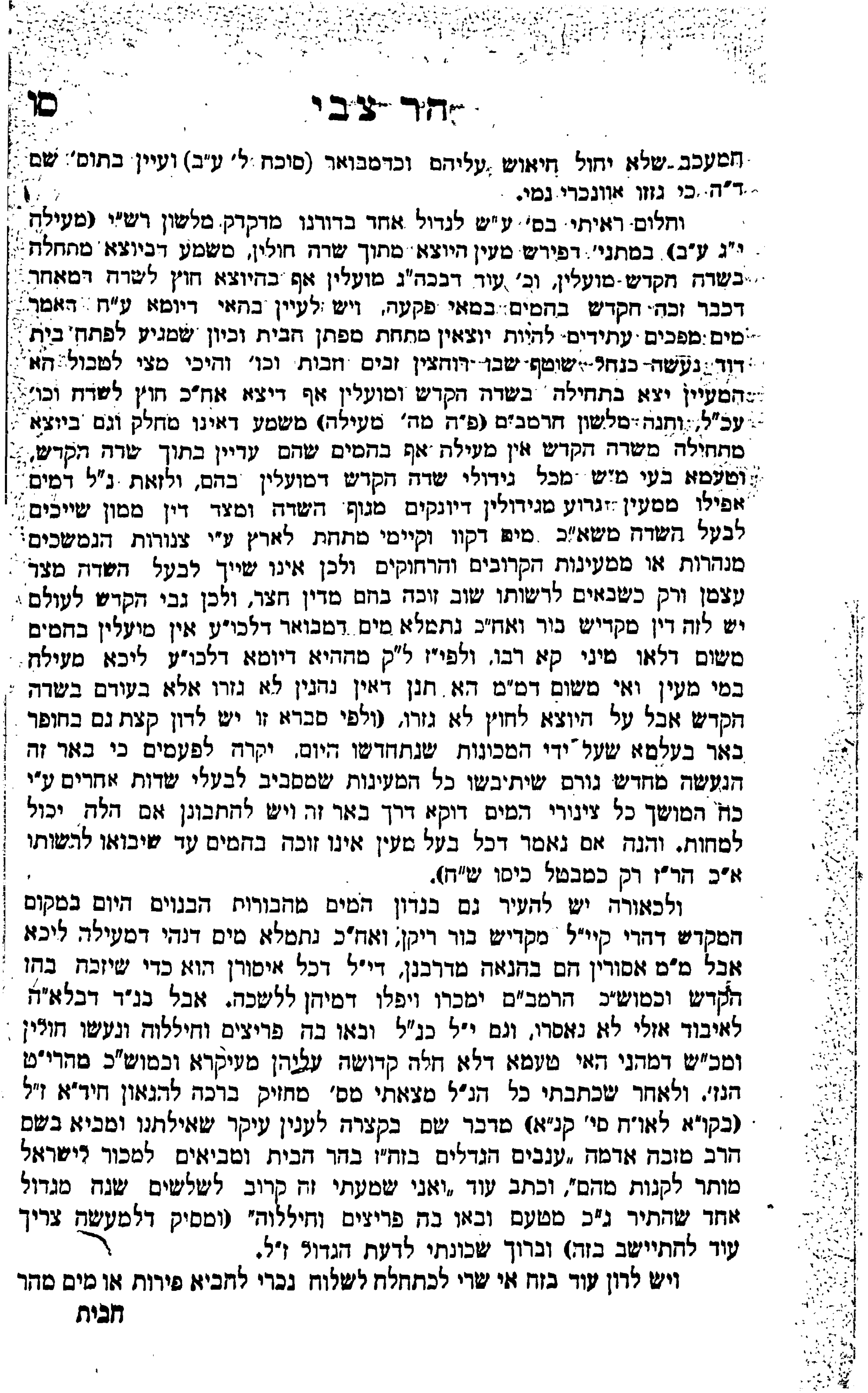
And here I have seen in the book Arukh ha-Shulhan, by one of the great men of our generation, who infers precisely from the language of Rashi (Me'ilah 13b) on the Mishnah, where he explained "a spring that issues from within a profane field", which implies that where it issues in the first place in a consecrated field, the law of sacrilege applies; and he wrote further that in such a case the law of sacrilege applies even to what has issued outside the field, for since the Temple treasury has already acquired the water, by what was its right cancelled? And one must examine that passage in Yoma 78, which says: "Gushing waters will in future issue from beneath the threshold of the House, and as soon as it reaches the entrances of the house of David it becomes like a rushing stream in which men and women with an issue bathe" etc. And how can they immerse? Surely the spring issued at first in a consecrated field, and the law of sacrilege applies even though it afterwards issued outside the field etc.; thus far his words. And behold, from the language of Maimonides (Laws of Sacrilege, chapter 5) it is implied that he does not distinguish, and even with one that issues in the first place from a consecrated field there is no sacrilege, even with the water that is still within the consecrated field; and this requires a reason: what difference is there from all the growths of a consecrated field, with which the law of sacrilege applies? And therefore it seems to me that water, even from a spring, is inferior to growths, which draw from the body of the field and by the law of property belong to the owner of the field; which is not so with water, which collects and stands beneath the earth through channels drawn from rivers or from springs near and far, and therefore does not belong to the owner of the field of itself, and only when it comes into his domain does he then acquire it by the law of a courtyard. And therefore, with regard to consecrated property, this always has the law of one who consecrates a cistern and afterwards it is filled with water, where it is explained that according to all the law of sacrilege does not apply to the water, because it did not grow from it. And according to this there is no difficulty from that passage in Yoma, for according to all there is no sacrilege with spring water; and if it is because nevertheless we have learnt in the Mishnah that one may not derive benefit, they decreed only while they are in the consecrated field, but concerning what issues outside they did not decree. (And according to this reasoning one may argue somewhat also concerning one who digs a well generally: for by means of the machines newly invented today it sometimes happens that this newly made well causes all the springs round about, belonging to the owners of other fields, to dry up, through the force that draws all the channels of water precisely by way of this well; and one must consider whether the other can protest. And behold, if we say that every owner of a spring does not acquire the water until it comes into his domain, then this is only like one who renders his fellow's purse idle.)
And seemingly one should also remark on the case of the water from the cisterns built today on the site of the Sanctuary, for we hold that one who consecrates an empty cistern and afterwards it is filled with water — granted that there is no sacrilege, nevertheless the water is forbidden for benefit by rabbinic law; one may say that the whole of its prohibition is so that the Temple treasury may acquire it, as Maimonides wrote: "they shall be sold and their price shall fall to the Chamber". But in our case, where without this it goes to waste, perhaps it was not forbidden; and one may also say, as above, "and violent men shall come into it and profane it", and it became profane; and all the more is this reason effective, since sanctity did not take effect upon it from the outset, as the Maharit mentioned above wrote. And after I had written all the above I found in the book Mahazik Berakhah by the Gaon the Hida of blessed memory (in the Kuntres Aharon to Orah Hayyim, section 151) that he speaks there briefly on the principal matter of our question, and cites in the name of the Rabbi of Mizbah Adamah: "Grapes that grow in this time on the Temple Mount and are brought to be sold to Israelites — it is permitted to buy from them"; and he wrote further: "And I heard this nearly thirty years ago from a great man who also permitted it on the ground of 'and violent men shall come into it and profane it'" (and he concludes that in practice one must still consider this further); and blessed be He that I have concurred with the view of the great man of blessed memory.
And one may further discuss in this whether it is permitted in the first instance to send a gentile to bring fruit or water from the Mount