Mount Tzvi 58
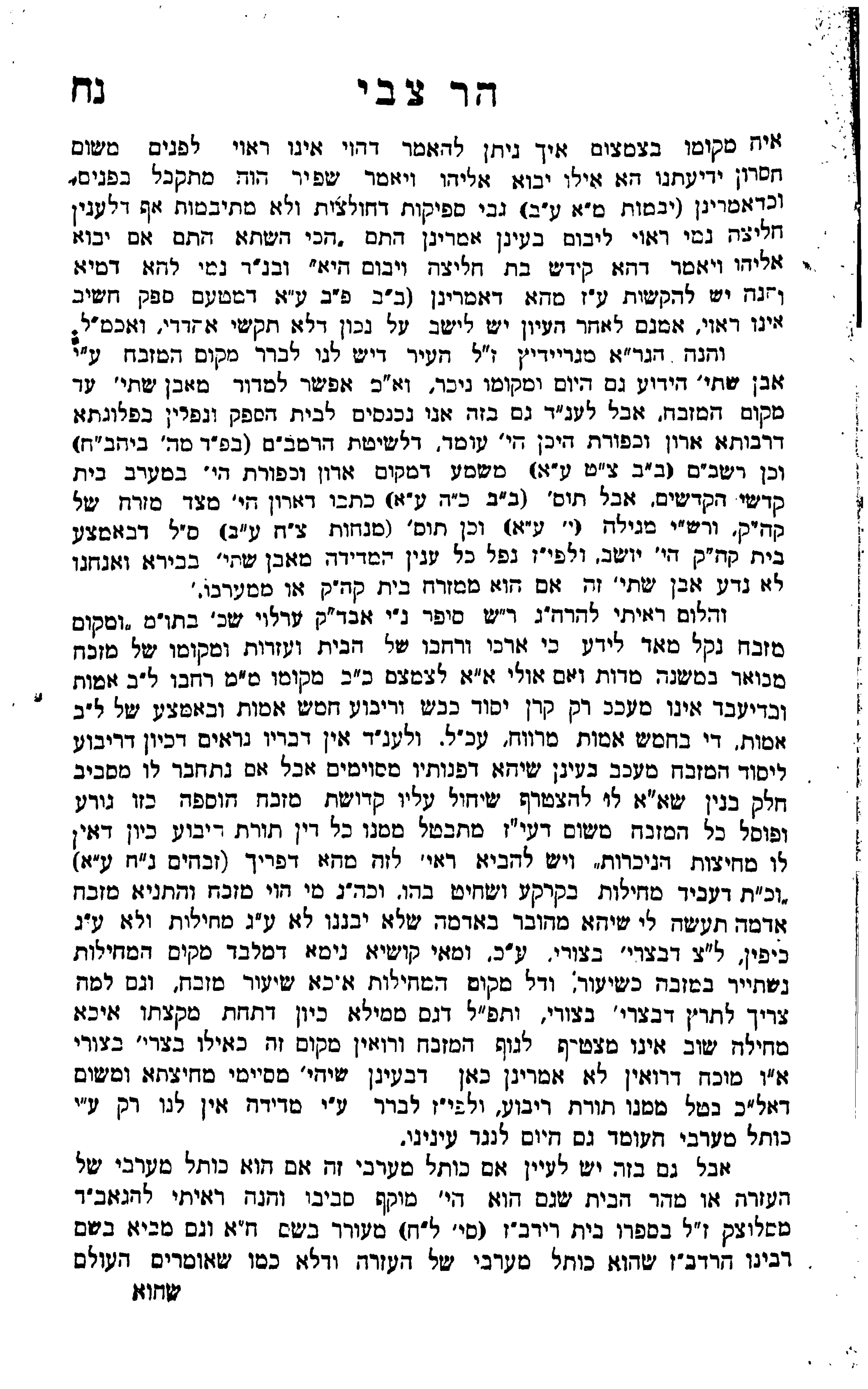
…where its place is, precisely: how can it be said that it counts as "not fit for within" on account of the lack of our knowledge, when, were Elijah to come and tell us, it would well be accepted within? And as we say (Yevamot 41b) concerning the doubtful cases, who perform halitzah and are not taken in levirate marriage, although for halitzah too we require that she be fit for levirate marriage, we say there: "How can you compare? There, if Elijah were to come and say that this one did betroth her, she is one fit for halitzah and levirate marriage"; and in the case before us too it is like this. Now one might raise a difficulty against this from what we say (Bava Batra 82a, that on account of doubt it is considered not fit; however, after examination one can settle it properly, so that they do not contradict each other, and this is not the place to enlarge upon it.
Now the Gaon Rabbi Eliyahu of Grätz, of blessed memory, remarked that we can determine the place of the altar by means of the Foundation Stone, which is known even today and whose place is recognisable; and if so, it is possible to measure from the Foundation Stone to the place of the altar. But in my humble opinion, in this too we enter into the realm of doubt and fall into the dispute of the great authorities as to where the Ark and the Ark-cover stood: for according to the view of Maimonides (chapter 4 of the Laws of the Chosen House), and likewise Rashbam (Bava Batra 99a), it is implied that the place of the Ark and the Ark-cover was at the west of the Holy of Holies; but Tosafot (Bava Batra 25a) wrote that the Ark was on the east side of the Holy of Holies; and Rashi on Megillah (10a), and likewise Tosafot (Menahot 98b), hold that it rested in the middle of the Holy of Holies. And according to this the whole matter of the measurement from the Foundation Stone falls into the pit, and we do not know of this Foundation Stone whether it is at the east of the Holy of Holies or at its west.
And here I have seen the great Rabbi and Gaon, Rabbi Shimon Sofer, may his light shine, head of the rabbinical court of the holy community of Erlau, who wrote in his responsa: "And the place of the altar is very easy to know, for the length and breadth of the House and of the Courts, and the place of the altar, are explained in the Mishnah of Middot; and if perhaps it is not possible to fix its place so precisely, nevertheless its breadth is thirty-two cubits, and after the fact nothing is indispensable but the horn, the base, the ramp and the squareness, five cubits; and in the middle of thirty-two cubits five cubits are enough, with room to spare"; thus far his words. And in my humble opinion his words do not seem right: for since the squareness of the base of the altar is indispensable, we require that its sides be defined; but if there is joined to it round about part of a structure which cannot combine with it so that the sanctity of the altar should take effect upon it, such an addition diminishes and disqualifies the whole altar, because through it the whole law of squareness is annulled for it, since it has no recognisable partitions. And one can bring a proof for this from what is objected (Zevahim 58a): "And if you will say that he makes tunnels in the ground and slaughters in them — in such a case is it an altar? Surely it was taught: 'An altar of earth thou shalt make for me' — that it be joined to the earth, that one build it neither upon tunnels nor upon arches. — No, it is needed where he filled them up with stones"; thus far. And what is the difficulty? Let us say that apart from the place of the tunnels there remained in the altar the required measure, and take away the place of the tunnels and there is still the measure of an altar. And also, why did he need to answer that he filled them up with stones? Let him derive it in any case: since there is a tunnel under part of it, that part does not combine with the body of the altar, and we regard this place as though he had filled it up with stones. It must be, then, that it is proved that "we regard" we do not say here, because we require that its partitions be defined, and because otherwise the law of squareness is annulled for it. And according to this, to determine it by measurement we have nothing but the Western Wall, which stands even today before our eyes.
But in this too one must examine whether this Western Wall is the western wall of the Court or of the Temple Mount, which too was enclosed round about. And behold, I have seen the Gaon, head of the rabbinical court of Slutzk, of blessed memory, in his book Beit Ridbaz (section 38), raising the point in the name of a certain scholar, and also bringing in the name of our master the Radbaz that it is the western wall of the Court, and not as people commonly say