First to Zion
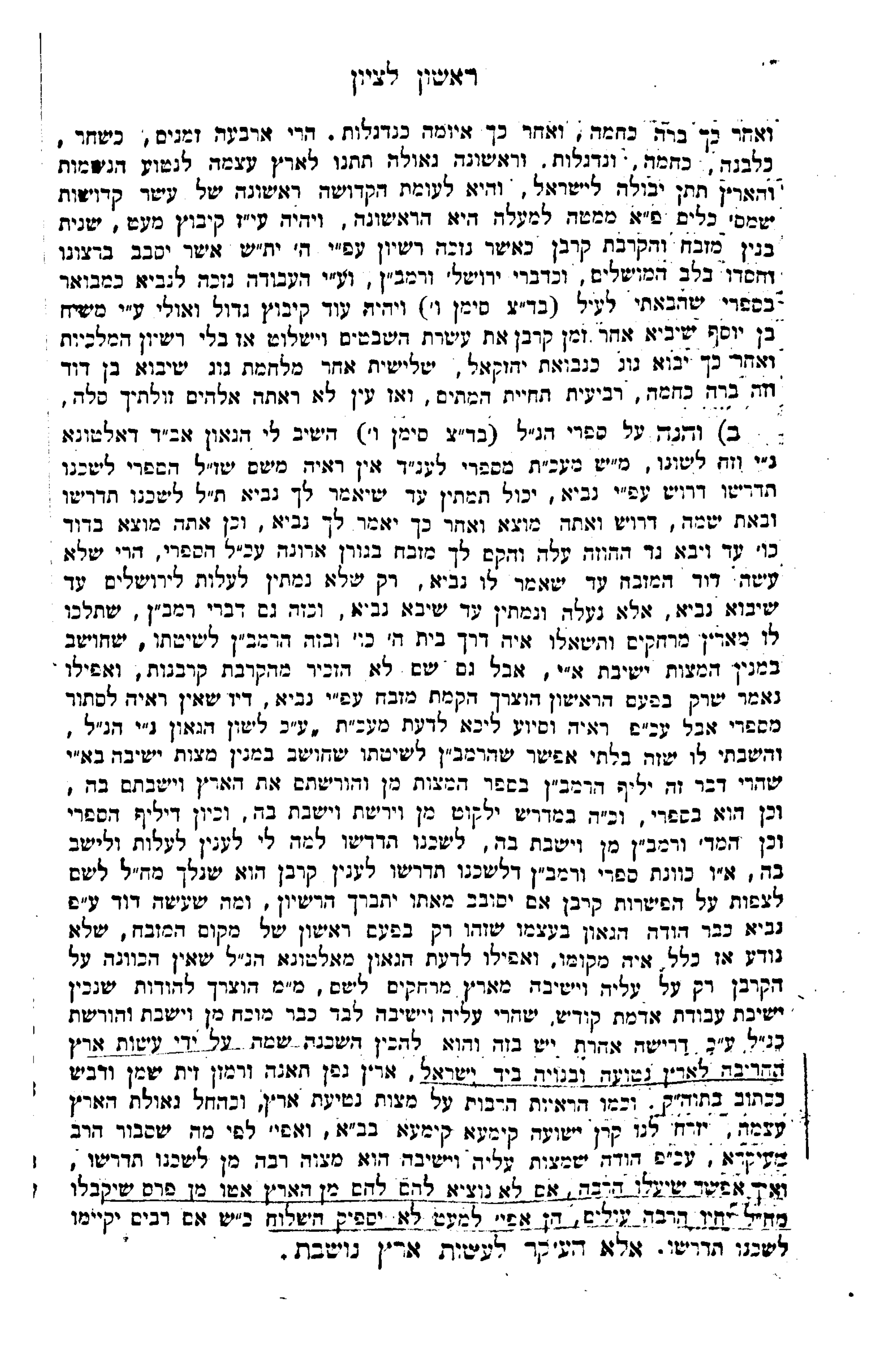
…and afterwards "clear as the sun", and afterwards "awesome as the bannered hosts". Here are four times: as the dawn, as the moon, as the sun, and the bannered hosts. The first: "you shall grant a redemption to the land", to the Land itself, to plant the desolate places, and the Land will yield its produce to Israel; and this corresponds to the first holiness of the ten holinesses in Tractate Kelim, chapter 1, which, counting from below upwards, is the first; and through this there will be a small ingathering. The second: the building of an altar and the offering of sacrifice, when we are granted permission by Yahweh, blessed be His name, who will bring it about by His will and His grace in the heart of the rulers, as in the words of the Jerusalem Talmud and Nahmanides; and through the Service we shall merit a prophet, as is explained in the Sifre which I brought above (in Seeking Zion, section 6); and there will be a further, great ingathering, and perhaps through Messiah son of Joseph, who after the time of the sacrifice will bring the ten tribes and will then rule without the permission of the kingdoms; and afterwards Gog will come, according to the prophecy of Ezekiel. The third: after the war of Gog, that the son of David will come, and this is "clear as the sun". The fourth: the resurrection of the dead, and then "no eye has seen, O God, beside thee", Selah.
- Now, concerning the Sifre mentioned above (Seeking Zion, section 6), the Gaon, head of the rabbinical court of Altona, may his light shine, replied to me, and this is his language: "As for what your honour wrote from the Sifre, in my humble opinion there is no proof from there; for this is the language of the Sifre: 'You shall seek His habitation': seek by the word of a prophet. One might think: wait until a prophet tells you; therefore Scripture says, 'You shall seek His habitation, and thither thou shalt come': seek and you will find, and afterwards a prophet will tell you. And so you find with David, etc., up to: 'And Gad the seer came: Go up, set up for thyself an altar in the threshing-floor of Araunah.' End of the language of the Sifre. Thus David did not make the altar until a prophet told him; only, we are not to wait to go up to Jerusalem until a prophet comes, but are to go up and wait until a prophet comes. And such also are the words of Nahmanides: that you shall go to it from a land far off and ask, Where is the way to the house of Yahweh, etc. And in this Nahmanides follows his own method, for he counts dwelling in the Land of Israel among the number of the commandments; but there too he did not mention the offering of sacrifices. And even if we say that only the first time was the setting up of an altar by the word of a prophet required, it is enough that there is no proof against it from the Sifre; but at all events there is no proof or support for your honour's opinion." Thus far the language of the Gaon mentioned above, may his light shine. And I replied to him that it is impossible that Nahmanides should here be following his own method of counting dwelling in the Land of Israel among the number of the commandments, for Nahmanides derives this in the Book of the Commandments from "And you shall possess the land and dwell in it", and so it is in the Sifre, and so it is in the Midrash Yalkut, from "and thou shalt possess it and dwell in it". And since the Sifre, and likewise the Midrash and Nahmanides, derive it from "and thou shalt dwell in it", why do I need "You shall seek His habitation" for the matter of going up and dwelling in it? Rather, certainly, the intent of the Sifre and of Nahmanides is that "You shall seek His habitation" concerns sacrifice: that we should go from outside the Land to there, to watch for the possibility of sacrifice, should the permission be brought about by Him, blessed be He. And as for David's acting by the word of a prophet, the Gaon himself has already conceded that this was only the first time, concerning the place of the altar, since it was then not known at all where its place was. And even according to the opinion of the Gaon of Altona mentioned above, that the intent is not sacrifice but only going up and dwelling there from a land far off, nevertheless he must concede that we are to intend a dwelling that tills the holy soil; for going up and dwelling alone are already proved from "and thou shalt dwell" and "and thou shalt possess", as above. Therefore there is another seeking in this, namely to prepare the dwelling there by making the ruined land a land planted and built by the hand of Israel, a land of vine, fig and pomegranate, of olive oil and honey, as is written in the holy Torah. And as with the many proofs concerning the commandment of planting the Land: when the redemption of the Land itself begins, the horn of salvation will shine forth for us little by little, speedily in our days, amen. And even according to what the Rabbi held at first, at all events he conceded that the commandment of going up and dwelling is a great commandment, from "You shall seek His habitation". And how is it possible for many to go up, if we do not bring forth bread for them from the earth? Shall there be many going up on the dole they receive from outside the Land? Behold, even for the few what is sent does not suffice, how much the more if many fulfil "You shall seek His habitation". Rather, the main thing is to make a settled land.