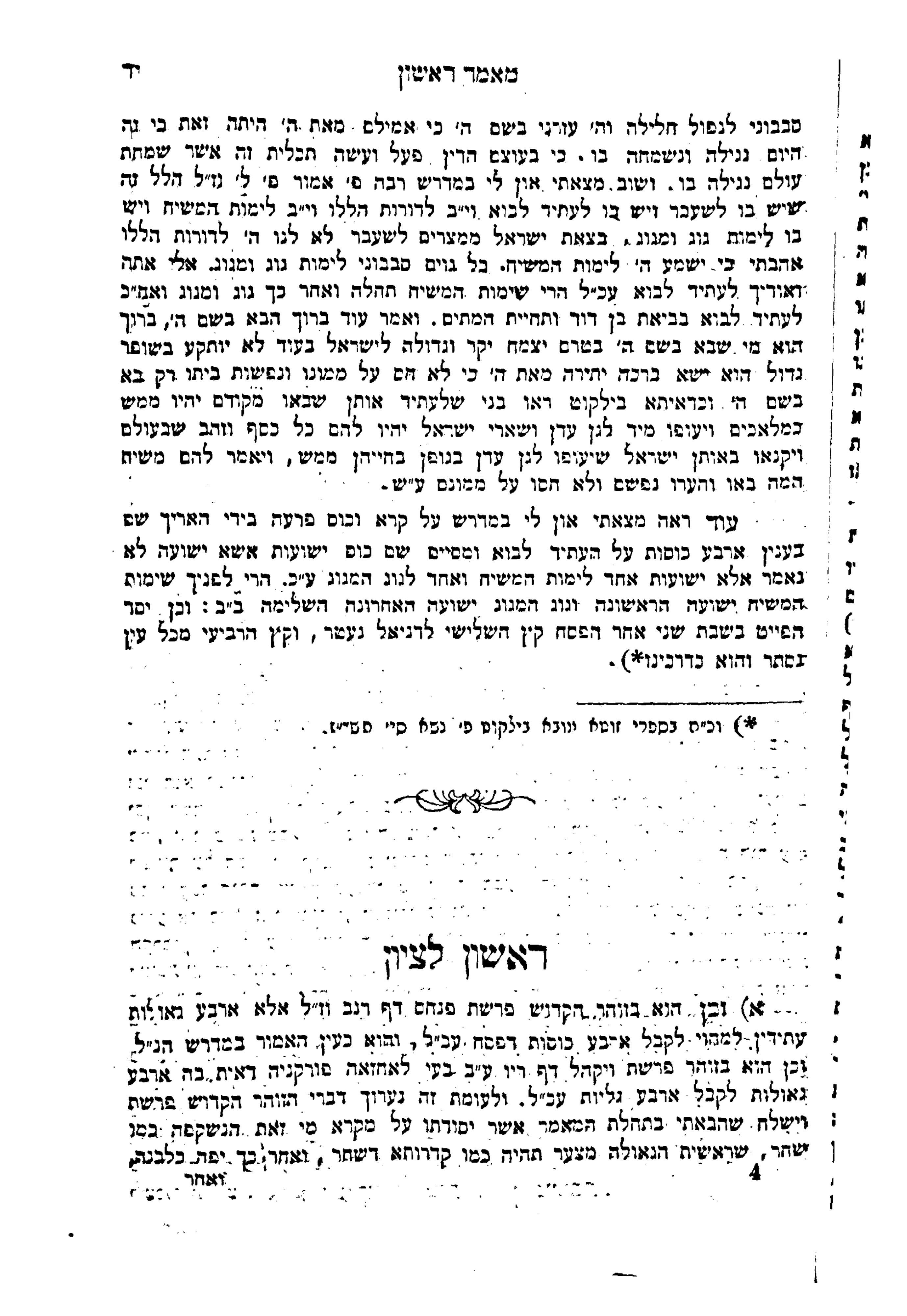
First Essay 14
…compassed me about to make me fall, Heaven forbid, and Yahweh helped me; "in the name of Yahweh I will cut them off." "From Yahweh was this" in me; "this is the day, let us exult and rejoice in it." For in the very might of judgement He wrought and brought about this end, in which we shall exult with everlasting joy. And again I found support for myself in Midrash Rabbah, portion Emor, section 30, and this is its language: "This Hallel contains the past, and contains the time to come, and contains these generations, and contains the days of the Messiah, and contains the days of Gog and Magog. 'When Israel went forth out of Egypt': the past. 'Not unto us, O Yahweh': these generations. 'I love, for Yahweh hears': the days of the Messiah. 'All nations compassed me about': the days of Gog and Magog. 'Thou art my God, and I will give thanks to thee': the time to come." End of its language. Thus the days of the Messiah come first, and afterwards Gog and Magog, and afterwards the time to come, with the coming of the son of David and the resurrection of the dead. And it says further, "Blessed is he that comes in the name of Yahweh": blessed is he who comes in the name of Yahweh before honour and greatness spring forth for Israel, while the great shofar has not yet been sounded; he shall receive an abundant blessing from Yahweh, for he did not spare his money and the souls of his household, but came in the name of Yahweh. And as it is found in the Yalkut: "See, my sons, that in the time to come those who came beforehand will be truly like angels and will fly at once to the Garden of Eden, and the rest of Israel will have all the silver and gold in the world, and will envy those Israelites who fly to the Garden of Eden in their bodies, truly in their lifetime; and the Messiah will say to them: These came and poured out their souls and did not spare their money"; see there.
Further, see: I found support for myself in the Midrash on the verse "And Pharaoh's cup was in my hand." It enlarges there on the matter of the four cups concerning the time to come, and concludes there: "'I will lift up the cup of salvations': it does not say 'salvation' but 'salvations', one for the days of the Messiah and one for Gog the Magog." Thus far. Here you have before you that the days of the Messiah are the first salvation, and Gog the Magog the last and complete salvation, speedily in our days. And so the liturgical poet composed for the second Sabbath after Passover: "The third End was crowned for Daniel, and the fourth End is hidden from every eye"; and this accords with our way*).
*) And so it is in Sifre Zuta, cited in the Yalkut, portion Naso, section 717.
First to Zion
- And so it is in the holy Zohar, portion Pinhas, folio 252, and this is its language: "Rather, four redemptions are destined to be, corresponding to the four cups of Passover." End of its language. And this is like what is said in the Midrash mentioned above. And so it is in the Zohar, portion Vayakhel, folio 216b: "He wished to show the redemption, in which there are four redemptions corresponding to the four exiles." End of its language. And over against this let us set out the words of the holy Zohar, portion Vayishlah, which I brought at the beginning of the Essay, which is founded on the verse "Who is she that looks forth as the dawn": that the beginning of the redemption will be small, like the first glimmer of dawn, and afterwards "fair as the moon"