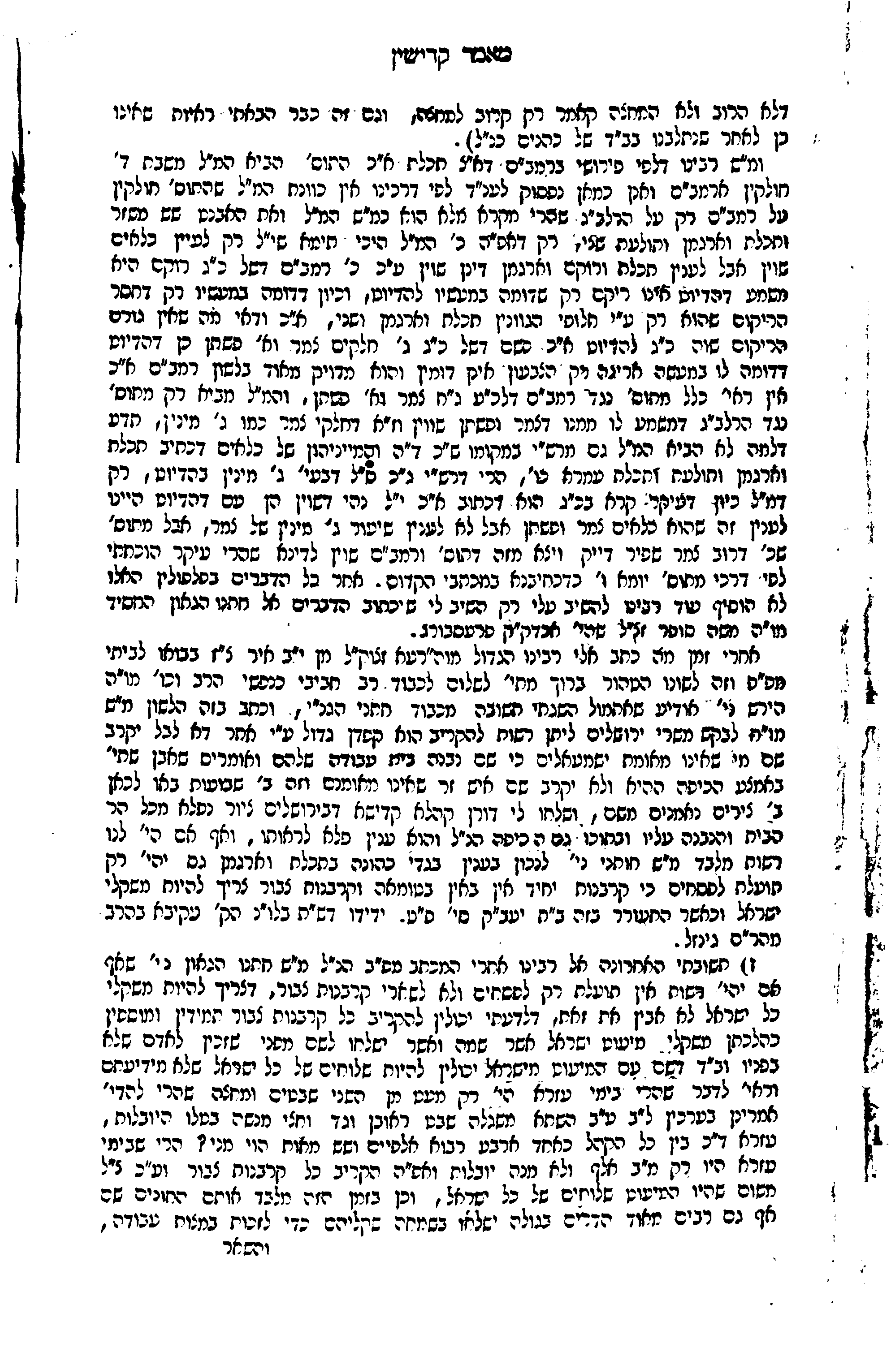
Essay on Holy Things
…he speaks neither of the majority nor of half, but only of close to half; and even this, I have already brought proofs that it is not so, after they had become confused in the court of the priests, as above.)
And as to what our master wrote: according to my interpretation of Maimonides, that tekhelet (the blue) is not required, then Tosafot, which the Mishneh le-Melekh cited from Shabbat 4, dispute Maimonides, and according to whom shall we decide? In my humble opinion, according to our approach, the Mishneh le-Melekh does not mean that Tosafot dispute Maimonides, but rather Ralbag. For it is an explicit verse, as the Mishneh le-Melekh wrote: "And the sash of fine twisted linen, and tekhelet, and purple, and scarlet"; only that nevertheless the Mishneh le-Melekh wrote: how could you say he holds that they are alike only in respect of mixed kinds, but in respect of tekhelet and embroidery and purple the rule is alike? Therefore Maimonides wrote that that of the High Priest is embroidered, implying that that of the ordinary priest is not embroidered, only that it resembles in its making that of the ordinary priest; and since it resembles it in its making, lacking only the embroidery, which comes about only through the alternation of the colours, tekhelet and purple and scarlet, then certainly in whatever does not bring about the embroidery the High Priest is equal to the ordinary priest. If so. From there: since that of the High Priest is three parts wool and one linen, so is that of the ordinary priest, which resembles it in the work of weaving, only the colours are not alike; and this is very precisely drawn from the language of Maimonides. If so, there is no proof at all from Tosafot against Maimonides, for according to everyone it is three parts wool and one linen; and the Mishneh le-Melekh cites from Tosafot only against Ralbag, from whom he understood that wool and linen are equal; and this is not so, for the parts of wool are as three kinds. And know: why did the Mishneh le-Melekh not cite Rashi too in his place, at the end of Kilayim, s.v. "And their girdles of mixed kinds", for it is written "tekhelet and purple and scarlet", and tekhelet is wool, etc.? So Rashi too holds that three kinds are required for the ordinary priest. Only that the Mishneh le-Melekh, since the verse is written chiefly of the High Priest, could then say: granted that they are thus equal with that of the ordinary priest, that is in respect of its being mixed kinds, wool and linen, but not in respect of the measure of three kinds of wool; but from Tosafot, who wrote "mostly wool", he inferred correctly. And it follows from this that Tosafot and Maimonides agree in law, for the chief proof according to my approach is from Tosafot on Yoma 6, as I wrote in my earlier letter. After all these words in these dialectical arguments, our master did not reply to me further, but did me the kindness of writing the matter to his son-in-law, the pious Gaon, our teacher Rabbi Moses Sofer, of blessed memory, who was head of the rabbinical court of the holy community of Pressburg.
After some time our great master, our teacher Rabbi Akiva Eger, of saintly and blessed memory, wrote to me, from 12 Iyyar 597, in his letter to my house, M.S.S., and these are his pure words: "Blessed be He who gives life. Peace to the honour of my much beloved, dear to me as my own soul, the Rabbi etc., our teacher Rabbi Hirsch, may his light shine. I inform you that yesterday I received a reply from my honoured son-in-law the Gaon, may his light shine, and he wrote in these words: 'As to what my father-in-law and teacher wrote, to ask the ministers of Jerusalem to give permission to offer sacrifices: he is very strict concerning this place, that none may approach there who is not of the nation of the Ishmaelites, for there their house of worship has been built, and they say that the Foundation Stone is in the middle of the dome, and no stranger who is not of their nation may approach there. And of this there are two reports; two trustworthy envoys came here from there. And the holy congregation in Jerusalem sent me as a gift a wonderful picture of the whole Temple Mount and what is built upon it, and within it also the dome mentioned above, and it is a wondrous thing to behold. And even if we had permission, besides what my father-in-law, may his light shine, rightly wrote on the matter of the priestly garments in tekhelet and purple, it would also be of use only for Passover offerings, for private sacrifices do not come in impurity, and public sacrifices must be from the shekels of Israel, as Ya'avetz raised this in his Responsa, section 89.' His friend who seeks the peace of his Torah with heart and soul, the humble Akiva, son of the Rabbi our teacher Rabbi Moses Ginz, of blessed memory."
- My last reply to our master, after the letter from Pressburg mentioned above. What his son-in-law the Gaon, may his light shine, wrote, that even if there were permission it would be of use only for Passover offerings and not for the other public sacrifices, because they must be from the shekels of all Israel: this I do not understand. In my opinion all the public sacrifices, the daily offerings and the additional offerings according to their law, can be offered from the shekels of the minority of Israel who are there and who will send there, because one may confer a benefit on a person in his absence, and the court there, with the minority of Israel, can be agents of all Israel without their knowledge. And there is proof of the matter, for in the days of Ezra there were only a few of the two tribes and a half; for it is said explicitly in Arakhin 32b: "Now that the tribe of Reuben and Gad and half Manasseh went into exile, the Jubilees ceased. Ezra, of whom it is written, 'The whole congregation together, forty-two thousand and six hundred', did they count?" So in the days of Ezra there were only forty-two thousand, and they did not count Jubilees, and even so he offered all the public sacrifices; and perforce one must say that it was because the minority were agents of all Israel. And so in our time, besides those who dwell there, also very many who live in exile will gladly send their shekels so as to merit the commandment of the Service,