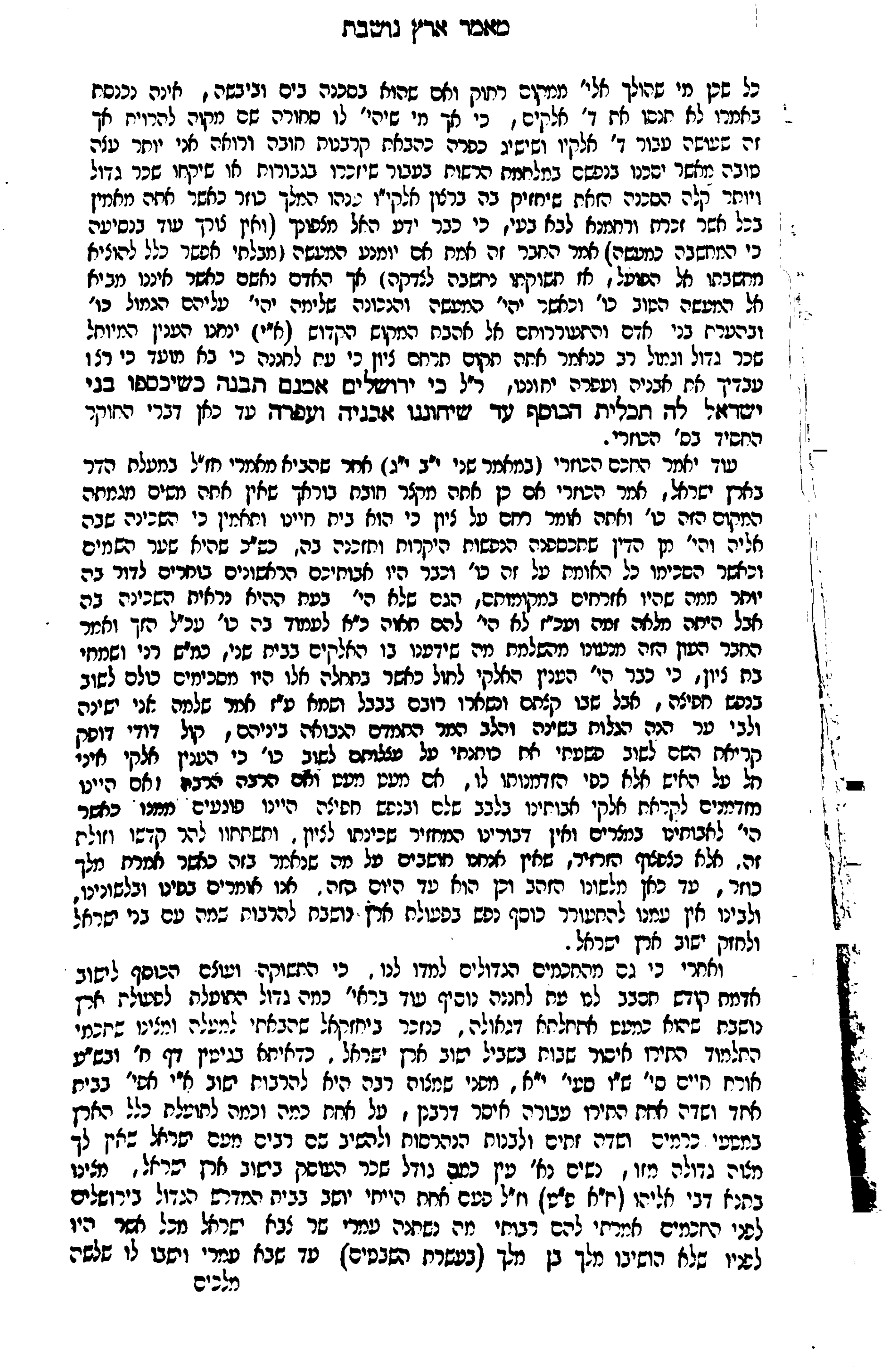
Essay on a Settled Land
…all the more so one who goes to it from a distant place; and though he is in danger by sea and by land, it does not fall under the saying, 'You shall not tempt Yahweh God'; for only one who has merchandise there hopes to profit, but this one has acted for the sake of Yahweh his God, and that he may attain atonement, like the bringing of obligatory sacrifices. And I regard it as better counsel than that men should risk their lives in a war of free choice in order to win renown for valour or to take a great reward; and this danger is lighter, which he undertakes in the will of his God. The king of the Khazars answered him: As you believe in all that you have mentioned, and the Merciful One desires the heart, for God already knows your secret thoughts (and there is no further need of the journey, for the thought is as the deed). The Haver said: That is true when the deed is prevented (when it is altogether impossible to bring his thought into action, or his longing is reckoned as righteousness); but a man is guilty when he does not carry the good deed into action, etc.; and when the deed and the intention are complete, the recompense will be upon them, etc. And by the stirring of men and their awakening to love of the holy place (the Land of Israel), the hoped-for matter will hasten, a great reward and a rich recompense, as it is said: 'Thou shalt arise and have mercy upon Zion, for it is time to favour her, for the set time has come; for thy servants take pleasure in her stones and favour her dust'; that is to say, that Jerusalem will indeed be built when the children of Israel long for her with the utmost longing, until they favour her stones and her dust." Thus far the words of the pious investigator in the Book of the Kuzari.
The sage of the Kuzari further says (in the Second Essay, 12, 13), after he had brought the sayings of our Sages of blessed memory on the merit of one who dwells in the Land of Israel: "The Kuzari said: If so, you fall short of the duty of your Torah, in that you do not make this place your goal, etc.; and you say, 'Have mercy on Zion, for it is the house of our life', and you believe that the Shekhinah will return to it; and it would be right that precious souls should long for it and be refined in it, all the more so since it is the gate of heaven, and since all the nations have agreed on this, etc. And your first fathers already chose to dwell in it rather than be citizens in their own places, although at that time the Shekhinah was not visible in it, but it was full of lewdness; and nevertheless they had no desire but to stand in it, etc." Thus far that passage. "And the Haver said: This sin kept us from the fulfilment of what God had made known to us concerning it in the Second Temple, as it is said: 'Sing and rejoice, daughter of Zion'; for the divine matter was already about to rest as at the first, had they all agreed to return with a willing soul; but only some of them returned, and the greater part remained in Babylon. And perhaps of this Solomon said: 'I sleep, but my heart wakes': behold, the exile is in sleep, and 'the heart' he said of the continuance of prophecy among them; 'the voice of my beloved knocks': the call of Yahweh to return; 'I have put off my coat': for their sloth to return, etc. For the divine matter does not rest upon a man except according to his preparing himself for it: if little, little, and if much, much. And if we were preparing ourselves to meet the God of our fathers with a whole heart and a willing soul, we would meet from Him what our fathers met in Egypt; and our saying 'Who restores His Shekhinah to Zion', and 'Bow down at His holy mountain', and the like, is nothing but the chirping of the starling, for we do not consider what is said in this, as you said, King of the Khazars." Thus far from his golden words. And so it is to this very day: we say it with our mouths and with our tongues, and our hearts are not with us to awaken the soul's longing for the work of a settled land, to multiply there a people of the children of Israel, and to strengthen the settlement of the Land of Israel.
And since the great sages too have taught us that the longing and very yearning for the settlement of the holy soil will bring about for us the time to favour her, we shall add further proof of how great is the benefit of the work of a settled land, which is almost the beginning of the redemption, as mentioned in Ezekiel, which I brought above. And we find that the Sages of the Talmud permitted a rabbinic Sabbath restriction for the sake of the settlement of the Land of Israel, as is found in Gittin folio 8 and in the Shulhan Arukh, Orah Hayyim, section 306, paragraph 11: because it is a great commandment to increase the settlement of the Land of Israel, even for one house and one field they permitted a rabbinic prohibition for its sake; how much more so for the benefit of the Land as a whole, through the work of vineyards and fields of olives, and to build the ruined places, and to bring back there many of the people of Israel, for there is no greater commandment than this. Let us now consider how great is the reward of one who busies himself with the settlement of the Land of Israel. We find in Tanna debe Eliyahu (Part 1, chapter 9), and these are its words: "Once I was sitting in the great house of study in Jerusalem before the sages, and I said to them: My masters, how did Omri, the captain of the host of Israel, differ from all who were before him, who did not attain a king son of a king (in the Ten Tribes), until Omri came and founded for himself three