The Maccabaean
multitude acclaiming the heroic protagonist of the people they had nicknamed "the Children of Death." In the midst of their clamor, Michal Halperin, with slow pace and unmoved bearing, left the lion's cage. Since that night the evil name, "Children of Death," as applied to Jews, died from the lips of the town-Arabs of Jaffa.
That circus-night revealed the man and his ways to me in part, for he himself took care, in ten years of familiar friendship, to reveal to me his innermost heart, his dreams, theories, platforms, all tending to the salvation of Israel on native soil—not as a townsfolk of sweated industrial laborers, but as a powerful nation of herdsmen and cattle-breeders. The old Sinaitic dispensation, according to Halperin, must give way, at a near day, to a new Revelation in the Wilderness—a new Torah proclaiming the message of a new life. To his mysticism, the world-war delayed the national Messiah, whose moral countenance, as he depicts it, is a composite portrait of a law-giving Moses and a law-destroying Nietzsche.
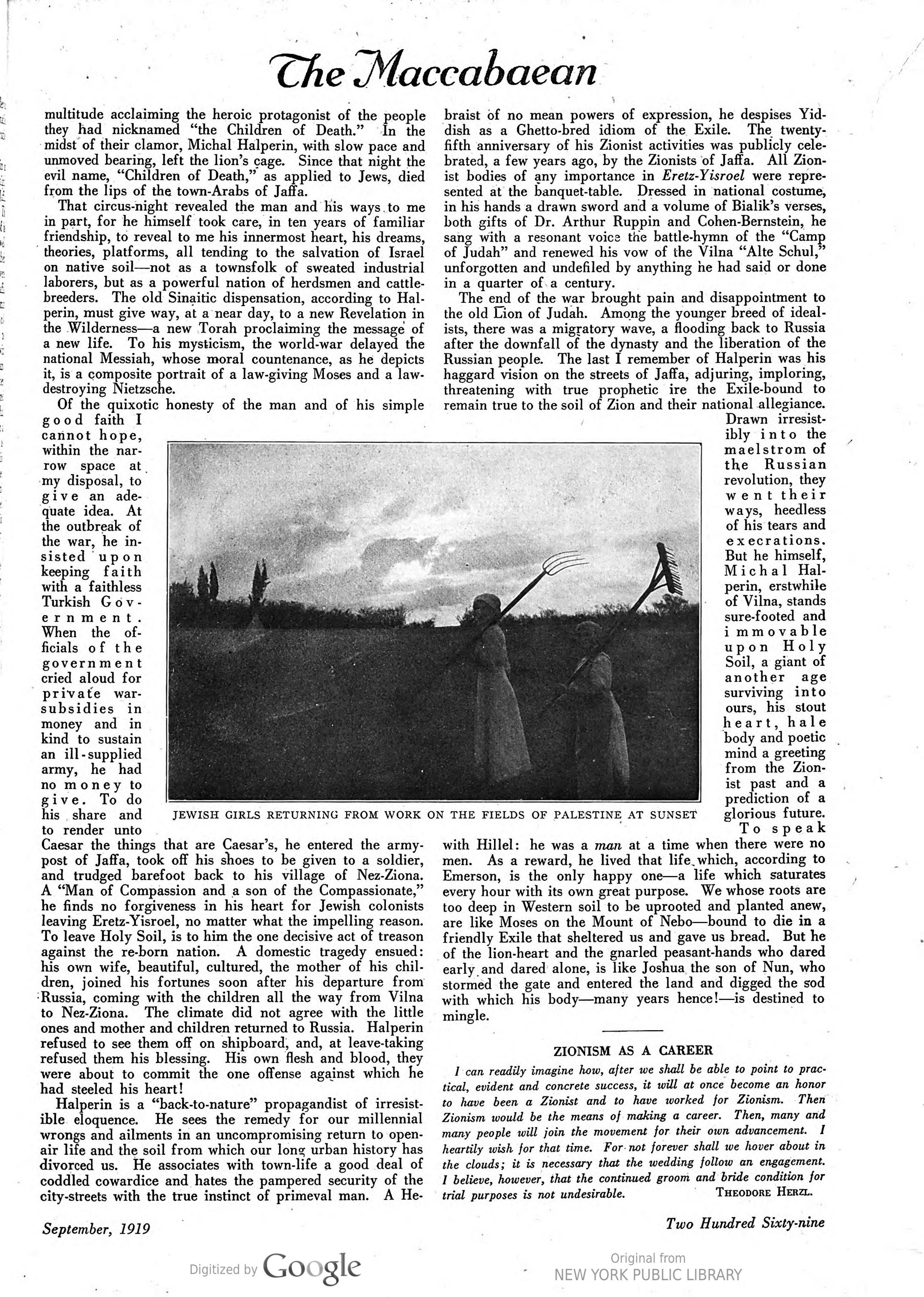
Of the quixotic honesty of the man and of his simple good faith I cannot hope, within the narrow space at my disposal, to give an adequate idea. At the outbreak of the war, he insisted upon keeping faith with a faithless Turkish Government. When the officials of the government cried aloud for private warsubsidies in money and in kind to sustain an ill-supplied army, he had no money to give. To do his share and JEWISH GIRLS RETURNING FROM WORK to render unto
Caesar the things that are Caesar’s, he entered the armypost of Jaffa, took off his shoes to be given to a soldier, and trudged barefoot back to his village of Nez-Ziona. A “Man of Compassion and a son of the Compassionate,” he finds no forgiveness in his heart for Jewish colonists leaving Eretz-Yisroel, no matter what the impelling reason. To leave Holy Soil, is to him the one decisive act of treason against the reborn nation. A domestic tragedy ensued: his own wife, beautiful, cultured, the mother of his children, joined his fortunes soon after his departure from "Russia, coming with the children all the way from Vilna to Nez-Ziona. The climate did not agree with the little ones and mother and children returned to Russia. Halperin refused to see them off on shipboard, and, at leave-taking refused them his blessing. His own flesh and blood, they were about to commit the one offense against which he
braist of no mean powers of expression, he despises Yiddish as a Ghetto-bred idiom of the Exile. The twenty-fifth anniversary of his Zionist activities was publicly celebrated, a few years ago, by the Zionists of Jaffa. All Zionist bodies of any importance in Eretz-Yisroel were represented at the banquet-table. Dressed in national costume, in his hands a drawn sword and a volume of Bialik’s verses, both gifts of Dr. Arthur Ruppin and Cohen-Bernstein, he sang with a resonant voice the battle-hymn of the “Camp of Judah” and renewed his vow of the Vilna “Alte Schul,” unforgotten and undefiled by anything he had said or done in a quarter of.a century.
The end of the war brought pain and disappointment to the old Lion of Judah. Among the younger breed of idealists, there was a migratory wave, a flooding back to Russia after the downfall of the dynasty and the liberation of the Russian people. The last I remember of Halperin was his haggard vision on the streets of Jaffa, adjuring, imploring, threatening with true prophetic ire the Exile-bound to remain true to the soil of Zion and their national allegiance.
Drawn irresistibly into the maelstrom of the Russian revolution, they went their ways, heedless of his tears and execrations. But he himself, Michal Halperin, erstwhile of Vilna, stands sure-footed and immovable upon Holy Soil, a giant of another age surviving into ours, his stout heart, hale body and poetic mind a greeting from the Zionist past and a prediction of a glorious future.
To speak with Hillel: he was a man at a time when there were no men. As a reward, he lived that life which, according to Emerson, is the only happy one—a life which saturates every hour with its own great purpose. We whose roots are too deep in Western soil to be uprooted and planted anew, are like Moses on the Mount of Nebo—bound to die in a friendly Exile that sheltered us and gave us bread. But he of the lion-heart and the gnarled peasant-hands who dared early and dared alone, is like Joshua the son of Nun, who stormed the gate and entered the land and digged the sod with which his body—many years hence!—is destined to mingle.
ZIONISM AS A CAREER
I can readily imagine how, after we shall be able to point to practical, evident and concrete success, it will at once become an honor to have been a Zionist and to have worked for Zionism. Then Zionism would be the means of making a career. Then, many and many people will join the movement for their own advancement. I heartily wish for that time. For not forever shall we hover about in the clouds; it is necessary that the wedding follow an engagement. I believe, however, that the continued groom and bride condition for trial purposes is not undesirable. THEODORE HERZL.