The Maccabaean
And then, to call the entire ship within vision of the Land, I roused the Christian pilgrims—heavy peasants of Russia who crossed themselves in awe and sang psalms as we approached the port of Jaffa. There was Sabbath-stillness upon the waves as we sighted the old Fatherland, and as the ship drew near the shore, we drew nearer to each other in our hearts. I was first among the passengers to jump into the little boat that brought us ashore, first to land with my feet on sacred soil, and then I prostrated myself to kiss the soil that bore my ancestors in the days of old.” And the old hero, wet-eyed, ceased to speak about matters too profound for speech.
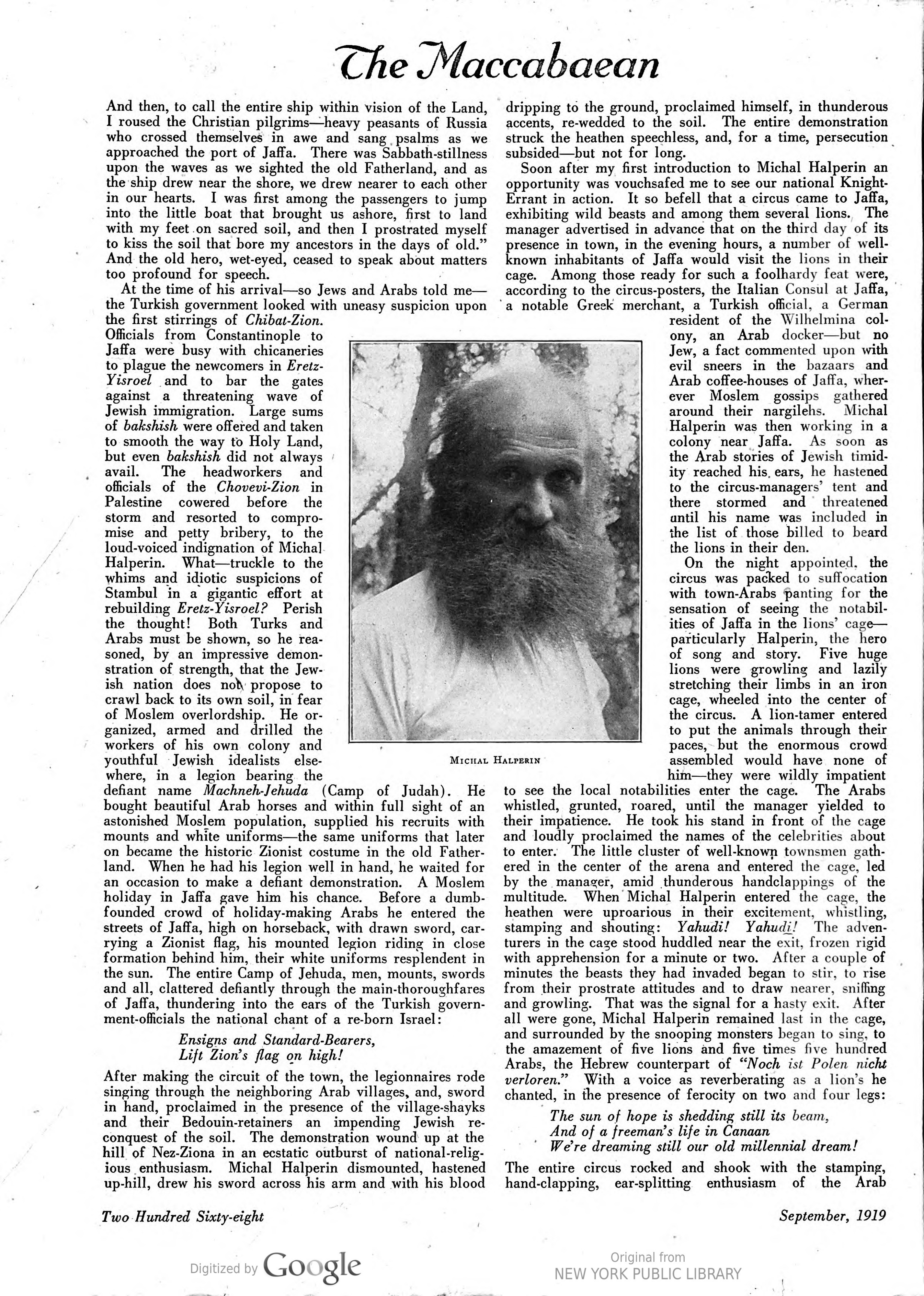
At the time of his arrival—so Jews and Arabs told me—the Turkish government looked with uneasy suspicion upon the first stirrings of Chibat-Zion. Officials from Constantinople to Jaffa were busy with chicaneries to plague the newcomers in Eretz-Yisroel and to bar the gates against a threatening wave of Jewish immigration. Large sums of bakshish were offered and taken to smooth the way to Holy Land, but even bakshish did not always avail. The headworkers and officials of the Chovevi-Zion in Palestine covered before the storm and resorted to compromise and petty bribery, to the loud-voiced indignation of Michal Halperin. What—truckle to the whims and idiotic suspicions of Stambul in a gigantic effort at rebuilding Eretz-Yisroel? Perish the thought! Both Turks and Arabs must be shown, so he reasoned, by an impressive demonstration of strength, that the Jewish nation does not propose to crawl back to its own soil, in fear of Moslem overlordship. He organized, armed and drilled the workers of his own colony and youthful Jewish idealists elsewhere, in a legion bearing the defiant name Machneh-Jehuda (Camp of Judah). He bought beautiful Arab horses and within full sight of an astonished Moslem population, supplied his recruits with mounts and white uniforms—the same uniforms that later on became the historic Zionist costume in the old Fatherland. When he had his legion well in hand, he waited for an occasion to make a defiant demonstration. A Moslem holiday in Jaffa gave him his chance. Before a dumbfounded crowd of holiday-making Arabs he entered the streets of Jaffa, high on horseback, with drawn sword, carrying a Zionist flag, his mounted legion riding in close formation behind him, their white uniforms resplendent in the sun. The entire Camp of Jehuda, men, mounts, swords and all, clattered defiantly through the main-thoroughfares of Jaffa, thundering into the ears of the Turkish government-officials the national chant of a reborn Israel:
Ensigns and Standard-Bearers, Lift Zion’s flag on high!
After making the circuit of the town, the legionnaires rode singing through the neighboring Arab villages, and, sword in hand, proclaimed in the presence of the village-shayks and their Bedouin-retainers an impending Jewish reconquest of the soil. The demonstration wound up at the hill of Nez-Ziona in an ecstatic outburst of national-religious enthusiasm. Michal Halperin dismounted, hastened uphill, drew his sword across his arm and with his blood
dripping to the ground, proclaimed himself, in thunderous accents, re-wedded to the soil. The entire demonstration struck the heathen speechless, and, for a time, persecution subsided—but not for long.
Soon after my first introduction to Michal Halperin an opportunity was vouchsafed me to see our national Knight-Errant in action. It so befell that a circus came to Jaffa, exhibiting wild beasts and among them several lions. The manager advertised in advance that on the third day of its presence in town, in the evening hours, a number of well-known inhabitants of Jaffa would visit the lions in their cage. Among those ready for such a foolhardy feat were, according to the circus-posters, the Italian Consul at Jaffa, a notable Greek merchant, a Turkish official, a German resident of the Wilhelmina colony, an Arab docker—but no Jew, a fact commented upon with evil sneers in the bazaars and Arab coffee-houses of Jaffa, wherever Moslem gossips gathered around their nargilehs. Michal Halperin was then working in a colony near Jaffa. As soon as the Arab stories of Jewish timidity reached his ears, he hastened to the circus-managers' tent and there stormed and threatened until his name was included in the list of those billed to beard the lions in their den.
On the night appointed, the circus was packed to suffocation with town-Arabs panting for the sensation of seeing the notabilities of Jaffa in the lions' cage— particularly Halperin, the hero of song and story. Five huge lions were growling and lazily stretching their limbs in an iron cage, wheeled into the center of the circus. A lion-tamer entered to put the animals through their paces, but the enormous crowd assembled would have none of him—they were wildly impatient
to see the local notabilities enter the cage. The Arabs whistled, grunted, roared, until the manager yielded to their impatience. He took his stand in front of the cage and loudly proclaimed the names of the celebrities about to enter. The little cluster of well-known townsmen gathered in the center of the arena and entered the cage, led by the manager, amid thunderous handclappings of the multitude. When Michal Halperin entered the cage, the heathen were uproarious in their excitement, whistling, stamping and shouting: Yahudi! Yahudi! The adventurers in the cage stood huddled near the exit, frozen rigid with apprehension for a minute or two. After a couple of minutes the beasts they had invaded began to stir, to rise from their prostrate attitudes and to draw nearer, sniffing and growling. That was the signal for a hasty exit. After all were gone, Michal Halperin remained last in the cage, and surrounded by the snooping monsters began to sing, to the amazement of five lions and five times five hundred Arabs, the Hebrew counterpart of "Noch ist Polen nicht verloren." With a voice as reverberating as a lion's he chanted, in the presence of ferocity on two and four legs:
The sun of hope is shedding still its beam, And of a freeman's life in Canaan We're dreaming still our old millennial dream!
The entire circus rocked and shook with the stamping, hand-clapping, ear-splitting enthusiasm of the Arab