The Maccabaean
a Palestine with a Jewish majority as an undesirable barrier between them, as a splinter in the flesh? Before the war the Arabs would certainly have looked upon it with jealous eye if the Jews in Palestine had received full freedom of development and a measure of national autonomy while their own national claims had remained unrecognized. During the war, however, circumstances so shaped themselves that it may be taken for granted that the Arabs will see their national demands in far-reaching measure fulfilled. Thus the bitter after-taste will to a large degree be removed from the granting of rights to the Jews in Palestine.
However, enough conflicting issues still remain. Peace will only maintain itself if in all colonization measures we observe as our principal rule of conduct not to prejudice any of the properly acquired rights of the Arabic resident. We must, of course, acquire our place in Palestine, but we must accomplish it not by ousting others from their sources of livelihood but by creating new sources of livelihood for ourselves. Fortunately this is possible. Before the war there lived in Palestine on an area of 30,000 square kilometers a population of at most 1,000,000; and during the war this number has probably been reduced to 750,000, or 25 inhabitants to a square kilometer. This is a very meager population. The soil is not at all fully utilized agriculturally. A considerable portion of the soil, in fact, has not yet been touched by the plow, and the part which is already under
cultivation could, with more intensive and improved methods, yield much greater returns. If we estimate the area of Palestine capable of use for agricultural purposes at one-half of the total area, that is at 15,000 square kilometers or 17,000,000 dunams, the number of agricultural units in Palestine at 80,000 to 100,000, and the area requisite for each unit at 100 dunams, there still remain over 7,000,000 to 9,000,000 dunams. This is twice as much as Jewish colonization in Palestine requires for the next thirty years. And in this connection we should consider that, while the grain-growing agricultural unit requires an area of 100 dunams, once Palestine determines its distinctive agricultural specialty to be the raising of the best tropical fruits and vegetables, an agricultural unit will require no more than 20 dunams.
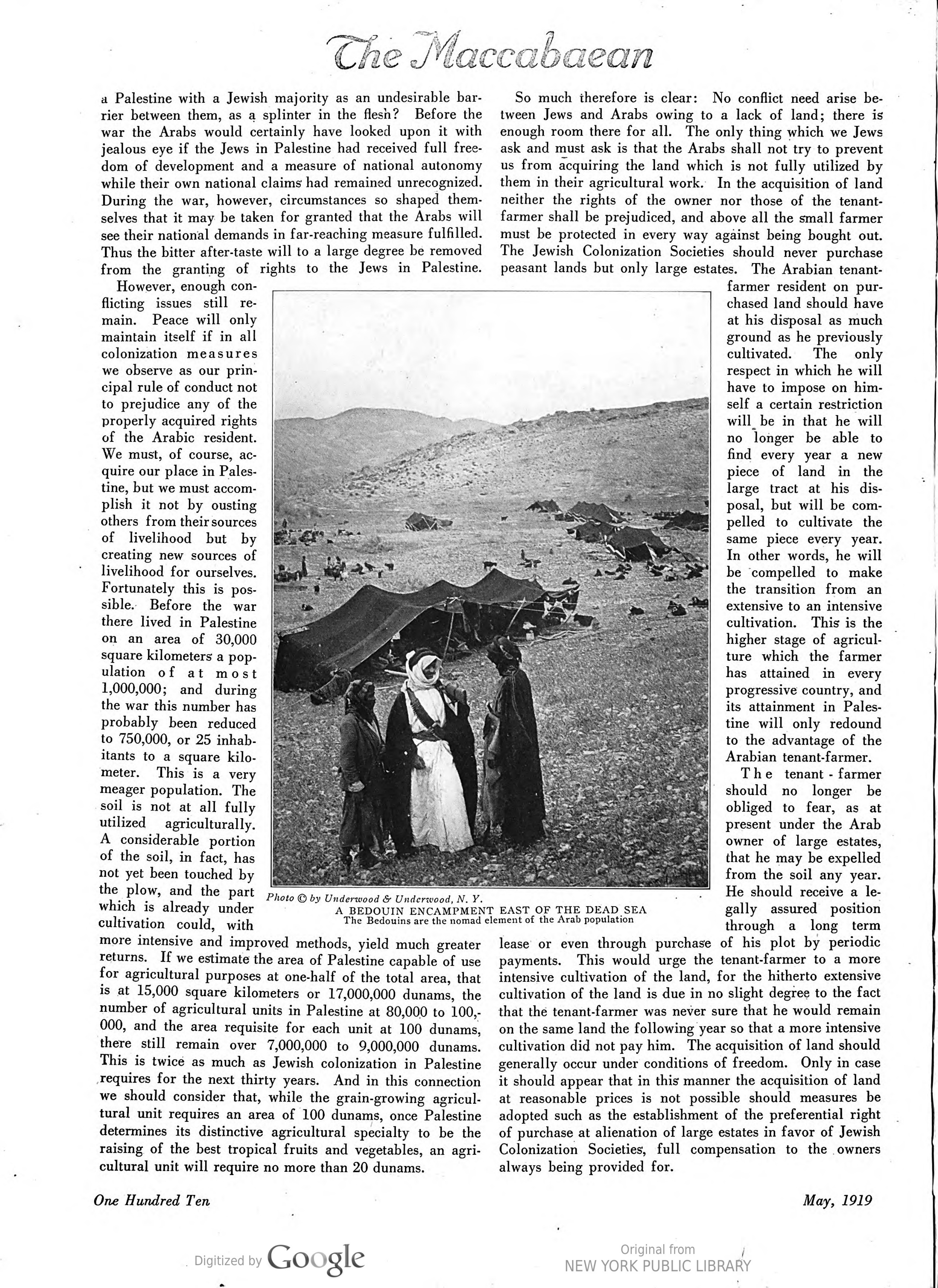
Photo © by Underwood & Underwood, N. Y.
A BEDOUIN ENCAMPMENT EAST OF THE DEAD SEA The Bedouins are the nomad element of the Arab population
No conflict need arise bea lack of land; there is only thing which we Jews s shall not try to prevent is not fully utilized by In the acquisition of land nor those of the tenantabove all the small farmer against being bought out. s should never purchase es. The Arabian tenant-
farmer resident on purchased land should have at his disposal as much ground as he previously cultivated. The only respect in which he will have to impose on himself a certain restriction will_be in that he will no longer be able to find every year a new piece of land in the large tract at his disposal, but will be compelled to cultivate the same piece every year. In other words, he will be 'compelled to make the transition from an extensive to an intensive cultivation. This is the higher stage of agriculture which the farmer has attained in every progressive country, and its attainment in Palestine will only redound to the advantage of the Arabian tenant-farmer.