The Relation of the Jews to the Arabs
By DR. ARTHUR RUPPIN
THE question of the future relations between the Jews and the Arabs has received considerable discussion. In our opinion it can only be solved by the establishment of harmonious conditions of life between Jews and Arabs.
If we desire to re-establish ourselves as a nation in Palestine and resume our place in the family of the nations of the Orient from which we were expelled almost two thousand years ago, we cannot afford to live in enmity with the leading and most numerous branch of this family, the Arabic. We shall for some decades be only a small people in Palestine, from one to two millions at most. All around us there will be Arabs as far as Aleppo in the north, to Bagdad in the east and across Egypt around to Morocco in the south and west. To live in peace with these thirty or forty millions of Arabs, so as not to be crushed by them, is not only a dictate of simple political wisdom; it is also, in a higher sense, a command of the national instinct which guides nations related in speech and race in their relations to each other. It is true that various obstacles arise to the establishment of fi truly friendly relations. Between the 17 = Jew who emigrates from Eastern Eu- £; rope to Palestine and the Arab who I has lived in Palestine for generations 4 there is a deep gulf, and only a few x individuals in both camps have hith- Y erto succeeded in bridging this gulf # and acquire sympathy with the other N nation. >
The Arab reproaches the Jew that in his pride over his European culture he separates himself from the Arab and treats him as a man of inferior culture. The reproach is not without foundation. The Jew, in fact, is inclined even in Palestine to hold fast to all European customs and to measure the culture of the Arab with his "Europeanism." This is stupid and presumptious. Should his culture really be superior in many respects to that of the Palestinian native, it must always be borne in mind that it was only owing to unfavorable external conditions that the Arab declined from his cultural level. But he possesses good natural ability, and he will certainly be able, with an adequate school system, to reach in a short time the cultural level of the Jews.
What the Jew reproaches the Arab with is that he sees in the Jew only an object of monetary gain, that he is absorbed in his quest for monetary gain, and has no understanding of any idealistic impulses whatever. In addition, the numerous field rob-
beries on the part of the Arab peasants and Bedouins and the deeds of violence principally connected with these are a source of constant complaint of the Jewish colonists.
Now it is true that the Arab actually has a strongly materialistic conception of life. A distinction must here be made between the Fellah (peasant) in the villages and the “Effendi” in the cities. The Arabian peasant in Palestine is a healthy and morally still uncorrupted human species. He is thrifty, patient in his endurance of hard labor, and hospitable. It is true that there are among the Fellahs elements inclined to commit field robberies and who do not stop at deeds of violence. It is also true that in the daily life of the Fellahs the question of making money plays the principal röle and that, when two Fellahs converse, they are almost never heard to speak of anything except the Beshlik (coin). This, however, need not surprise us, because at bottom the peasant is practically everywhere a materialist and individualist. Much less appealing than the Fellah is the urban Effendi, especially the one who has caueht a
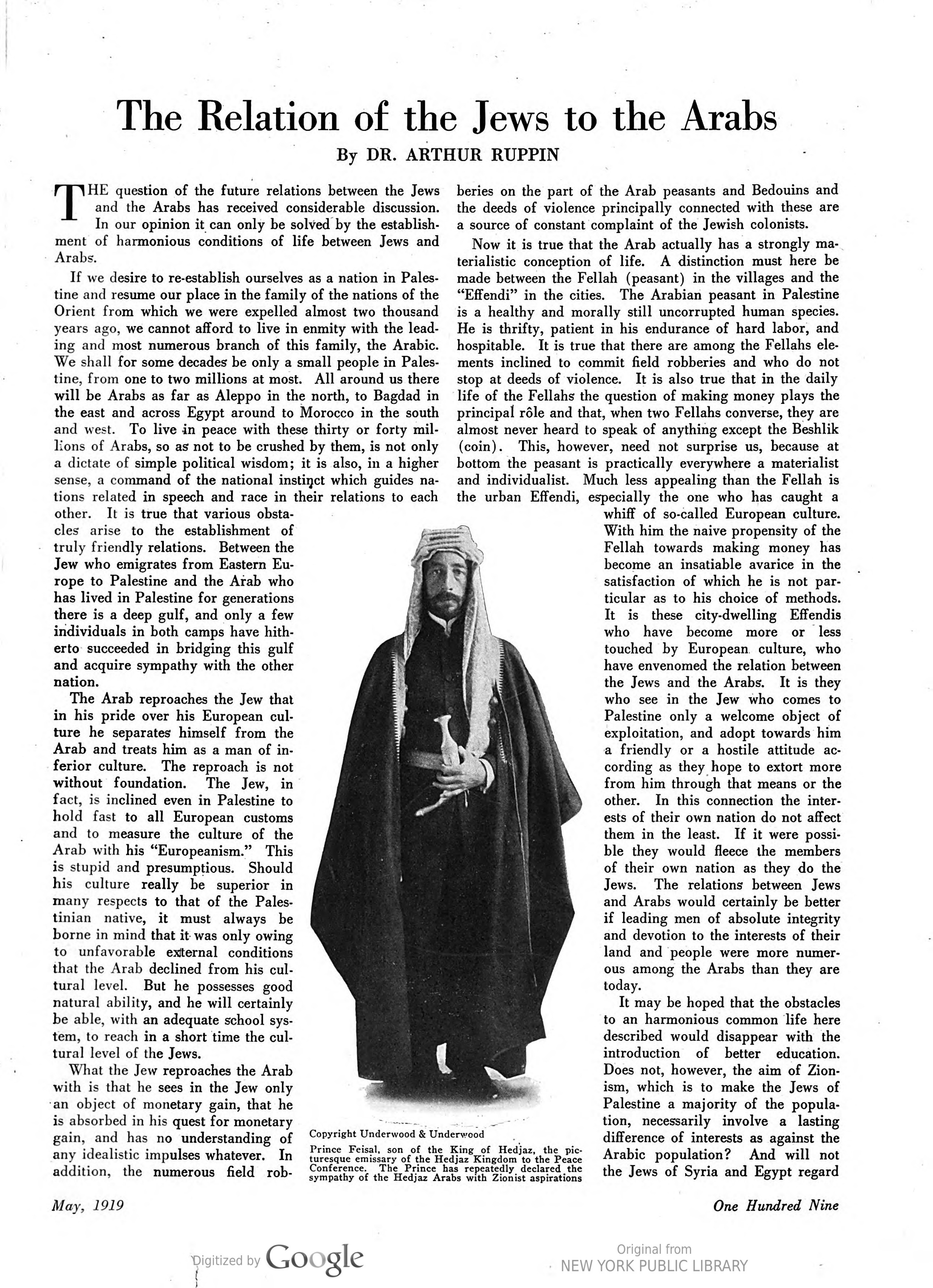
Copyright Underwood & Underwood Prince Feisal, son of the King of Hedjaz, the picturesque emissary of the Hedjaz Kingdom to the Peace Conference. The Prince has repeatedly declared the sympathy of the Hedjaz Arabs with Zionist aspirations
whiff of so-called European culture. With him the naive propensity of the Fellah towards making money has become an insatiable avarice in the satisfaction of which he is not particular as to his choice of methods. It is these city-dwelling Effendis who have become more or less touched by European. culture, who have envenomed the relation between the Jews and the Arabs. It is they who see in the Jew who comes to Palestine only a welcome object of exploitation, and adopt towards him a friendly or a hostile attitude according as they hope to extort more from him through that means or the other. In this connection the interests of their own nation do not affect them in the least. If it were possible they would fleece ihe members of their own nation as they do the Jews. The relations between Jews and Arabs would certainly be better if leading men of absolute integrity and devotion to the interests of their land and people were more numerous among the Arabs than they are today.
It may be hoped that the obstacles to an harmonious common life here described would disappear with the introduction of better education. Does not, however, the aim of Zionism, which is to make the Jews of Palestine a majority of the population, necessarily involve a lasting difference of interests as against the Arabic population? And will not the Jews of Syria and Egypt regard