oppose. This is an important admission. Hitherto, they have denied the claim of the Congress organization that it represents a majority of American Jewry. They have laughed at our alleged pretense. They have credited the entire movement to a few demagogues, to the Yiddish newspapers, etc. Now, tbey feel that they must be protected, as a minority, against any possible action by the Congress on nationality, on Zionism, on the permanent organization of American Jewry. What a calamity it would be if a majority of American Jews, assembled in a Congress through their democratically elected representatives, endorsed the Zionist movement! That would certainly be taking an unfair advantage of them. In matters of conscience, one with God is a majority. Here the Congressists come along and want to apply the secular test to Jewish questions; they want the majority to rule." As good Americans, our friends of the Socialist party and of the American Jewish Committee cannot permit it.
Why Henry Morgenthau Resigned
ÄA FANTASTIC story was cabled here from Paris on July 2ıst, in which it was reported that a number of European papers had published an article according to which Henry Morgenthau resigned as American Ambassador to Turkey under pressure from Constantinople because he had been actively engaged in the “Zionist colonization movement which contemplated buying land from Turkey in Palestine for a colony which was to be converted into an independent republic after the war.” It is a matter of public knowledge that Jews have been purchasing land in Palestine. The Turkish government has been friendly to such efforts, and has not interposed any obstacles in the way of a peaceful settlement of Palestine by Jews. With the outbreak of the war, however, these land purchases naturally ceased, owing to unsettled conditions. If any purchases were made, they were made upon contracts entered into before Turkey became a belligerent. The connection of Mr. Morgenthau with land purchases before the war and after was not directly important, and he certainly had nothing to do with any fanciful idea that a republic could be created by extensive land purchases. This roundabout way of securing political recognition in Palestine for Jews would not commend itself to the mind of any practical statesmen. But the origin of the Parisian tale, and the motives inspiring it, may be inferred from one paragraph in the cablegram. According to that paragraph, Turkey agreed to the plan under German pressure in order to get money by the sale of land to carry on the war. This shows a confused state of mind on the part of the reporter. The report should not have distressed our European brethren. For their benefit it may be said that Mr. Morgenthau was not recalled by the American government, but that he voluntarily retired for personal business reasons and that if the American government could
have persuaded him, Mr. Morgenthau would have remained at his post while the war lasted, for he was performing efficient service not only for Jewish interests, but for the Christian interests in the Turkish empire as well.
The Appointment of Mr. Elkus
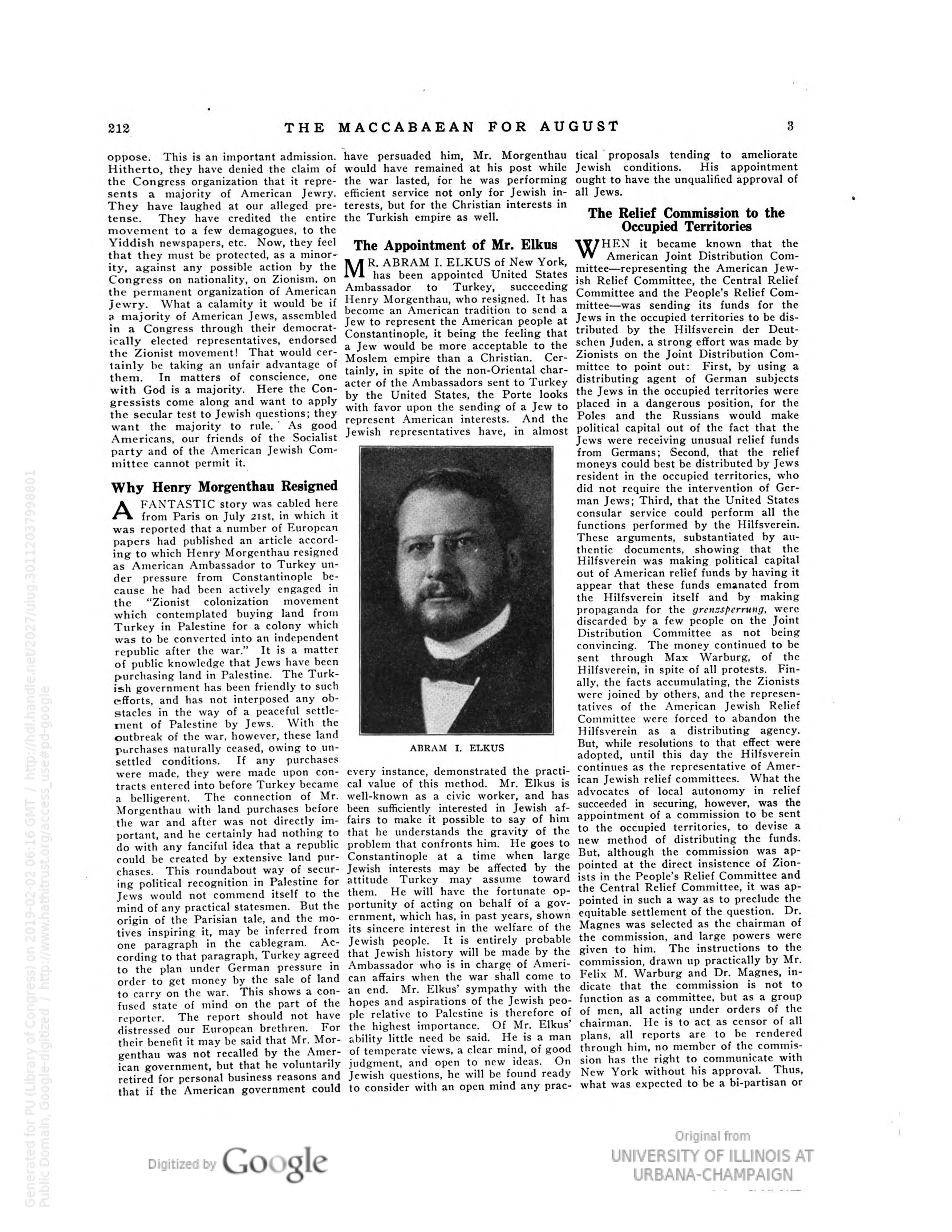
MR. ABRAM I. ELKUS of New York, has been appointed United States Ambassador to Turkey, succeeding Henry Morgenthau, who resigned. It has become an American tradition to send a Jew to represent the American people at Constantinople, it being the feeling that a Jew would be more acceptable to the Moslem empire than a Christian. Certainly, in spite of the non-Oriental character of the Ambassadors sent to Turkey by the United States, the Porte looks with favor upon the sendings of a Jew to represent American interests. And the Jewish representatives have, in almost
ABRAM I. ELKUS
every instance, demonstrated the practical value of this method. Mr. Elkus is well-known as a civic worker, and has been sufficiently interested in Jewish affairs to make it possible to say of him that he understands the gravity of the problem that confronts him. He goes to Constantinople at a time when large Jewish interests may be affected by the attitude Turkey may assume toward them. He will have the fortunate opportunity of acting on behalf of a government, which has, in past years, shown its sincere interest in the welfare of the Jewish people. It is entirely probable that Jewish history will be made by the Ambassador who is in charge of American affairs when the war shall come to an end. Mr. Elkus’ sympathy with the hopes and aspirations of the Jewish people relative to Palestine is therefore of the highest importance. Of Mr. Elkus’ ability little need be said. He is a man of temperate views, a clear mind, of good judgment, and open to new ideas. On Jewish questions, he will be found ready to consider with an open mind any prac-
tical proposals tending to ameliorate Jewish conditions. His appointment ought to have the unqualified approval of all Jews.
The Relief Commission to the Occupied Territories
wen it became known that the American Joint Distribution Committee—representing the American Jewish Relief Committee, the Central Relief Committee and the People’s Relief Committee—was sending its funds for the Jews in the occupied territories to be distributed by the Hilfsverein der Deutschen Juden, a strong effort was made by Zionists on the Joint Distribution Committee to point out: First, by using a distributing agent of German subjects the Jews in the occupied territories were placed in a dangerous position, for the Poles and the Russians would make political capital out of the fact that the Jews were receiving unusual relief funds from Germans; Second, that the relief moneys could best be distributed by Jews resident in the occupied territories, who did not require the intervention of German Jews; Third, that the United States consular service could perform all the functions performed by the Hilfsverein. These arguments, substantiated by authentic documents, showing that the Hilfsverein was making political capital out of American relief funds by having it appear that these funds emanated from the Hilfsverein itself and by making propaganda for the grenssperrung, were discarded by a few people on the Joint Distribution Committee as not being convincing. The money continued to be sent through Max Warburg, of the Hilfsverein, in spite of all protests. Finally, the facts accumulating, the Zionists were joined by others, and the representatives of the American Jewish Relief Committee were forced to abandon the Hilfsverein as a distributing agency. But, while resolutions to that effect were adopted, until this day the Hilfsverein continues as the representative of American Jewish relief committees. What the advocates of local autonomy in relief succeeded in securing, however, was the appointment of a commission to be sent to the occupied territories, to devise a new method of distributing the funds. But, although the commission was appointed at the direct insistence of Zionists in the People’s Relief Committee and the Central Relief Committee, it was appointed in such a way as to preclude the equitable settlement of the question. Dr. Magnes was selected as the chairman of the commission, and large powers were given to him. The instructions to the commission, drawn up practically by Mr. Felix M. Warburg and Dr. Magnes, indicate that the commission is not to _ function as a committee, but as a group of men, all acting under orders of the chairman. He is to act as censor of all plans, all reports are to be rendered through him, no member of the commission has the right to communicate with New York without his approval. Thus, what was expected to be a bi-partisan or