poetical gift and a delicate feeling. His language and poetical style prove that he finds himself in the near neighborhood of Byalik. I could also mention a good many names of promising beginners, but we have been so much disappointed with promising beginners in the last few years that it is better to "wait and see." In fine, it must be said that we have not only a great and rich modern Hebrew poetry, but that we suffer from a superabundance of lyrics, which in its turn affects not a little other branches of Hebrew literature.
In the last five or six years a new generation of Hebrew poets has arisen, who are sometimes poets by accident, as the poetry they produce has nothing whatsoever to do with the ancient Hebrew spirit, or the Hebrew spirit at all. The one reason why they should be called Hebrew poets is because they write their poetry in Hebrew. They are in most cases young men who have received the so called modern liberal education, i. e., their Hebrew knowledge consists only of modern Hebrew manuals and school books which have been compiled bv so called modern Hebrew teachers.
One of these two modern Hebrew poets is certainly Eliah Maitus. Maitus is certainly a gifted poet, and a passionate and thirsty soul, but I imagine that as a French poet he would earn more honor and popularity than as a Hebrew poet. To what an extent Maitus has come in touch with decadent European thought, and how far he originates himself from the Hebrew spirit, is to be seen from one of his pieces of poetry published in a number of the Hebrew monthly Haschi-
know whether this piece of poetry expresses original feeling, or whether it is an able copy of decadent French poets like Baudelaire and Verlaine, for if we compare this piece of poetry, which is characteristic of the poet, with many verses of the above mentioned French poets, we do certainly find that there is not only a similarity of feeling but also an affınity of strivings.
I want to reach the height of the hill of sin,To remove from my clothes the dust of erroneous ways,To pick the pomegranates of sin: give sulphur to my soul,And a full cup of madness give me, too.I want to reach the heights of the hill of sin,To leap from abyss to abyss and wander between clefts;I want to dip my heart in pitch, and then flickerLike a stake of fire, furious, majestic.
Do not these verses remind one of Baudelaire's "Fleurs du Mal?" A little more Hebrew, but not less decadent, is the young Hungarian Hebrew poet, Victor Feuerstein. Hungarian Jewry has up to now contributed only a little to modern Hebrew literature, and poetry in particular, and it is rather curious to observe how the first Hungarian Hebrew poet competes in modernity, if not in decadence, with the Hebrew poets of Russia and Galicia.
In reading his verses one is at once reminded of the gypsy surroundings and of the semi-madness in which the young poet lives. One simply thinks that the passionate young poet with his fiery soul is writing strophes that wild Gypsies danced; so strange is Feuerstein in his feelings and his thoughts.
There is, of course, a great deal in the poetry of young Feuerstein which is still far from being major, it would have been better not to have published some of his verses. But still, being a gifted poet, his poetical capacity may develop and grow, and the future may belong to him.
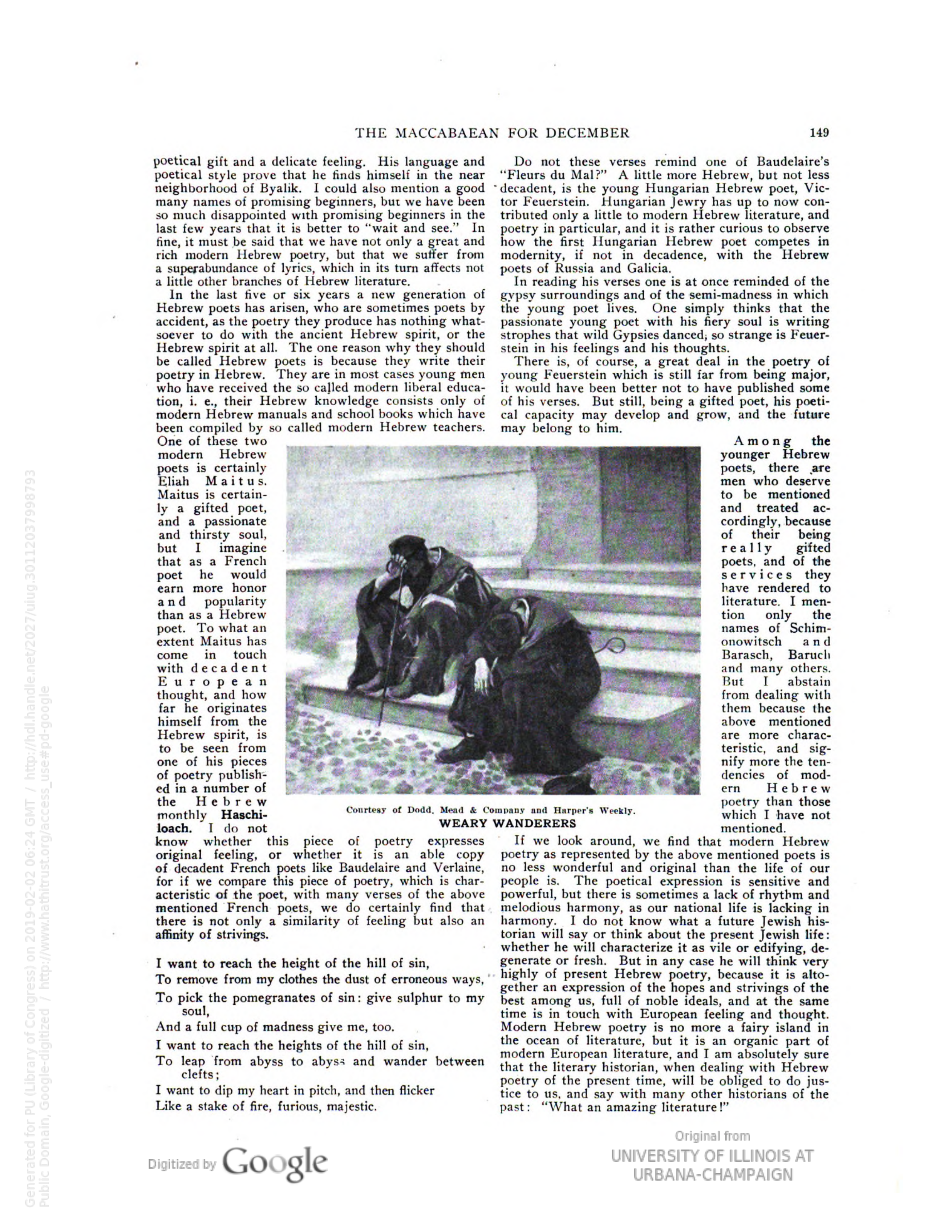
Courtesy of Dodd, Mead & Company and Harper's Weekly.
WEARY WANDERERS
Among the younger Hebrew poets, there are men who deserve to be mentioned and treated accordingly, because of their being really gifted poets, and of the services they have rendered to literature. I mention only the names of Schimonowitsch and Barasch, Baruch and many others. But I abstain from dealing with them because the above mentioned are more characteristic, and signify more the tendencies of modern Hebrew poetry than those which I have not mentioned.
If we look around, we find that modern Hebrew poetry as represented by the above mentioned poets is no less wonderful and original than the life of our people is. The poetical expression is sensitive and powerful, but there is sometimes a lack of rhythm and melodious harmony, as our national life is lacking in harmony. I do not know what a future Jewish historian will say or think about the present Jewish life: whether he will characterize it as vile or edifying, degenerate or fresh. But in any case he will think very highly of present Hebrew poetry, because it is altogether an expression of the hopes and strivings of the best among us, full of noble ideals, and at the same time is in touch with European feeling and thought. Modern Hebrew poetry is no more a fairy island in the ocean of literature, but it is an organic part of modern European literature, and I am absolutely sure that the literary historian, when dealing with Hebrew poetry of the present time, will be obliged to do justice to us, and say with many other historians of the past: “What an amazing literature!”