prospect of gaining easier access to Alexandretta, Russia would ever relinquish the hope of Constantinople or pause in its onward march towards that goal, is grievously mistaken about the only true aim of Russia's policy. It is the fundamental principle of the so-called will of Peter the Great, which, as I believe, had been drawn up by Prince Cantemir, of Moldavia. But of this on another occasion. To conquer Constantinople and to place upon the heads of the Tsar the ancient crown of the Byzantine Emperors is the fixed pole of Russia's ambition. The Tsars have considered themselves as the rightful heirs to the Byzantine emperors; they have adopted the double-headed eagle as their standard from the Byzantines, together with Christianity. Constantinople is known in Russia and among the Slav nations by the name of "Tsarigrad," "the town of the Tsars," and the imagination of the Russians has been inflamed with the vision of Russia's enthronment in the old capital of the Orthodox emperors.
To persuade ourselves that because of a temporary check Russia and the Russians of any denomination, Liberals or Radicals of the future, as well as autocrats in modern times, would ever flinch from the attempt at conquering Constantinople is to lay up for ourselves a rich store of disappointment, a snare and a delusion which should no longer be entertained. It is one of the fixed assets in the political calculation of the future. Whether it be true or not, is not for me to say, that England has made up its mind to take this contingency into a favorable consideration and to shape its Near Eastern policy in accordance with the situation created by Russia settling definitely in Constantinople. So the tale runs. It may take more time until it comes to pass than some anticipate, but
that it will come to pass there is little doubt. Whatever may happen now in the Far East—and the expansion in that direction is much more due to the treaty of Berlin and to the momentary pause imposed upon Russia’s aggression in the Near East—vanquished or victorious Russia can so little- think of relinquishing her object in the Near East as give up the idea of being a great power. If they lose the game in the Far East Russia is sure to compensate itself in the Near East, and, if she should win, who dare put a limit to her ambition? Threats of retaliation against this country are already being circulated and we may be quite sure that nothing will be left undone to try and carry them out. Sooner or later Russia will. see herself installed in Constantinople? Germany has now entered the path of a peaceful penetration, by commercial conquest. Whatever other aims may be lying at the back of the advances’ made to Turkey by Germany, those who have studied the recent Bagdad railway scheme have had ample opportunity to 'satisfy themselves that they are not meant to further England’s
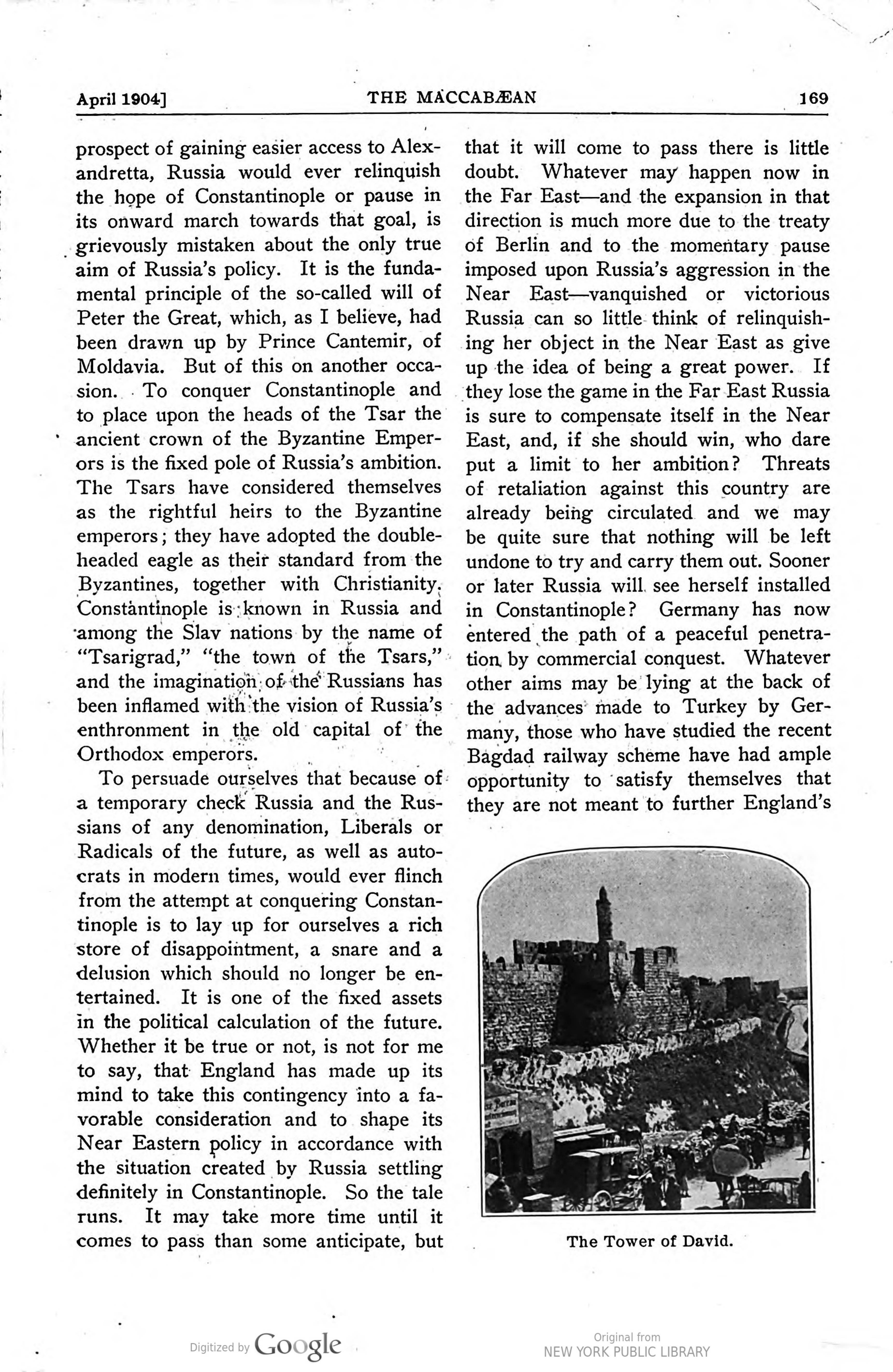
The Tower of David.