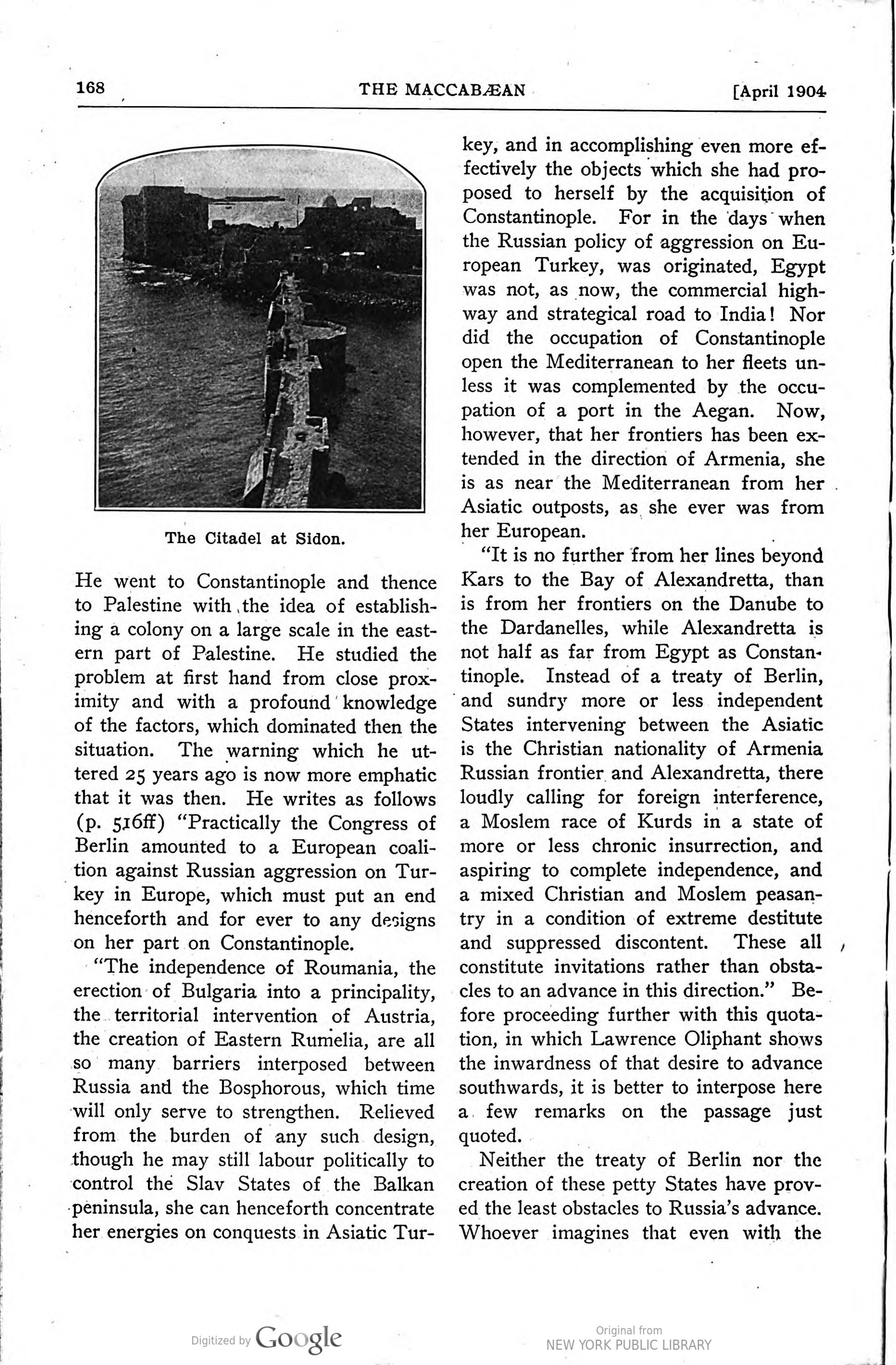
The Citadel at Sidon.
He went to Constantinople and thence to Palestine with the idea of establishing a colony on a large scale in the eastern part of Palestine. He studied the problem at first hand from close proximity and with a profound knowledge of the factors, which dominated then the situation. The warning which he uttered 25 years ago is now more emphatic that it was then. He writes as follows (p. 516ff) "Practically the Congress of Berlin amounted to a European coalition against Russian aggression on Turkey in Europe, which must put an end henceforth and for ever to any designs on her part on Constantinople.
"The independence of Roumania, the erection of Bulgaria into a principality, the territorial intervention of Austria, the creation of Eastern Rumelia, are all so many barriers interposed between Russia and the Bosphorous, which time will only serve to strengthen. Relieved from the burden of any such design, though he may still labour politically to control the Slav States of the Balkan peninsula, she can henceforth concentrate her energies on conquests in Asiatic Tur-
key, and in accomplishing even more effectively the objects which she had proposed to herself by the acquisition of Constantinople. For in the days when the Russian policy of aggression on European Turkey, was originated, Egypt was not, as now, the commercial highway and strategical road to India! Nor did the occupation of Constantinople open the Mediterranean to her fleets unless it was complemented by the occupation of a port in the Aegan. Now, however, that her frontiers has been extended in the direction of Armenia, she is as near the Mediterranean from her Asiatic outposts, as she ever was from her European.
“It is no further from her lines beyond Kars to the Bay of Alexandretta, than is from her frontiers on the Danube to the Dardanelles, while Alexandretta is not half as far from Egypt as Constantinople. Instead of a treaty of Berlin, ‘and sundry more or less independent States intervening between the Asiatic is the Christian nationality of Armenia Russian frontier and Alexandretta, there loudly calling for foreign interference, a Moslem race of Kurds in a state of more or less chronic insurrection, and aspiring to complete independence, and a mixed Christian and Moslem peasantry in a condition of extreme destitute and suppressed discontent. These all constitute invitations rather than obstacles to an advance in this direction.” Before proceeding further with this quotation, in which Lawrence Oliphant shows the inwardness of that desire to advance southwards, it is better to interpose here a. few remarks on the passage just quoted.
Neither the treaty of Berlin nor the creation of these petty States have proved the least obstacles to Russia’s advance. Whoever imagines that even with the