"Die Welt"
(continued from page 7)
…and 1 woman) and 1 woman from among those of no confession. All were single, 3 aged 20—30, 1 aged 30—40.
The very carefully compiled reports of the Statistical Office of the City of Cracow have for a number of years furnished detailed and systematic data on changes of confession, which alone, like the Vienna data, give ample information on the whole baptismal movement.
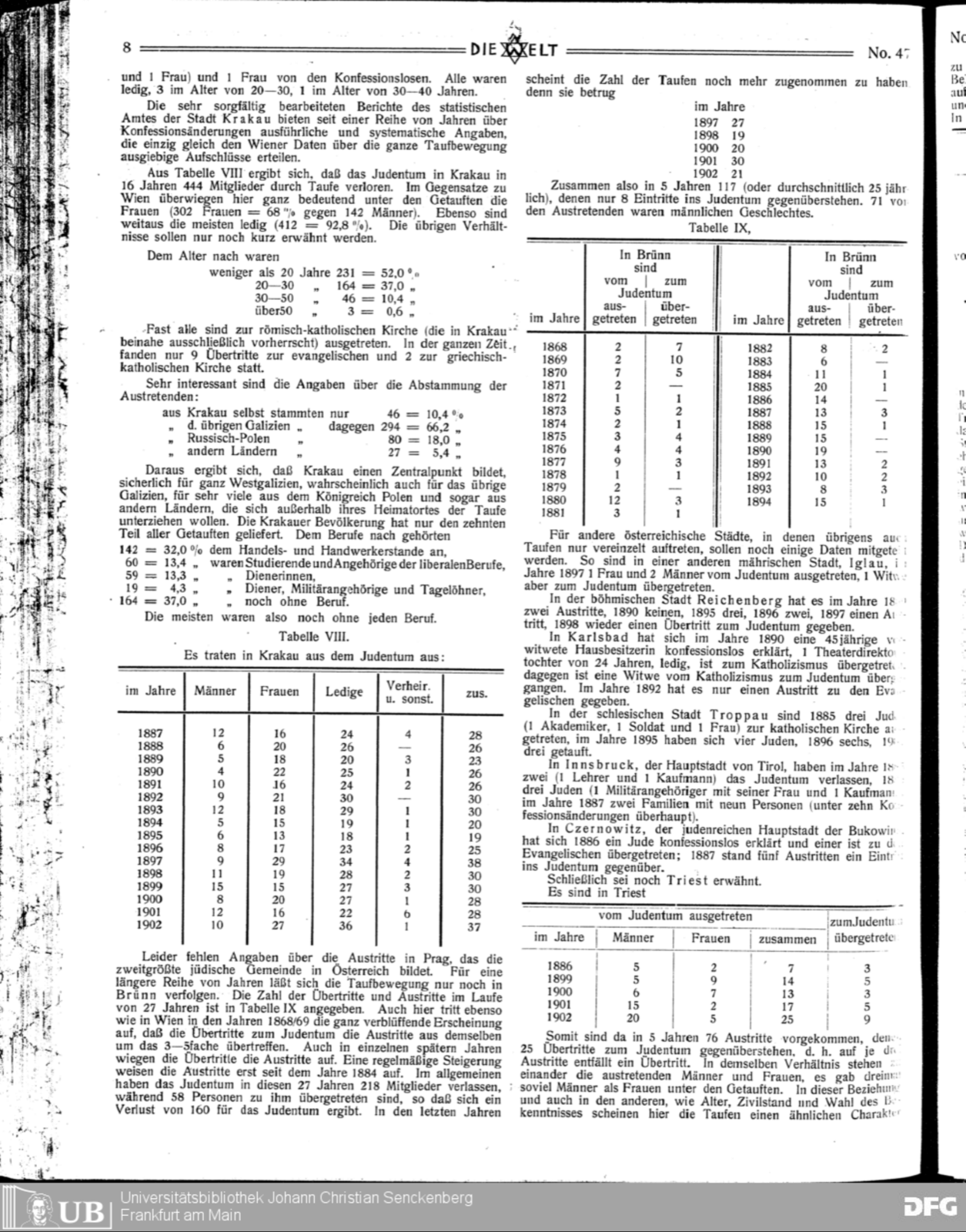
Table VIII shows that Judaism in Cracow lost 444 members through baptism in 16 years. In contrast to Vienna, women here very greatly preponderate among the baptised (302 women = 68 % as against 142 men). Likewise by far the greater number were single (412 = 92,8 %). The remaining circumstances need only be mentioned briefly.
By age there were under 20 years 231 = 52,0 % 20—30 " 164 = 37,0 " 30—50 " 46 = 10,4 " over 50 " 3 = 0,6 "
Almost all went over to the Roman Catholic Church (which in Cracow predominates almost exclusively). In the whole period there took place only 9 conversions to the Protestant and 2 to the Greek Catholic Church.
Very interesting are the data on the origin of those who left: from Cracow itself came only 46 = 10,4 % " the rest of Galicia " on the other hand 294 = 66,2 " " Russian Poland " " 80 = 18,0 " " other countries " " 27 = 5,4 "
From this it follows that Cracow forms a central point, certainly for the whole of Western Galicia, probably also for the rest of Galicia, for very many from the Kingdom of Poland and even from other countries, for those who wish to undergo baptism away from their home town. The population of Cracow has furnished only a tenth of all the baptised. By occupation there belonged
142 = 32,0 % to the commercial and artisan class, 60 = 13,4 " were students and members of the liberal professions, 59 = 13,3 " " maidservants, 19 = 4,3 " " servants, military men and day-labourers, 164 = 37,0 " " still without occupation.
Most of them, then, were still without any occupation.
Table VIII.
There left Judaism in Cracow:
| in the year | Men | Women | Single | Married and other | Total |
|---|---|---|---|---|---|
| 1887 | 12 | 16 | 24 | 4 | 28 |
| 1888 | 6 | 20 | 26 | — | 26 |
| 1889 | 5 | 18 | 20 | 3 | 23 |
| 1890 | 4 | 22 | 25 | 1 | 26 |
| 1891 | 10 | 16 | 24 | 2 | 26 |
| 1892 | 9 | 21 | 30 | — | 30 |
| 1893 | 12 | 18 | 29 | 1 | 30 |
| 1894 | 5 | 15 | 19 | 1 | 20 |
| 1895 | 6 | 13 | 18 | 1 | 19 |
| 1896 | 8 | 17 | 23 | 2 | 25 |
| 1897 | 9 | 29 | 34 | 4 | 38 |
| 1898 | 11 | 19 | 28 | 2 | 30 |
| 1899 | 15 | 15 | 27 | 3 | 30 |
| 1900 | 8 | 20 | 27 | 1 | 28 |
| 1901 | 12 | 16 | 22 | 6 | 28 |
| 1902 | 10 | 27 | 36 | 1 | 37 |
Unfortunately data are lacking on the secessions in Prague, which forms the second-largest Jewish community in Austria. For a longer series of years the baptismal movement can be followed only in Bruenn. The number of conversions to and secessions from Judaism in the course of 27 years is given in Table IX. Here too, just as in Vienna, there appears in the years 1868/69 the quite astonishing phenomenon that the conversions to Judaism exceed the secessions from it three- to fivefold. In some individual later years, too, the conversions outweigh the secessions. The secessions show a regular increase only from the year 1884. In all, 218 members left Judaism in these 27 years, while 58 persons went over to it, so that a loss of 160 results for Judaism. In recent years the number of baptisms seems to have increased still further, for it amounted
in the year 1897 27 1898 19 1900 20 1901 30 1902 21
Altogether, then, 117 in 5 years (or on average 25 annually), against which stand only 8 entries into Judaism. 71 of those who left were of the male sex.
Table IX.
| in the year | In Bruenn there left Judaism | In Bruenn there went over to Judaism | in the year | In Bruenn there left Judaism | In Bruenn there went over to Judaism |
|---|---|---|---|---|---|
| 1868 | 2 | 7 | 1882 | 8 | 2 |
| 1869 | 2 | 10 | 1883 | 6 | — |
| 1870 | 7 | 5 | 1884 | 11 | 1 |
| 1871 | 2 | — | 1885 | 20 | 1 |
| 1872 | 1 | 1 | 1886 | 14 | — |
| 1873 | 5 | 2 | 1887 | 13 | 3 |
| 1874 | 2 | 1 | 1888 | 15 | 1 |
| 1875 | 3 | 4 | 1889 | 15 | — |
| 1876 | 4 | 4 | 1890 | 19 | — |
| 1877 | 9 | 3 | 1891 | 13 | 2 |
| 1878 | 1 | 1 | 1892 | 10 | 2 |
| 1879 | 2 | — | 1893 | 8 | 3 |
| 1880 | 12 | 3 | 1894 | 15 | 1 |
| 1881 | 3 | 1 |
For other Austrian towns, in which, moreover, baptisms occur only sporadically, a few further data shall be given. Thus in another Moravian town, Iglau, in the year 1897 1 woman and 2 men left Judaism, while 1 widow went over to Judaism.
In the Bohemian town of Reichenberg there were in the year 1890 two secessions, in 1890 none, in 1895 three, in 1896 two, in 1897 one secession, and in 1898 again one conversion to Judaism.
In Carlsbad, in the year 1890, a widowed house-owner of 45 declared herself of no confession; 1 theatre director's daughter of 24, single, went over to Catholicism, while on the other hand a widow passed from Catholicism to Judaism. In the year 1892 there was only one secession, to the Protestants.
In the Silesian town of Troppau three Jews (1 university man, 1 soldier and 1 woman) went over to the Catholic Church in 1885; in the year 1895 four Jews had themselves baptised, in 1896 six, in 1897 three.
In Innsbruck, the capital of the Tyrol, in the year 1895 two (1 teacher and 1 merchant) left Judaism, in 1896 three Jews (1 military man with his wife and 1 merchant), in the year 1887 two families with nine persons (among ten changes of confession in all).
In Czernowitz, the capital of the Bukovina, so rich in Jews, one Jew declared himself of no confession in 1886 and one went over to the Protestants; in 1887 five secessions were set against one entry into Judaism.
Finally, Trieste may also be mentioned.
In Trieste there
| left Judaism | went over to Judaism | |||
|---|---|---|---|---|
| in the year | Men | Women | Total | |
| 1886 | 5 | 2 | 7 | 3 |
| 1899 | 5 | 9 | 14 | 5 |
| 1900 | 6 | 7 | 13 | 3 |
| 1901 | 15 | 2 | 17 | 5 |
| 1902 | 20 | 5 | 25 | 9 |
Thus 76 secessions occurred there in 5 years, against which stand 25 conversions to Judaism, i.e. to every three secessions there falls one conversion. The men and women who left stand to each other in the same proportion: there were three times as many men as women among the baptised. In this respect, and also in the others, such as age, civil status and choice of creed, the baptisms here seem of a character similar