No. 47. — "Die Welt" — Page 7.
(continued from page 6)
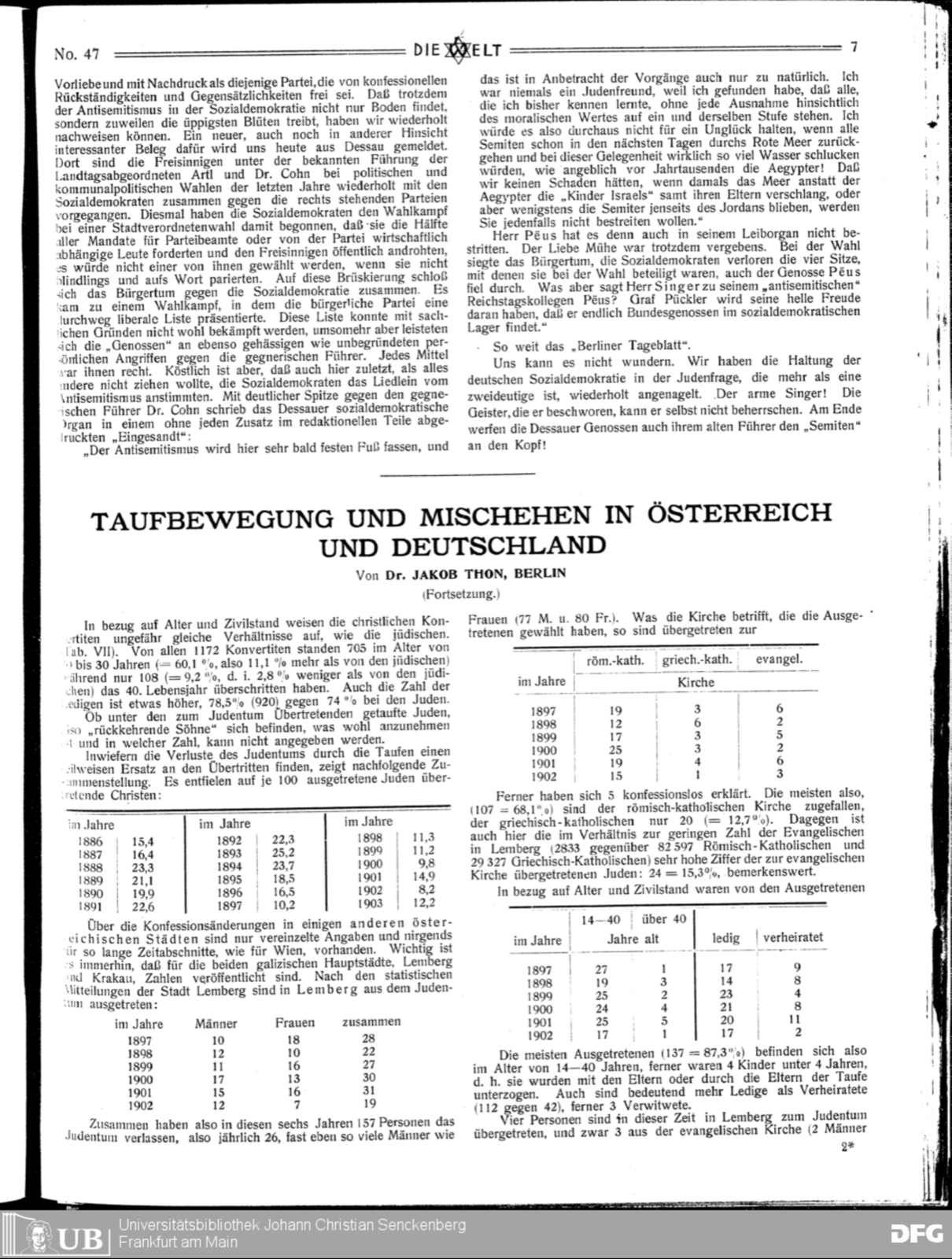
…predilection and with emphasis as the party that is free from confessional backwardness and antagonisms. That antisemitism nevertheless not only finds soil in Social Democracy, but at times puts forth the most luxuriant blossoms, we have been able to show repeatedly. A fresh proof of this, interesting in other respects as well, is reported to us to-day from Dessau. There the Liberals, under the well-known leadership of the Diet deputies Artl and Dr. Cohn, have repeatedly gone together with the Social Democrats against the parties of the Right in the political and municipal elections of recent years. This time the Social Democrats opened the campaign for a town-council election by demanding half of all the seats for party officials or for persons economically dependent on the party, and by publicly threatening the Liberals that not one of them would be elected unless they obeyed blindly and to the word. Upon this affront the middle classes closed ranks against Social Democracy. It came to an electoral contest in which the bourgeois party presented a thoroughly liberal list. This list could hardly be opposed on grounds of substance; all the more did the "comrades" indulge in personal attacks upon the opposing leaders, as spiteful as they were groundless. Every means was good enough for them. But the delicious thing is that here too, at the last, when nothing else would take, the Social Democrats struck up the little song of antisemitism. With a plain thrust at the opposing leader, Dr. Cohn, the Dessau Social Democratic organ printed in its editorial section, without any comment whatever, a "Letter to the Editor":
'Antisemitism will very soon gain a firm footing here, and in view of what has happened that is only too natural. I have never been a friend of the Jews, because I have found that all whom I have come to know hitherto stand, without a single exception, on one and the same level as regards moral worth. I should therefore by no means consider it a misfortune if all the Semites were to go back through the Red Sea within the next few days and on this occasion really swallowed as much water as the Egyptians supposedly did thousands of years ago! That we should have suffered no harm if at that time the sea had swallowed the "Children of Israel" together with their parents instead of the Egyptians, or if at least the Semites had stayed on the far side of the Jordan, you will surely not wish to dispute.'
Herr Pëus, indeed, did not dispute it in his own organ. Yet the labour of love was in vain all the same. At the election the middle classes were victorious; the Social Democrats lost the four seats for which they had stood in the election, and Comrade Pëus too was defeated. But what does Herr Singer say to his "antisemitic" Reichstag colleague Pëus? Count Pückler will take a hearty delight in having at last found allies in the Social Democratic camp."
Thus far the "Berliner Tageblatt."
It cannot surprise us. We have repeatedly nailed to the post the attitude of German Social Democracy on the Jewish question, which is more than ambiguous. Poor Singer! The spirits he conjured up he himself cannot master. In the end the Dessau comrades will fling "Semite" at the head of their old leader too!
THE BAPTISMAL MOVEMENT AND MIXED MARRIAGES IN AUSTRIA AND GERMANY
By Dr. JAKOB THON, BERLIN
(Continued.)
As regards age and civil status, the Christian converts show roughly the same proportions as the Jewish. (Tab. VII). Of all the 1172 converts, 705 were between the ages of 14 and 30 (= 60,1 %, that is, 11,1 % more than of the Jewish), while only 108 (= 9,2 %, i.e. 2,8 % fewer than of the Jewish) had passed their fortieth year. The number of the unmarried, too, is somewhat higher, 78,5 % (920) as against 74 % among the Jews.
Whether among those going over to Judaism there are baptised Jews, that is, "returning sons," as may well be assumed, and in what number, cannot be stated.
To what extent the losses of Judaism through baptism find a partial compensation in the conversions to it is shown by the following summary. For every 100 Jews who left there were, of Christians going over:
| in the year | in the year | in the year | |||
|---|---|---|---|---|---|
| 1886 | 15,4 | 1892 | 22,3 | 1898 | 11,3 |
| 1887 | 16,4 | 1893 | 25,2 | 1899 | 11,2 |
| 1888 | 23,3 | 1894 | 23,7 | 1900 | 9,8 |
| 1889 | 21,1 | 1895 | 18,5 | 1901 | 14,9 |
| 1890 | 19,9 | 1896 | 16,5 | 1902 | 8,2 |
| 1891 | 22,6 | 1897 | 10,2 | 1903 | 12,2 |
On the changes of confession in some other Austrian towns there are only isolated data, and nowhere for such long periods as for Vienna. It is nevertheless important that figures have been published for the two Galician capitals, Lemberg and Cracow. According to the statistical reports of the City of Lemberg, there left Judaism in Lemberg:
| in the year | Men | Women | Total |
|---|---|---|---|
| 1897 | 10 | 18 | 28 |
| 1898 | 12 | 10 | 22 |
| 1899 | 11 | 16 | 27 |
| 1900 | 17 | 13 | 30 |
| 1901 | 15 | 16 | 31 |
| 1902 | 12 | 7 | 19 |
Altogether, then, 157 persons left Judaism in these six years, that is, 26 annually, almost as many men as women (77 m. and 80 w.). As regards the church chosen by those who left, there went over to the
| in the year | Roman Catholic Church | Greek Catholic Church | Protestant Church |
|---|---|---|---|
| 1897 | 19 | 3 | 6 |
| 1898 | 12 | 6 | 2 |
| 1899 | 17 | 3 | 5 |
| 1900 | 25 | 3 | 2 |
| 1901 | 19 | 4 | 6 |
| 1902 | 15 | 1 | 3 |
Further, 5 declared themselves of no confession. Most of them, then (107 = 68,1 %), fell to the Roman Catholic Church, only 20 (= 12,7 %) to the Greek Catholic. On the other hand, here too the figure of Jews who went over to the Protestant Church, 24 = 15,3 %, is remarkable, being very high in proportion to the small number of Protestants in Lemberg (2833 as against 82 597 Roman Catholics and 29 327 Greek Catholics).
As regards age and civil status, of those who left there were
| in the year | 14-40 years old | over 40 years old | single | married |
|---|---|---|---|---|
| 1897 | 27 | 1 | 17 | 9 |
| 1898 | 19 | 3 | 14 | 8 |
| 1899 | 25 | 2 | 23 | 4 |
| 1900 | 24 | 4 | 21 | 8 |
| 1901 | 25 | 5 | 20 | 11 |
| 1902 | 17 | 1 | 17 | 2 |
Most of those who left (137 = 87,3 %) were thus between the ages of 14 and 40; there were also 4 children under 4 years, i.e. they were subjected to baptism with their parents or through their parents. There were also considerably more single persons than married (112 as against 42), and 3 widowed besides.
Four persons went over to Judaism in Lemberg during this period, namely 3 from the Protestant Church (2 men
2*