Page 8. — "Die Welt" — No. 40.
Also a Sermon
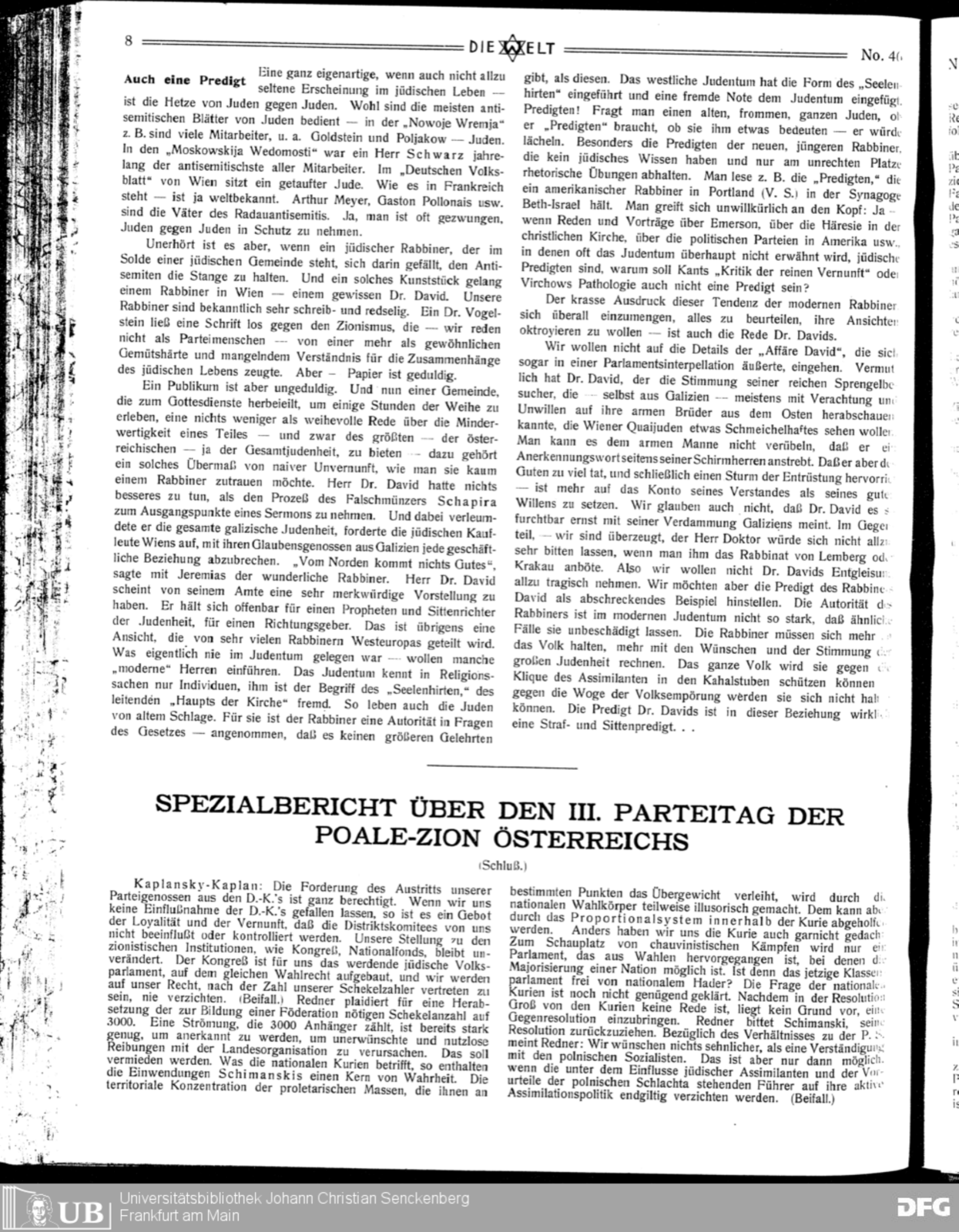
A quite peculiar, if not over-rare, phenomenon in Jewish life is the agitation of Jews against Jews. It is true that most of the antisemitic papers are served by Jews—on the "Novoye Vremya," for instance, many of the contributors, among them Goldstein and Polyakov, are Jews. On the "Moskovskiya Vedomosti" a Herr Schwarz was for years the most antisemitic of all the contributors. On the "Deutsches Volksblatt" of Vienna there sits a baptised Jew. How matters stand in France is known to all the world. Arthur Meyer, Gaston Pollonais and others are the fathers of rowdy antisemitism. Indeed, one is often compelled to defend Jews against Jews.
But it is unheard of when a Jewish rabbi, in the pay of a Jewish congregation, takes pleasure in backing up the antisemites. And such a feat was accomplished by a rabbi in Vienna—a certain Dr. David. Our rabbis, as is well known, are much given to writing and talking. A Dr. Vogelstein let loose a pamphlet against Zionism which—we do not speak as party men—bore witness to a more than ordinary hardness of heart and to a want of understanding of the connections of Jewish life. But—paper is patient.
An audience, however, is impatient. And now to offer a congregation that hastens to divine service in order to experience a few hours of consecration a speech anything but consecrated, on the inferiority of one part—and that the largest part—of Austrian, nay, of all Jewry—that requires such an excess of naïve unreason as one would hardly credit a rabbi with. Herr Dr. David had nothing better to do than to take the trial of the counterfeiter Schapira as the starting-point of a sermon. And in doing so he slandered the whole of Galician Jewry, and called upon the Jewish merchants of Vienna to break off all business relations with their co-religionists from Galicia. "Out of the north cometh no good," said the strange rabbi with Jeremiah. Herr Dr. David seems to have a very curious notion of his office. He evidently regards himself as a prophet and censor of morals for Jewry, as one who sets its course. This, by the way, is a view shared by very many rabbis of Western Europe. What never really lay in Judaism, certain "modern" gentlemen wish to introduce. In matters of religion Judaism knows only individuals; the notion of the "shepherd of souls," of the guiding "head of the Church," is foreign to it. So, too, live the Jews of the old stamp. For them the rabbi is an authority in questions of the Law—provided that there is no greater scholar than he. Western Jewry has introduced the form of the "shepherd of souls" and inserted a foreign note into Judaism. Sermons! Ask an old, pious, whole Jew whether he needs "sermons," whether they mean anything to him—he would smile. Especially the sermons of the new, younger rabbis, who have no Jewish learning and merely hold rhetorical exercises in the wrong place. Read, for example, the "sermons" which an American rabbi in Portland (U. S.) delivers in the Beth-Israel synagogue. One involuntarily clutches one's head: yes—if speeches and lectures on Emerson, on heresy in the Christian Church, on the political parties in America, etc., in which Judaism is often not mentioned at all, are Jewish sermons, why should not Kant's "Critique of Pure Reason" or Virchow's Pathology be a sermon too?
The crass expression of this tendency of the modern rabbis to meddle everywhere, to pass judgment on everything, to wish to impose their views, is Dr. David's speech as well.
We will not go into the details of the "David affair," which even found expression in a parliamentary interpellation. Presumably Dr. David, who knew the mood of his wealthy congregants—who, even those from Galicia themselves, mostly look down with contempt and displeasure upon their poor brethren from the East—wished to let the Vienna Quai-Jews see something flattering. One cannot blame the poor man for striving after a word of recognition from his patrons. But that he overdid the thing, and in the end called forth a storm of indignation, is to be set down rather to the account of his understanding than of his good will. Nor do we believe that Dr. David means his condemnation of Galicia so terribly in earnest. On the contrary—we are convinced that the Herr Doktor would not need much pressing if he were offered the rabbinate of Lemberg or Cracow. So we will not take Dr. David's lapse too tragically. But we should like to hold up the sermon of Rabbi David as a deterrent example. The authority of the rabbi in modern Jewry is not so strong that such cases can leave it undamaged. The rabbis must keep closer to the people, must reckon more with the wishes and the temper of the great mass of Jewry. The whole people will be able to protect them against the clique of assimilationists in the kahal chambers—against the wave of popular indignation they will not be able to hold out. The sermon of Dr. David is in this respect truly a sermon of chastisement and of morals. . .
SPECIAL REPORT ON THE THIRD PARTY CONGRESS OF THE POALE-ZION OF AUSTRIA
(Conclusion.)
Kaplansky-Kaplan: The demand that our party comrades withdraw from the D.-K.'s is entirely justified. If we allow no influence on the part of the D.-K.'s, then it is a dictate of loyalty and of reason that the District Committees should not be influenced or controlled by us. Our attitude towards the Zionist institutions, such as the Congress and the National Fund, remains unchanged. The Congress is for us the Jewish people's parliament in the making, built upon equal suffrage, and we shall never renounce our right to be represented according to the number of our shekel-payers. (Applause.) The speaker pleads for a reduction to 3000 of the number of shekels required for the formation of a federation. A tendency that counts 3000 adherents is already strong enough to be recognised, strong enough to cause undesirable and useless friction with the national organisation. That should be avoided. As regards the national curiae, Schimanski's objections contain a kernel of truth. The territorial concentration of the proletarian masses, which gives them the preponderance at certain points, is in part rendered illusory by the national electoral bodies. But this can be remedied by the proportional system within the curia. Nor did we ever conceive of the curia otherwise. Only a parliament that has issued from elections in which one nation can be outvoted becomes the scene of chauvinistic struggles. Is, then, the present class parliament free from national strife? The question of the national curiae has not yet been sufficiently cleared up. Since the Groß resolution makes no mention of the curiae, there is no reason to bring in a counter-resolution. The speaker asks Schimanski to withdraw his resolution. As to the relation to the P. S., the speaker says: We desire nothing more ardently than an understanding with the Polish socialists. But that is possible only if the leaders, who stand under the influence of Jewish assimilationists and of the prejudices of the Polish Schlachta, finally renounce their active policy of assimilation. (Applause.)