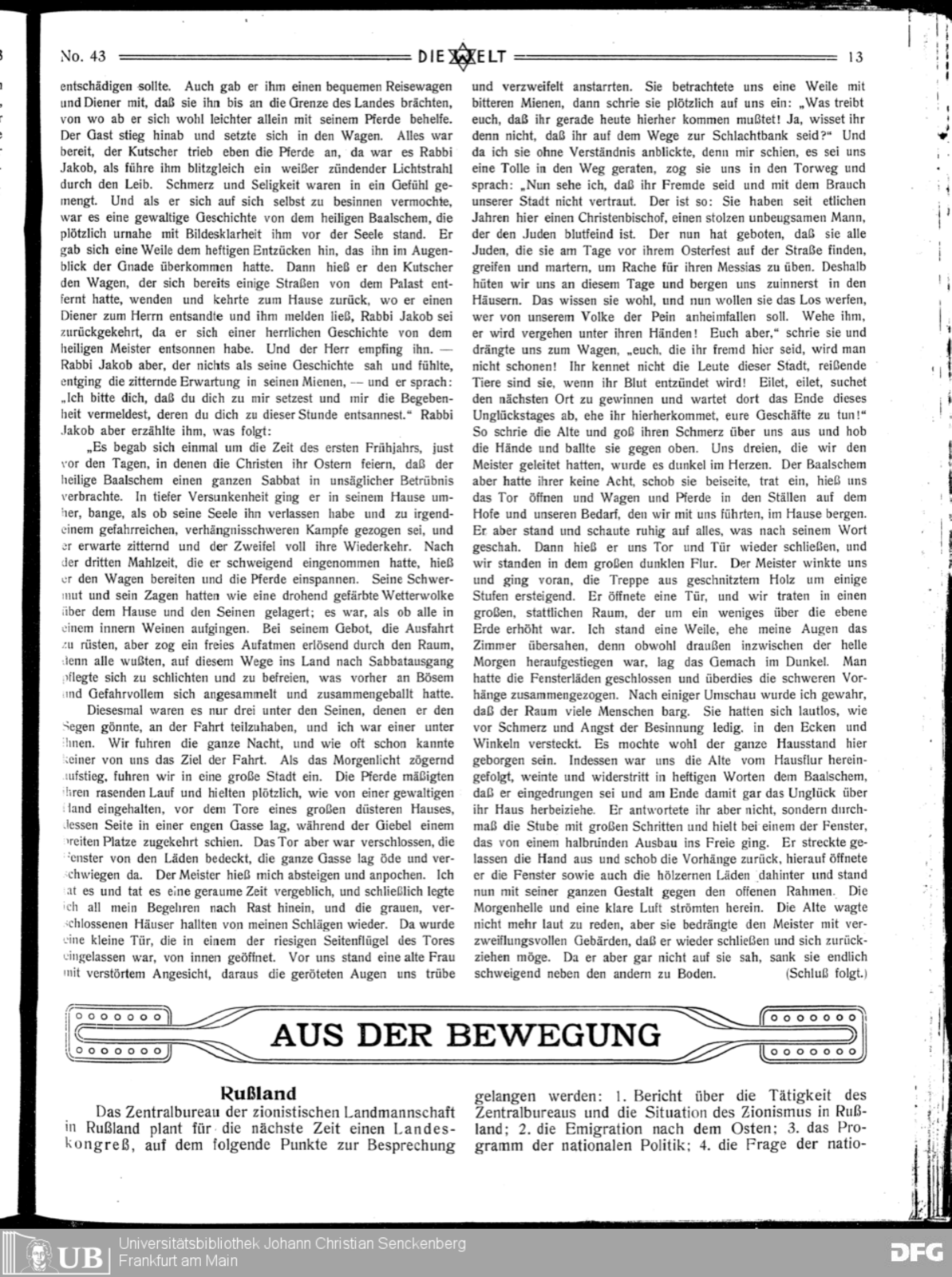
No. 43. — "Die Welt" — Page 13.
(continued from page 12)
…was to make amends. He also gave him a comfortable travelling carriage and servants to go with him, that they might bring him to the frontier of the country, from where he would no doubt manage more easily alone with his horse. The guest went down and seated himself in the carriage. All was ready, the coachman was just urging on the horses, when it seemed to Rabbi Jakob as though a white, kindling ray of light shot like lightning through his body. Pain and bliss were mingled in one feeling. And when he was able to collect himself, it was a mighty story of the holy Baalschem that suddenly stood before his soul, primevally near, with the clearness of a picture. For a while he gave himself up to the vehement rapture that had come over him in the moment of grace. Then he bade the coachman turn the carriage, which had already gone some streets from the palace, and returned to the house, where he sent a servant to the master and had it announced to him that Rabbi Jakob had returned, since he had remembered a glorious story of the holy master. And the master received him. — But Rabbi Jakob, who saw and felt nothing but his story, did not perceive the trembling expectation in his features, — and he said: "I pray thee, sit down by me and relate to me the occurrence which thou didst remember at this hour." And Rabbi Jakob told him what follows:
"It came to pass once, about the time of the first spring, just before the days in which the Christians keep their Easter, that the holy Baalschem spent a whole Sabbath in unspeakable sadness. In deep absorption he walked about his house, fearful, as though his soul had left him and gone forth to some perilous, fateful combat, and he awaited its return trembling and full of doubt. After the third meal, which he had taken in silence, he bade them make ready the carriage and harness the horses. His melancholy and his faltering had lain over the house and his household like a menacingly coloured storm-cloud; it was as though all were dissolving in an inward weeping. At his command to prepare for the drive, however, a free breath of relief passed redeemingly through the room, for all knew that on this road into the country after the going-out of the Sabbath, whatever of evil and of peril had before gathered and massed together was wont to be settled and set free.
This time there were only three of his household to whom he granted the blessing of sharing in the drive, and I was one of them. We drove the whole night, and, as so often, none of us knew the goal of the journey. When the morning light rose hesitantly, we drove into a great city. The horses slackened their furious pace and halted suddenly, as though checked by a mighty hand, before the gate of a large, gloomy house, whose side lay on a narrow lane, while its gable seemed turned towards a broad square. But the gate was locked, the windows covered by their shutters, the whole lane lay desolate and silent. The master bade me get down and knock. I did so, and did so a long while in vain, and at last I put all my longing for rest into it, and the grey, shut houses echoed with my blows. Then a little door that was let into one of the huge side-leaves of the gate was opened from within. Before us stood an old woman with a distraught face, out of which her reddened eyes stared at us dully and despairingly. She regarded us a while with bitter looks, then suddenly she cried out at us: "What drives you, that you must needs come here to-day of all days! Why, do you not know that you are on the way to the slaughter-house?" And since I gazed at her without understanding, for it seemed to me that a madwoman had crossed our path, she drew us into the gateway and said: "Now I see that you are strangers and not acquainted with the custom of our city. It is this: for some years they have had a Christian bishop here, a proud, unbending man, who is a deadly enemy of the Jews. He has commanded that they seize and torture all Jews whom they find in the street on the day before their Easter feast, to take vengeance for their Messiah. Therefore we keep ourselves close on this day and hide in the innermost parts of our houses. That they know well, and now they mean to cast lots which of our people shall fall to the torment. Woe to him, he will perish under their hands! But you," she cried, and pushed us towards the carriage, "you who are strangers here, you will not be spared! You know not the people of this city; ravening beasts they are when their blood is inflamed! Hasten, hasten, seek to reach the nearest place and wait there for the end of this day of misfortune, before you come hither to do your business!" So the old woman cried, and poured out her grief over us, and raised her hands and clenched them upward. To us three who had accompanied the master it grew dark in our hearts. But the Baalschem took no heed of her, pushed her aside, went in, bade us open the gate and shelter carriage and horses in the stables in the courtyard, and the necessaries we carried with us in the house. He himself stood and looked on calmly at all that was done at his word. Then he bade us shut gate and door again, and we stood in the great dark hall. The master beckoned to us and went before, mounting a few steps of the staircase of carved wood. He opened a door, and we entered a large, stately room, which was raised a little above the level of the ground. I stood a while before my eyes could take in the chamber, for although outside the bright morning had meanwhile risen, the room lay in darkness. The shutters had been closed and, besides, the heavy curtains drawn together. After looking about for some time I became aware that the room held many people. They had hidden themselves soundlessly in the corners and nooks, as though bereft of their senses for pain and fear. The whole household might well be sheltered here. Meanwhile the old woman had followed us in from the hall, wept and remonstrated with the Baalschem in vehement words that he had forced his way in and might in the end even draw misfortune down upon her house. He did not answer her, however, but paced the room with long strides and stopped at one of the windows, which gave on to the open from a semicircular bay. He calmly stretched out his hand and drew back the curtains, then he opened the windows and the wooden shutters behind them as well, and now stood with his whole figure against the open frame. The brightness of morning and a clear air streamed in. The old woman no longer dared to speak aloud, but she beset the master with despairing gestures to close them again and withdraw. But since he did not look at her at all, she sank at last silently to the floor beside the others.
(Conclusion follows.)
FROM THE MOVEMENT
Russia
The Central Bureau of the Zionist territorial federation in Russia is planning for the near future a national conference, at which the following points will come up for discussion: 1. Report on the activity of the Central Bureau and the situation of Zionism in Russia; 2. emigration to the East; 3. the programme of national policy; 4. the question of the natio-