No. 36 — "Die Welt" — 11
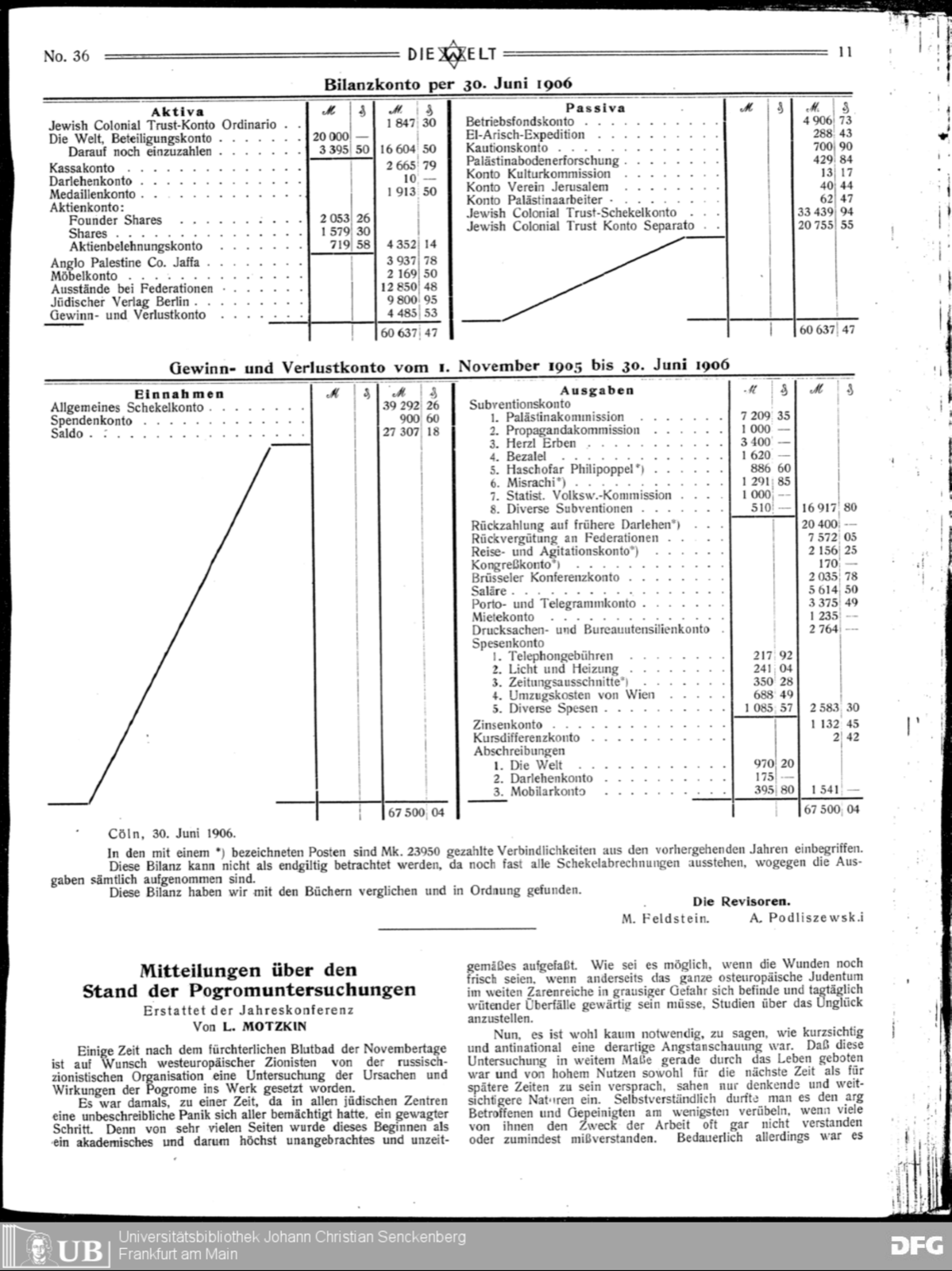
Balance Sheet as at 30 June 1906
| Assets | M. | Pf. | M. | Pf. | Liabilities | M. | Pf. | M. | Pf. |
|---|---|---|---|---|---|---|---|---|---|
| Jewish Colonial Trust Account Ordinario | 1 847 | 30 | Working-capital account | 4 906 | 73 | ||||
| Die Welt, participation account | 20 000 | — | El-Arish Expedition | 288 | 43 | ||||
| Still to be paid in thereon | 3 395 | 50 | 16 604 | 50 | Security-deposit account | 700 | 90 | ||
| Cash account | 2 665 | 79 | Palestine soil research | 429 | 84 | ||||
| Loan account | 10 | — | Culture Commission account | 13 | 17 | ||||
| Medal account | 1 913 | 50 | Verein Jerusalem account | 40 | 44 | ||||
| Share account: | Palestine workers account | 62 | 47 | ||||||
| Founder Shares | 2 053 | 26 | Jewish Colonial Trust Shekel account | 33 439 | 94 | ||||
| Shares | 1 579 | 30 | Jewish Colonial Trust Account Separato | 20 755 | 55 | ||||
| Loans-on-shares account | 719 | 58 | 4 352 | 14 | |||||
| Anglo Palestine Co., Jaffa | 3 937 | 78 | |||||||
| Furniture account | 2 169 | 50 | |||||||
| Outstanding with Federations | 12 850 | 48 | |||||||
| Jüdischer Verlag, Berlin | 9 800 | 95 | |||||||
| Profit and loss account | 4 485 | 53 | |||||||
| 60 637 | 47 | 60 637 | 47 |
Profit and Loss Account from 1 November 1905 to 30 June 1906
| Receipts | M. | Pf. | M. | Pf. | Expenditure | M. | Pf. | M. | Pf. |
|---|---|---|---|---|---|---|---|---|---|
| General Shekel account | 39 292 | 26 | Subsidies account | ||||||
| Donations account | 900 | 60 | 1. Palestine Commission | 7 209 | 35 | ||||
| Balance | 27 307 | 18 | 2. Propaganda Commission | 1 000 | — | ||||
| 3. Herzl heirs | 3 400 | — | |||||||
| 4. Bezalel | 1 620 | — | |||||||
| 5. Haschofar, Philippopolis*) | 886 | 60 | |||||||
| 6. Misrachi*) | 1 291 | 85 | |||||||
| 7. Statist. and Econ. Commission | 1 000 | — | |||||||
| 8. Sundry subsidies | 510 | — | 16 917 | 80 | |||||
| Repayment on earlier loans*) | 20 400 | — | |||||||
| Refunds to Federations | 7 572 | 05 | |||||||
| Travel and agitation account*) | 2 156 | 25 | |||||||
| Congress account*) | 170 | — | |||||||
| Brussels Conference account | 2 035 | 78 | |||||||
| Salaries | 5 614 | 50 | |||||||
| Postage and telegram account | 3 375 | 49 | |||||||
| Rent account | 1 235 | — | |||||||
| Printed matter and office supplies account | 2 764 | — | |||||||
| Expenses account | |||||||||
| 1. Telephone charges | 217 | 92 | |||||||
| 2. Light and heating | 241 | 04 | |||||||
| 3. Press cuttings*) | 350 | 28 | |||||||
| 4. Cost of removal from Vienna | 688 | 49 | |||||||
| 5. Sundry expenses | 1 085 | 57 | 2 583 | 30 | |||||
| Interest account | 1 132 | 45 | |||||||
| Exchange-difference account | 2 | 42 | |||||||
| Write-offs | |||||||||
| 1. Die Welt | 970 | 20 | |||||||
| 2. Loan account | 175 | — | |||||||
| 3. Furniture account | 395 | 80 | 1 541 | — | |||||
| 67 500 | 04 | 67 500 | 04 |
Cologne, 30 June 1906.
The items marked with an *) include Mk. 23950 of liabilities paid from the preceding years.
This balance sheet cannot be regarded as final, since almost all the Shekel returns are still outstanding, whereas the expenditure has all been entered.
We have compared this balance sheet with the books and found it in order.
The Auditors. M. Feldstein. A. Podliszewski.
Report on the State of the Pogrom Inquiries
Delivered to the Annual Conference By L. MOTZKIN
Some time after the terrible bloodbath of the November days, an inquiry into the causes and effects of the pogroms was set on foot by the Russian Zionist Organisation at the wish of West European Zionists.
It was at that time — a time when in all Jewish centres an indescribable panic had seized upon everyone — a daring step. For from very many quarters this undertaking was regarded as an academic one, and therefore as highly inappropriate and untimely. How could it be possible, it was said, while the wounds were still fresh, while on the other hand the whole of East European Jewry throughout the wide empire of the Tsar stood in dreadful danger and had to expect furious assaults day after day, to undertake studies of the calamity.
Now, it is hardly necessary to say how short-sighted and anti-national such a view, born of fear, was. That this inquiry was in large measure demanded by life itself, and promised to be of great use both for the time immediately ahead and for later times, was perceived only by thinking and more far-sighted natures. Of course, one could least of all hold it against the sorely stricken and tormented if many of them often did not understand the purpose of the work at all, or at least misunderstood it. It was, however, regrettable