14 — "Die Welt" — No. 32
BEERSHEBA
By DAVIS TRIETSCH, Jaffa.
Whoever goes from Gaza to Beersheba sees something that cannot be seen a second time in all Palestine: endless stretches of land without mountains and hills, without villages, without trees, without wells — without the slightest variety in the landscape — and yet a wonderfully blessed piece of land.
Here grows what Gaza exports in grain. A territory of two million dunams of land is almost one great cornfield, which
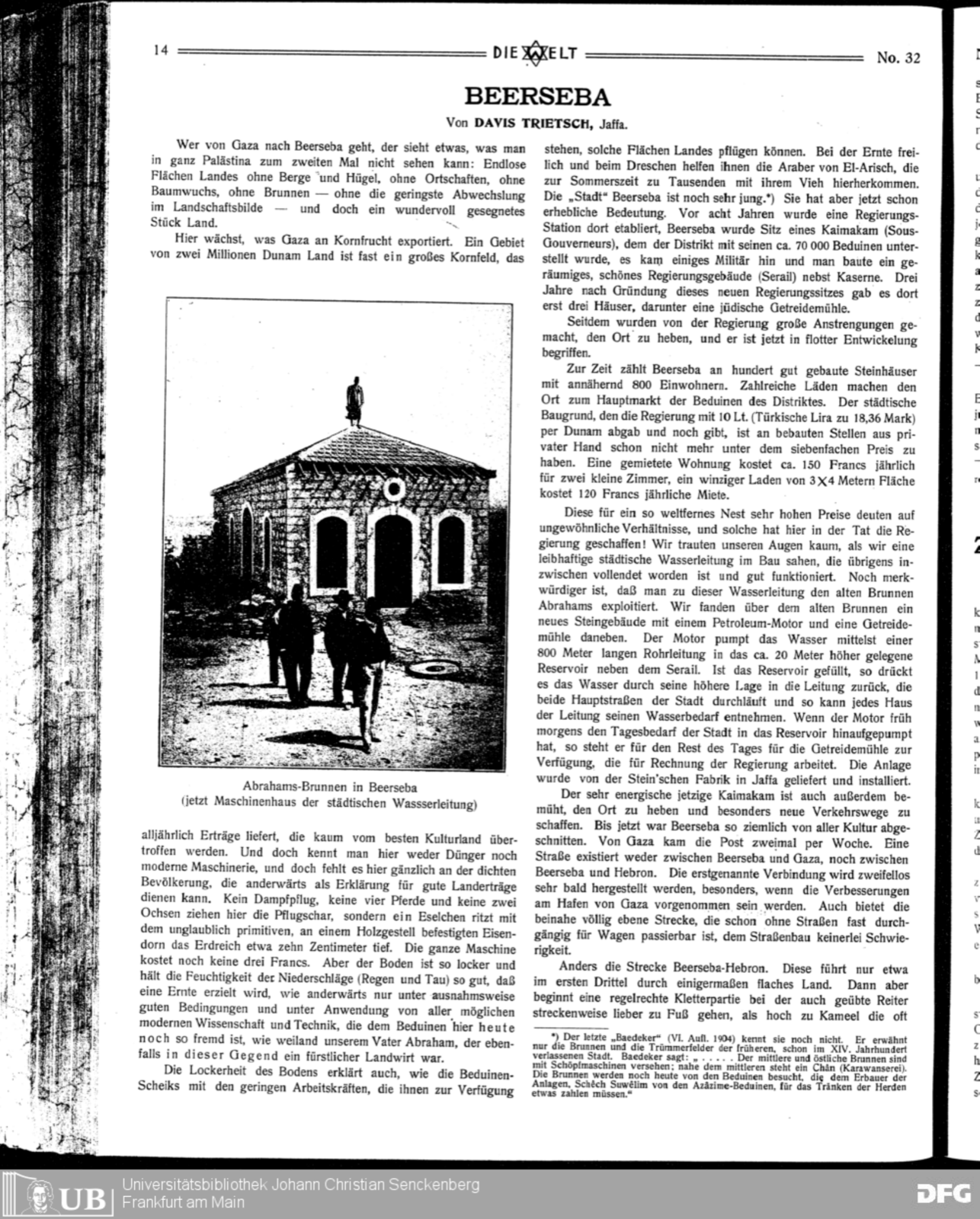
Abraham's Well at Beersheba (now the engine-house of the municipal water-works)
yields every year returns hardly surpassed by the best cultivated land. And yet neither manure nor modern machinery is known here, and yet there is entirely lacking here the dense population which elsewhere may serve as an explanation for good yields of the land. No steam-plough, no four horses and no two oxen draw the ploughshare here; instead a little donkey scratches the soil some ten centimetres deep with the incredibly primitive iron spike fastened to a wooden frame. The whole machine costs not even three francs. But the soil is so loose, and holds the moisture of the precipitation (rain and dew) so well, that a harvest is obtained such as elsewhere only under exceptionally good conditions and with the application of every possible modern science and technique, which is still as strange to the Bedouin here to-day as it was of old to our father Abraham, who likewise was a princely husbandman in this region.
The looseness of the soil also explains how the Bedouin sheikhs, with the small labour forces at their disposal, can plough such stretches of land. At the harvest, to be sure, and at the threshing they are helped by the Arabs of El-Arish, who come here in their thousands with their cattle in the summer season. The "town" of Beersheba is still very young.*) But it already has considerable importance. Eight years ago a Government station was established there; Beersheba became the seat of a Kaimakam (sous-gouverneur), to whom the district with its some 70 000 Bedouins was made subject; some soldiery came there, and a spacious, handsome Government building (Serail) was built, together with barracks. Three years after the founding of this new seat of government there were only three houses there, among them a Jewish corn-mill.
Since then great efforts have been made by the Government to raise the place, and it is now in brisk development.
At present Beersheba numbers some hundred well-built stone houses with nearly 800 inhabitants. Numerous shops make the place the chief market of the Bedouins of the district. The urban building-ground, which the Government gave out and still gives out at 10 Lt. (Turkish lira at 18,36 marks) per dunam, is already no longer to be had from private hands at built-up spots under seven times that price. A rented dwelling costs about 150 francs yearly for two small rooms; a tiny shop of 3X4 metres floor-space costs 120 francs yearly rent.
These prices, very high for so remote a nest, point to unusual conditions, and such conditions the Government has in fact created here! We could scarcely trust our eyes when we saw a veritable municipal water-supply under construction, which, by the way, has since been completed and works well. More remarkable still is that the old well of Abraham is exploited for this water-supply. Over the old well we found a new stone building with a petroleum motor, and a corn-mill beside it. The motor pumps the water by means of a pipe-line 800 metres long into the reservoir, lying about 20 metres higher, beside the Serail. When the reservoir is filled, it forces the water by its higher position back into the main, which runs through both chief streets of the town, and so every house can draw its water from the main. When the motor has pumped the town's daily requirement up into the reservoir early in the morning, it is available for the rest of the day for the corn-mill, which works for the account of the Government. The plant was supplied and installed by Stein's factory in Jaffa.
The very energetic present Kaimakam is moreover endeavouring to raise the place and especially to create new routes of communication. Until now Beersheba was pretty well cut off from all civilisation. The post came from Gaza twice a week. A road exists neither between Beersheba and Gaza nor between Beersheba and Hebron. The first-named connection will doubtless be made very soon, especially when the improvements to the harbour of Gaza have been carried out. Moreover, the almost entirely level stretch, which even without roads is passable for carriages almost throughout, offers no difficulty whatever to road-building.
It is otherwise with the stretch Beersheba–Hebron. This leads through tolerably flat country only for about the first third. But then begins a regular piece of climbing, in which even practised riders in places prefer to go on foot rather than, high upon the camel, the often
*) The latest "Baedeker" (6th ed. 1904) does not yet know it. It mentions only the wells and the fields of ruins of the former town, which was already abandoned in the 14th century. Baedeker says: "..... The middle and the eastern well are provided with drawing-machines; near the middle one stands a Chân (caravanserai). The wells are still visited to-day by the Bedouins, who must pay something for the watering of their herds to the builder of the works, Schêch Suwêlim of the Azâzime Bedouins."