No. 31 — "Die Welt" — 9
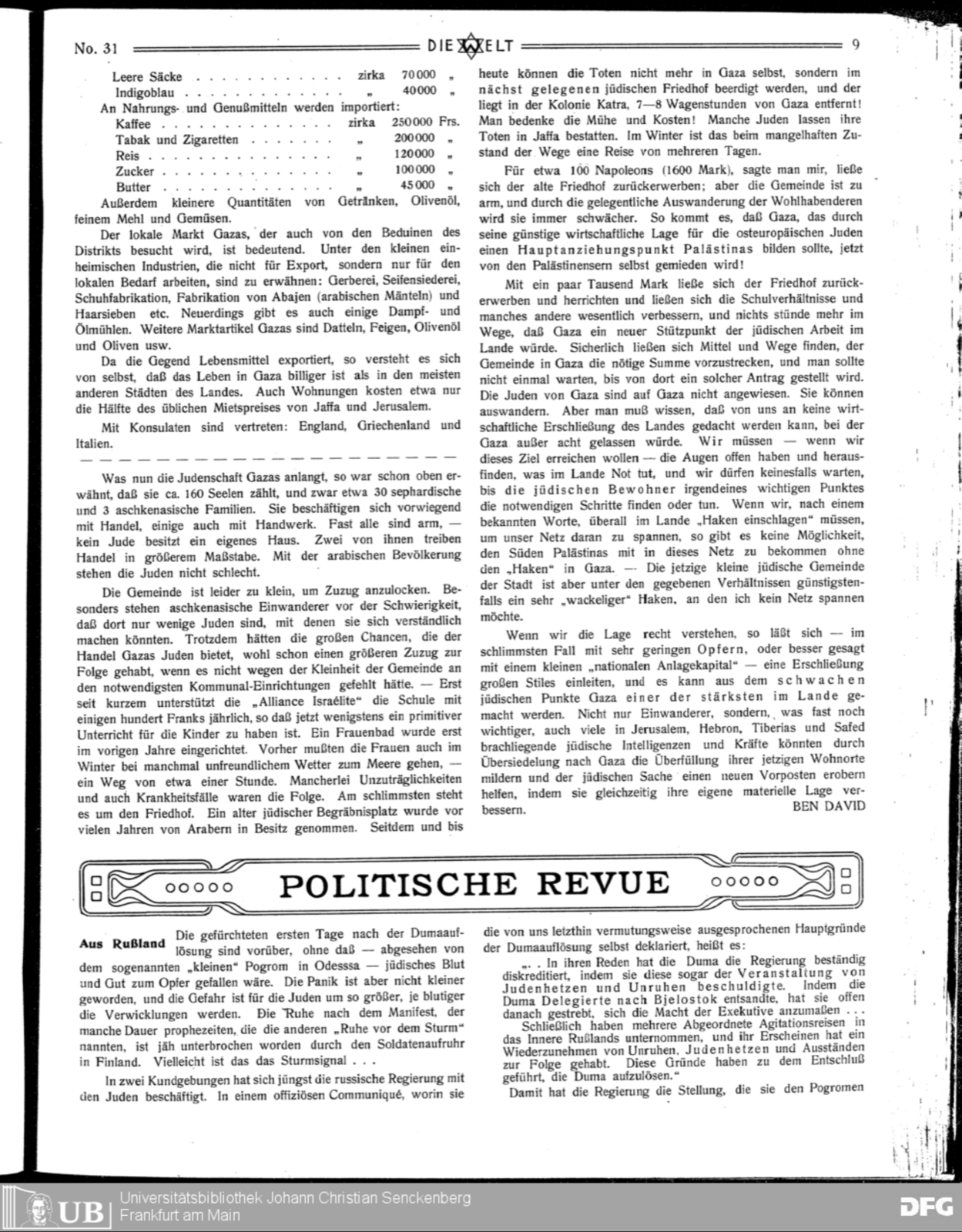
Empty sacks . . . . . . . . . . . about 70 000 "
Indigo blue . . . . . . . . . . . . " 40 000 "
Of foodstuffs and luxuries there are imported:
Coffee . . . . . . . . . . . . . about 250 000 Frs.
Tobacco and cigarettes . . . . . . . " 200 000 "
Rice . . . . . . . . . . . . . . " 120 000 "
Sugar . . . . . . . . . . . . . " 100 000 "
Butter . . . . . . . . . . . . . " 45 000 "
Besides these, smaller quantities of beverages, olive oil, fine flour and vegetables.
The local market of Gaza, which is also frequented by the Bedouins of the district, is considerable. Among the small native industries, which work not for export but only for local needs, are to be mentioned: tanning, soap-boiling, the making of shoes, the making of abajes (Arab cloaks) and hair-sieves, etc. Lately there are also a few steam- and oil-mills. Further market articles of Gaza are dates, figs, olive oil and olives, etc.
Since the district exports provisions, it goes without saying that living in Gaza is cheaper than in most other towns of the country. Dwellings, too, cost only about half the usual rent of Jaffa and Jerusalem.
Consulates are maintained by: England, Greece and Italy.
——
As regards the Jewry of Gaza, it has already been mentioned above that it numbers about 160 souls, namely some 30 Sephardi and 3 Ashkenazi families. They are occupied chiefly in trade, some also in handicrafts. Almost all are poor, — no Jew owns a house of his own. Two of them carry on trade on a larger scale. The Jews are on no bad terms with the Arab population.
The community is unfortunately too small to attract new settlers. Ashkenazi immigrants especially few before the difficulty that there are only few Jews there with whom they could make themselves understood. Nevertheless, the great chances which the trade of Gaza offers to Jews would probably have brought about a larger influx long ago, had there not been a want, owing to the smallness of the community, of the most necessary communal institutions. — Only recently has the "Alliance Israélite" been supporting the school with a few hundred francs a year, so that now at least a primitive instruction is to be had for the children. A women's bath was set up only last year. Before that the women had to go to the sea even in winter, in weather sometimes inclement, — a walk of about an hour. Sundry inconveniences, and cases of illness too, were the consequence. Worst of all is the state of the cemetery. An old Jewish burial-ground was taken possession of by Arabs many years ago. Since then and to this day the dead can no longer be buried in Gaza itself, but in the nearest Jewish cemetery, and that lies in the colony Katra, 7—8 hours by carriage from Gaza! Consider the trouble and cost! Some Jews have their dead buried in Jaffa. In winter, with the defective state of the roads, that is a journey of several days.
For some 100 Napoleons (1600 marks), I was told, the old cemetery could be bought back; but the community is too poor, and through the occasional emigration of the better-off it grows ever weaker. So it comes about that Gaza, which by its favourable economic position ought to form one of the chief points of attraction in Palestine for the Jews of Eastern Europe, is now shunned by the Palestinians themselves!
With a few thousand marks the cemetery could be bought back and put in order, and the school conditions and much else could be substantially improved, and nothing would then stand in the way of Gaza becoming a new base for Jewish work in the land. Surely ways and means could be found of advancing the necessary sum to the community in Gaza, and one ought not even to wait until such a request is made from there. The Jews of Gaza are not dependent on Gaza. They can emigrate. But it must be understood that no economic opening-up of the country can be contemplated on our part in which Gaza would be left out of account. We must — if we wish to attain this goal — keep our eyes open and find out what the country needs, and we must on no account wait until the Jewish inhabitants of some important point find or take the necessary steps. If, according to a well-known saying, we must "drive in hooks" everywhere in the land in order to stretch our net upon them, then there is no possibility of bringing the south of Palestine into this net without the "hook" in Gaza. — But the present small Jewish community of the town is, under the existing circumstances, at best a very "shaky" hook, on which I should not care to stretch a net.
If we rightly understand the situation, then — in the worst case with very slight sacrifices, or better said with a small "national investment capital" — an opening-up on a grand scale can be initiated, and out of the weak Jewish point Gaza one of the strongest in the land can be made. Not only immigrants, but, what is almost more important, many Jewish intellects and energies now lying fallow in Jerusalem, Hebron, Tiberias and Safed could, by removing to Gaza, relieve the overcrowding of their present places of residence and help to win a new outpost for the Jewish cause, while at the same time bettering their own material position.
BEN DAVID
POLITICAL REVIEW
From Russia The dreaded first days after the dissolution of the Duma are past without — apart from the so-called "little" pogrom in Odesssa — Jewish blood and property having fallen victim. The panic, however, has not grown less, and the danger for the Jews is the greater the bloodier the complications become. The calm after the Manifesto, to which some prophesied duration and which others called "the calm before the storm," has been abruptly broken by the mutiny of the soldiers in Finland. Perhaps that is the storm signal . . .
In two pronouncements the Russian Government has lately occupied itself with the Jews. In a semi-official communiqué, in which it itself declares the chief reasons for the dissolution of the Duma which we recently put forward by way of conjecture, it says:
". . In its speeches the Duma has constantly discredited the Government, even accusing it of instigating Jew-baiting and disturbances. By sending delegates to Bjelostok, the Duma openly strove to arrogate to itself the power of the executive . . .
Finally, several deputies undertook agitation tours into the interior of Russia, and their appearance has had as its consequence a renewal of disturbances, Jew-baiting and strikes. These reasons have led to the resolution to dissolve the Duma."
With this the Government has the position which it, the pogroms