8 — "Die Welt" — No. 31
"Why are we in Golus? Are we not ourselves to blame for it?" But no answer came.
I went on: "If you are old, Rabbi, and can and should no longer work, you have, after all, a young son; he can take your place, — and if not he, then others can surely fill the place."
The old man looked at me with dull, expressionless eyes and made no answer.
And I continued:
"If the head and chief of the Jews does nothing for the people, what can the other Jews do?"
And again the old man stammered:
"We are in Golus, we are in Golus!" Another answer I did not get from him.
That was the fourth guardian — the Jewish . . .
(Translated from the Russian Zionist weekly "Kadinnah").
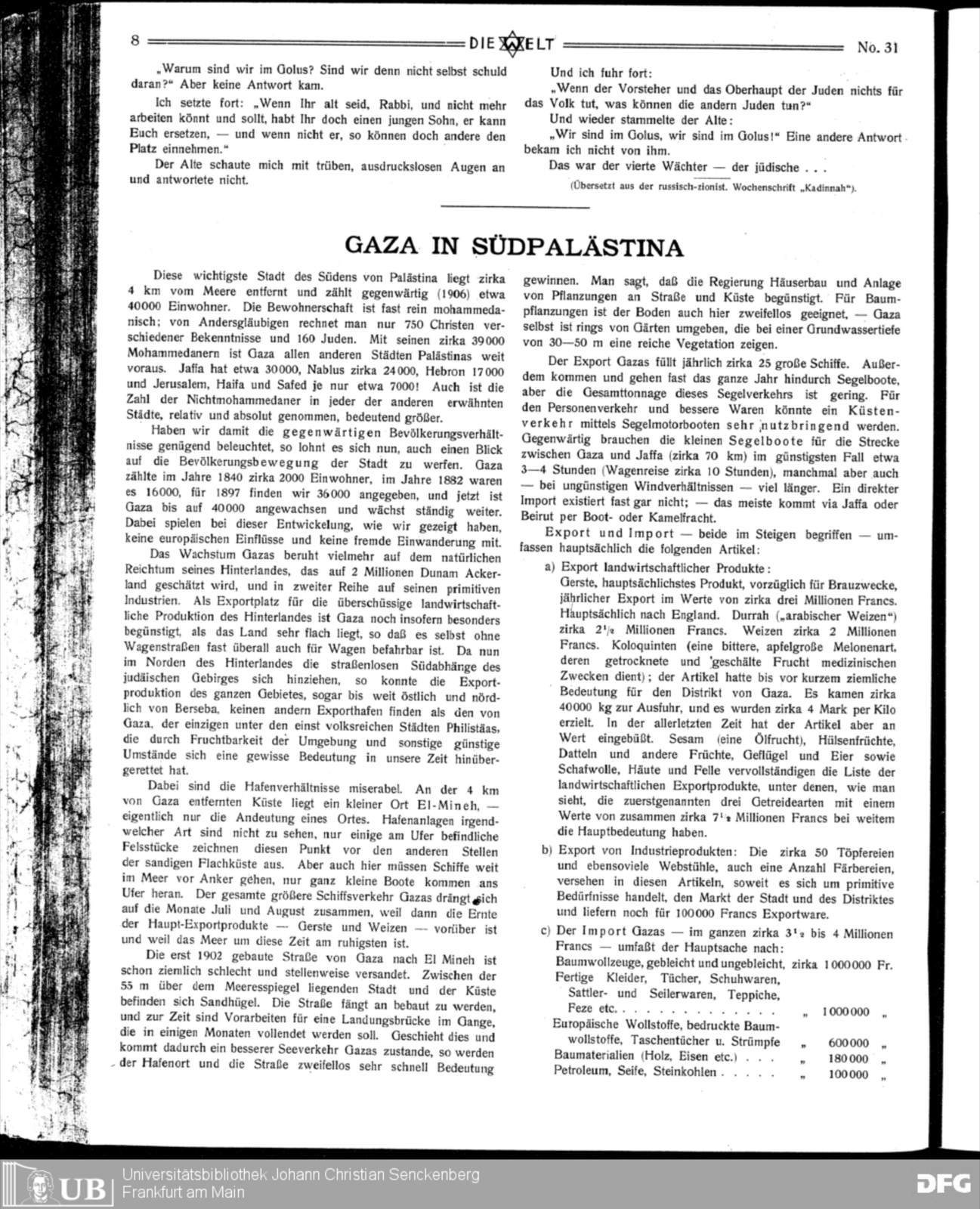
GAZA IN SOUTHERN PALESTINE
This, the most important town of the south of Palestine, lies about 4 km from the sea and numbers at present (1906) some 40000 inhabitants. The population is almost purely Mohammedan; of those of other faiths there are reckoned only 750 Christians of various confessions and 160 Jews. With its approximately 39000 Mohammedans Gaza is far ahead of all the other towns of Palestine. Jaffa has some 30000, Nablus about 24000, Hebron 17000, and Jerusalem, Haifa and Safed only some 7000 each! The number of non-Mohammedans, too, is considerably greater in each of the other towns mentioned, taken both relatively and absolutely.
Having thus sufficiently illuminated the present conditions of population, it is worth while now to cast a glance also at the movement of the town's population. Gaza numbered about 2000 inhabitants in the year 1840; in the year 1882 there were 16000; for 1897 we find 36000 given; and now Gaza has grown to 40000 and is growing steadily further. And in this development, as we have shown, no European influences and no foreign immigration play any part.
The growth of Gaza rests rather upon the natural wealth of its hinterland, which is estimated at 2 million dunam of arable land, and in the second place upon its primitive industries. As an export place for the surplus agricultural production of the hinterland, Gaza is further especially favoured inasmuch as the land lies very flat, so that even without carriage-roads it is passable almost everywhere for wagons as well. Since, moreover, the roadless southern slopes of the Judaean hills extend along the north of the hinterland, the export production of the whole territory, even as far as well to the east and north of Beersheba, could find no other port of export than that of Gaza, the only one among the once populous cities of Philistia which, through the fertility of its surroundings and other favourable circumstances, has carried a certain importance over into our own time.
Yet the harbour conditions are wretched. On the coast, 4 km distant from Gaza, lies a small place, El-Mineh, — in truth only the suggestion of a place. Harbour works of any kind are not to be seen; only a few pieces of rock lying on the shore distinguish this point from the other spots of the sandy, flat coast. But here too ships must anchor far out at sea; only quite small boats come in to the shore. The whole of Gaza's larger shipping traffic is crowded into the months of July and August, because the harvest of the chief export products — barley and wheat — is then over, and because the sea is calmest at that season.
The road from Gaza to El Mineh, built only in 1902, is already rather bad and in places choked with sand. Between the town, which lies 55 m above sea-level, and the coast there are sand-hills. The road is beginning to be built up, and at present preliminary works are in progress for a landing-pier, which is to be completed in a few months. Should this come about, and a better sea traffic for Gaza result from it, the harbour place and the road will without doubt very quickly gain in importance. It is said that the Government favours the building of houses and the laying out of plantations along the road and the coast. For tree-planting the soil here too is without doubt suitable, — Gaza itself is surrounded on all sides by gardens which, with a ground-water depth of 30—50 m, display a rich vegetation.
Gaza's export fills about 25 large ships yearly. Besides these, sailing-boats come and go almost the whole year through, but the total tonnage of this sailing traffic is small. For passenger traffic and better-class goods a coastal service by means of motor sailing-boats might prove very profitable. At present the small sailing-boats need, in the most favourable case, some 3—4 hours for the distance between Gaza and Jaffa (about 70 km) (journey by carriage about 10 hours), but sometimes — with unfavourable winds — much longer. A direct import scarcely exists at all; — most comes via Jaffa or Beirut by boat or camel freight.
Export and import — both on the increase — comprise chiefly the following articles:
-
a) Export of agricultural products: Barley, the chief product, excellent for brewing purposes, yearly export to the value of about three million francs. Chiefly to England. Durrah ("Arabian wheat") about 2 1/2 million francs. Wheat about 2 million francs. Colocynths (a bitter kind of melon the size of an apple, whose dried and peeled fruit serves medicinal purposes); until recently the article was of considerable importance for the district of Gaza. Some 40000 kg were exported, and about 4 marks per kilo were obtained. Very lately, however, the article has lost in value. Sesame (an oil-fruit), pulse, dates and other fruits, poultry and eggs, as well as sheep's wool, hides and skins, complete the list of agricultural export products, among which, as may be seen, the three kinds of grain first named, with a value together of about 7 1/2 million francs, are by far the most important.
-
b) Export of industrial products: The approximately 50 potteries and as many looms, as well as a number of dye-works, supply the market of the town and district in these articles, so far as primitive needs are concerned, and furnish besides 100000 francs' worth of goods for export.
-
c) The import of Gaza — in all about 3 1/2 to 4 million francs — comprises in the main: Cotton cloths, bleached and unbleached, about 1000000 Fr. Ready-made clothes, cloths, footwear, saddlery and rope goods, carpets, fezzes etc. . . . . . . . . . . . . " 1000000 " European woollen stuffs, printed cotton stuffs, handkerchiefs and stockings " 600000 " Building materials (timber, iron etc.) . . . " 180000 " Petroleum, soap, coal . . . . . " 100000 "