Page 10. — "Die Welt" — No. 30.
It will therefore no doubt be worth while to throw a little light upon these strangely obscure conditions.*)
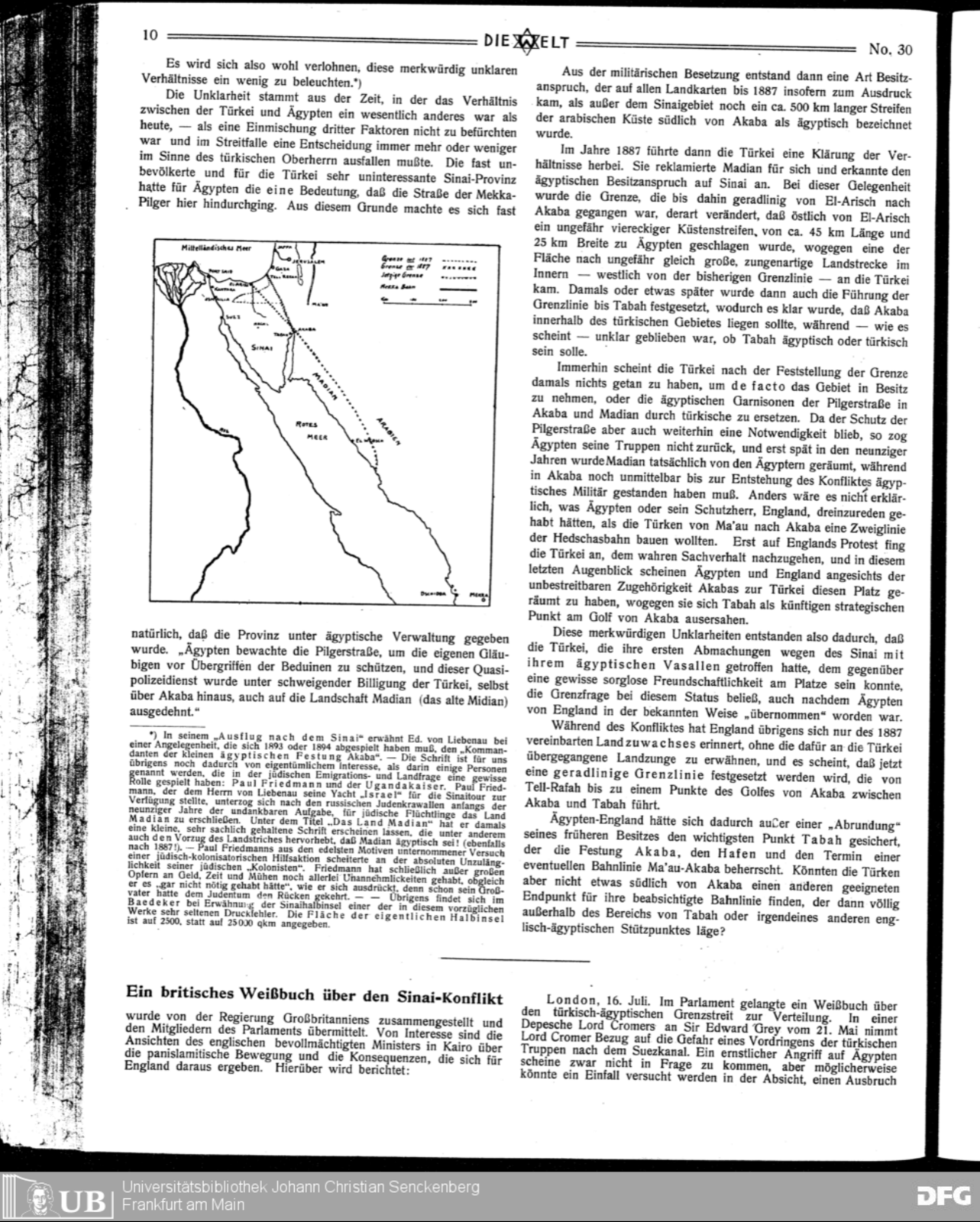
The obscurity dates from the time when the relation between Turkey and Egypt was essentially different from what it is to-day, — when the interference of third parties was not to be feared, and in case of dispute a decision was always bound to fall out more or less in the sense of the Turkish suzerain. The almost unpeopled Sinai Province, of very little interest to Turkey, had for Egypt the one significance that the road of the Mecca pilgrims passed through it. For this reason it came about almost
[Map of the Sinai region with legend]
naturally that the province was placed under Egyptian administration. "Egypt guarded the pilgrim road in order to protect its own faithful from encroachments by the Bedouins, and this quasi-police service was extended, with the tacit approval of Turkey, even beyond Akaba, to the district of Madian (the ancient Midian) as well."
*) In his "Excursion to Sinai," Ed. von Liebenau, in connection with an affair which must have taken place in 1893 or 1894, mentions the "commandant of the little Egyptian fortress of Akaba." — The work is, moreover, of peculiar interest to us in that it names several persons who have played a certain part in the Jewish emigration and land question: Paul Friedmann and the Uganda Emperor. Paul Friedmann, who placed his yacht "Israel" at Herr von Liebenau's disposal for the Sinai tour, undertook, after the Russian anti-Jewish riots at the beginning of the nineties, the thankless task of opening up the land of Madian for Jewish refugees. Under the title "The Land of Madian" he published at that time a small, very matter-of-fact pamphlet, which among other things also emphasizes the advantage of the region that Madian was Egyptian! (likewise after 1887!). — Paul Friedmann's attempt at a Jewish colonizing relief action, undertaken from the noblest motives, was wrecked on the absolute inadequacy of his Jewish "colonists." In the end Friedmann had, besides great sacrifices of money, time and trouble, all manner of unpleasantnesses as well, although he "would not have needed to at all," as he puts it, for even his grandfather had turned his back on Judaism. — — Incidentally, in Baedeker's mention of the Sinai Peninsula there occurs one of the misprints that are very rare in that excellent work. The area of the peninsula proper is given as 2500 instead of 25000 sq. km.
Out of the military occupation there then arose a kind of claim to possession, which found expression on all maps up to 1887 in that, besides the Sinai territory, a strip of the Arabian coast some 500 km long, south of Akaba, was also marked as Egyptian.
In the year 1887 Turkey then brought about a clarification of the situation. She claimed Madian for herself and recognized the Egyptian claim to Sinai. On this occasion the boundary, which until then had run in a straight line from El-Arish to Akaba, was so altered that east of El-Arish a roughly quadrangular coastal strip, about 45 km long and 25 km wide, was added to Egypt, whereas a tongue-like stretch of land in the interior, of roughly equal area — west of the former boundary line — went to Turkey. At that time, or somewhat later, the course of the boundary line as far as Tabah was also fixed, whereby it became clear that Akaba was to lie within Turkish territory, while — as it seems — it had remained unclear whether Tabah was to be Egyptian or Turkish.
At all events, Turkey seems at that time, after the fixing of the boundary, to have done nothing to take possession of the territory de facto, or to replace the Egyptian garrisons of the pilgrim road at Akaba and in Madian with Turkish ones. But since the protection of the pilgrim road remained a necessity thereafter as well, Egypt did not withdraw her troops, and only late in the nineties was Madian actually evacuated by the Egyptians, while at Akaba Egyptian soldiery must have been stationed right up to the outbreak of the conflict. Otherwise it would be inexplicable what say Egypt, or her protector England, could have had in the matter when the Turks wished to build a branch line of the Hedjaz Railway from Ma'au to Akaba. Only upon England's protest did Turkey begin to look into the true state of affairs, and at this last moment Egypt and England seem, in view of the indisputable appurtenance of Akaba to Turkey, to have evacuated that place, whereas they selected Tabah as a future strategic point on the Gulf of Akaba.
These strange obscurities thus arose from the fact that Turkey, which had made her first arrangements regarding Sinai with her Egyptian vassal, towards whom a certain careless friendliness might well be in place, left the boundary question in this state even after Egypt had been "taken over" by England in the well-known manner.
During the conflict, moreover, England remembered only the accession of territory agreed upon in 1887, without mentioning the tongue of land that had passed to Turkey in exchange for it, and it seems that a straight boundary line will now be fixed, running from Tell-Rafah to a point on the Gulf of Akaba between Akaba and Tabah.
Egypt-England would thereby have secured, besides a "rounding-off" of its former possession, the all-important point of Tabah, which commands the fortress of Akaba, the harbour and the terminus of an eventual railway line Ma'au-Akaba. But could the Turks not find, somewhat south of Akaba, another suitable terminal point for their projected railway line, which would then lie entirely outside the range of Tabah or of any other Anglo-Egyptian base?
A British White Book on the Sinai Conflict
has been compiled by the Government of Great Britain and transmitted to the members of Parliament. Of interest are the views of the English Minister Plenipotentiary in Cairo on the Pan-Islamic movement and the consequences arising from it for England. On this the following is reported:
London, 16 July. A White Book on the Turco-Egyptian boundary dispute was distributed in Parliament. In a dispatch from Lord Cromer to Sir Edward Grey of 21 May, Lord Cromer refers to the danger of an advance of the Turkish troops towards the Suez Canal. A serious attack upon Egypt did not, indeed, seem to come into question, but possibly an incursion might be attempted with the intention that an outbreak