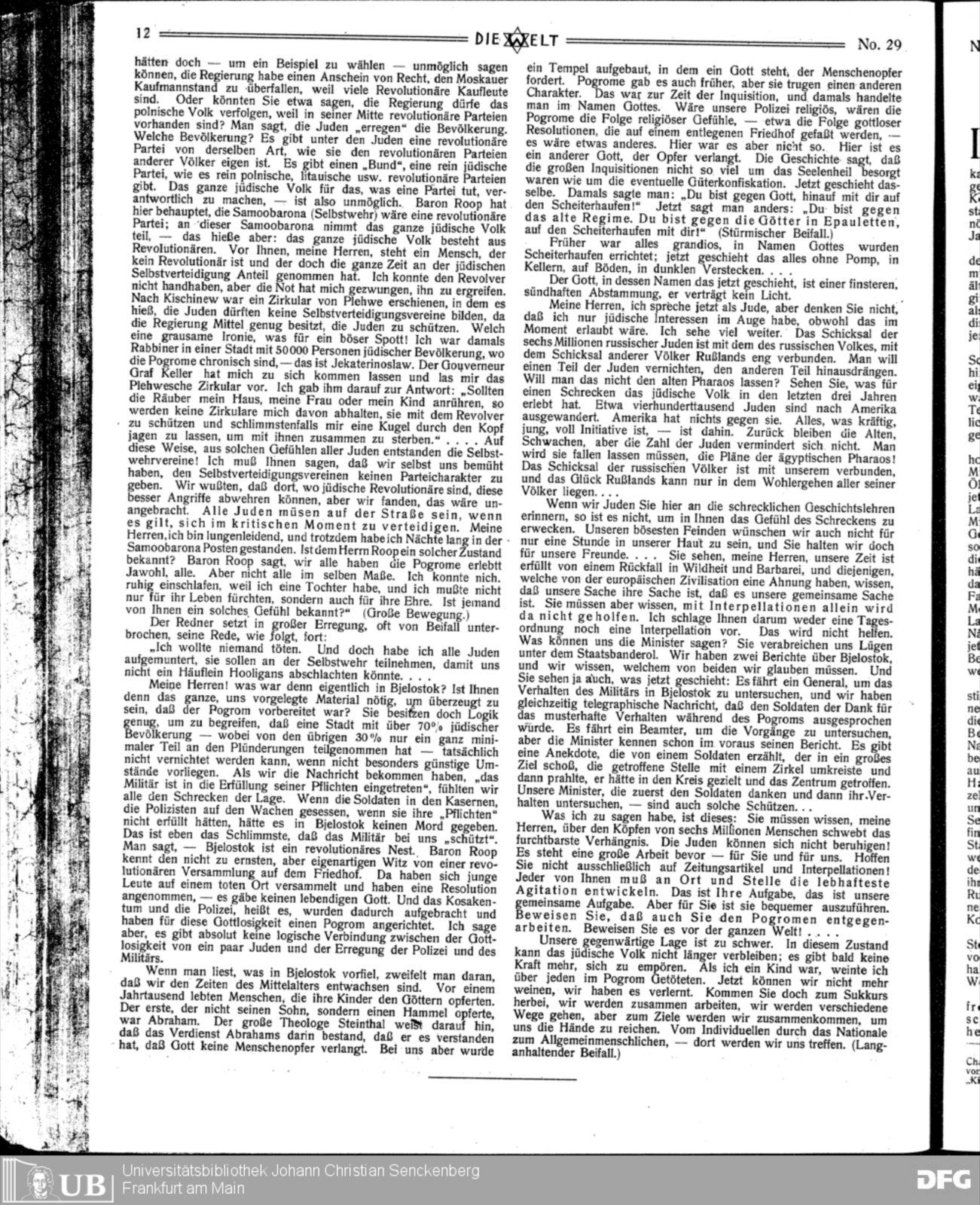
Page 12. — "Die Welt" — No. 29.
(continued from page 11)
...could surely not — to choose an example — possibly have said that the Government had a semblance of right to fall upon the merchant class of Moscow because many revolutionaries are merchants. Or could you perhaps say that the Government may persecute the Polish people because revolutionary parties exist in its midst? It is said that the Jews "excite" the population. Which population? There is among the Jews a revolutionary party of the same kind as is proper to the revolutionary parties of other peoples. There is a "Bund," a purely Jewish party, just as there are purely Polish, Lithuanian, etc., revolutionary parties. To make the whole Jewish people responsible for what one party does, — is therefore impossible. Baron Roop has asserted here that the Samoobarona (self-defence) is a revolutionary party; the whole Jewish people takes part in this Samoobarona, — but that would mean: the whole Jewish people consists of revolutionaries. Before you, gentlemen, stands a man who is no revolutionary and who has nevertheless taken part the whole time in the Jewish self-defence. I could not handle a revolver, but necessity compelled me to take it up. After Kishineff a circular of Plehve's appeared, in which it was said that the Jews might not form self-defence societies, since the Government possessed means enough to protect the Jews. What cruel irony, what wicked mockery! I was at that time Rabbi in a town with a Jewish population of 50,000 persons, where pogroms are chronic, — that is Ekaterinoslav. The Governor, Count Keller, sent for me and read me Plehve's circular. I gave him this answer: "Should the robbers touch my house, my wife or my child, no circulars will keep me from protecting them with the revolver and, at the worst, from having a bullet sent through my head, so as to die together with them." . . . In this way, out of such feelings of all Jews, the self-defence societies arose! I must tell you that we ourselves have endeavoured not to give the self-defence societies a party character. We knew that where there are Jewish revolutionaries, these can better ward off attacks, but we found that this would be unfitting. All Jews must be in the street when it is a question of defending themselves at the critical moment. Gentlemen, I suffer from my lungs, and in spite of that I have stood sentry for nights together in the Samoobarona. Is Herr Roop acquainted with such a state of things? Baron Roop says we have all lived through the pogroms. Yes indeed, all. But not all in the same measure. I could not fall asleep in peace, because I have a daughter, and I had to fear not only for her life, but also for her honour. Is such a feeling known to any one of you?" (Great sensation.)
The speaker, in great agitation and often interrupted by applause, continues his speech as follows:
"I did not wish to kill anyone. And yet I encouraged all Jews to take part in the self-defence, so that a handful of hooligans might not be able to slaughter us. . . .
Gentlemen! what, then, really happened in Bjelostok? Do you really need all the material laid before us in order to be convinced that the pogrom was prepared? You surely possess logic enough to grasp that a town with over 70% Jewish population — of the remaining 30% only a quite minimal part having taken part in the plundering — cannot in fact be destroyed unless especially favourable circumstances are present. When we received the news, "the military has entered upon the fulfilment of its duties," we all felt the horror of the situation. Had the soldiers sat in their barracks and the policemen at their stations, had they not fulfilled their "duties," there would have been no murder in Bjelostok. That is just the worst of it, that with us the military "protects." It is said, — Bjelostok is a revolutionary nest. Baron Roop knows the not over-serious but peculiar joke about a revolutionary meeting in the cemetery. Young people had gathered in a place of the dead and passed a resolution, — that there was no living God. And the Cossacks and the police, it is said, were enraged by this and made a pogrom for this godlessness. But I say there is absolutely no logical connection between the godlessness of a couple of Jews and the excitement of the police and the military.
When one reads what took place in Bjelostok, one doubts whether we have outgrown the times of the Middle Ages. A thousand years ago there lived men who sacrificed their children to the gods. The first who sacrificed not his son but a ram was Abraham. The great theologian Steinthol points out that the merit of Abraham lay in his having understood that God demands no human sacrifices. But with us a temple has been built in which there stands a god who demands human sacrifices. There were pogroms in earlier times too, but they bore a different character. That was at the time of the Inquisition, and then men acted in the name of God. Were our police religious, were the pogroms the result of religious feelings, — the result, say, of godless resolutions passed in a remote cemetery, — it would be something different. But here it was not so. Here it is another god that demands sacrifices. History tells us that the great Inquisitions were not so much concerned for the salvation of souls as for the possible confiscation of goods. The same thing is happening now. Then men said: "Thou art against God, up with thee on to the stake!" Now they say otherwise: "Thou art against the old régime. Thou art against the gods in epaulettes, on to the stake with thee!" (Stormy applause.)
Formerly everything was on a grand scale; in the name of God stakes were erected; now it all happens without pomp, in cellars, in garrets, in dark hiding-places. . . .
The god in whose name this now happens is of a dark and sinful descent; he cannot bear the light.
Gentlemen, I am speaking now as a Jew, but do not think that I have only Jewish interests in view, although at this moment that would be permissible. I see much further. The fate of the six million Russian Jews is closely bound up with that of the Russian people, with the fate of the other peoples of Russia. They wish to destroy one part of the Jews and to drive out the other part. Will they not leave that to the old Pharaohs? See what terror the Jewish people has lived through in the last three years. Some four hundred thousand Jews have emigrated to America. America has nothing against them. All that is strong, young, full of initiative, — is gone. Those who remain behind are the old and the weak, but the number of the Jews does not diminish. They will have to let them drop, these plans of the Egyptian Pharaohs! The fate of the Russian peoples is bound up with ours, and the happiness of Russia can lie only in the well-being of all its peoples. . . .
If we Jews here remind you of the terrible lessons of history, it is not in order to awaken in you the feeling of horror. We do not wish even our worst enemies to be in our skin for so much as an hour, and you, after all, we hold to be our friends. . . . You see, gentlemen, our time is filled with a relapse into savagery and barbarism, and those who have any notion of European civilization know that our cause is their cause, that it is our common cause. But you must know that interpellations alone will be of no help here. I therefore propose to you neither an order of the day nor an interpellation. That will not help. What can the Ministers tell us? They dispense lies to us under the State's revenue seal. We have two reports on Bjelostok, and we know which of the two we must believe. And you see, too, what is happening now: a General travels to investigate the conduct of the military in Bjelostok, and at the same time we have telegraphic news that thanks have been expressed to the soldiers for their exemplary conduct during the pogrom. An official travels to investigate the occurrences, but the Ministers already know his report in advance. There is an anecdote told of a soldier who shot at a large target, drew a circle with a pair of compasses round the spot he had hit, and then boasted that he had aimed at the circle and hit the centre. Our Ministers, who first thank the soldiers and then investigate their conduct, — are marksmen of the same sort. . .
What I have to say is this: you must know, gentlemen, that over the heads of six million human beings hangs the most fearful doom. The Jews cannot be at rest! A great work lies ahead — for you and for us. Do not put your hope exclusively in newspaper articles and interpellations! Each of you must develop the liveliest agitation on the spot. That is your task, that is our common task. But for you it is easier to carry out. Prove that you too work against the pogroms. Prove it before the whole world! . . .
Our present situation is too hard. The Jewish people cannot remain any longer in this condition; soon there will be no strength left even to revolt. When I was a child, I wept over every one killed in a pogrom. Now we can weep no more; we have forgotten how. Come, then, to our succour; we shall work together; we shall go different ways, but at the goal we shall come together to give one another our hands. From the individual through the national to the universally human, — there we shall meet. (Prolonged applause.)