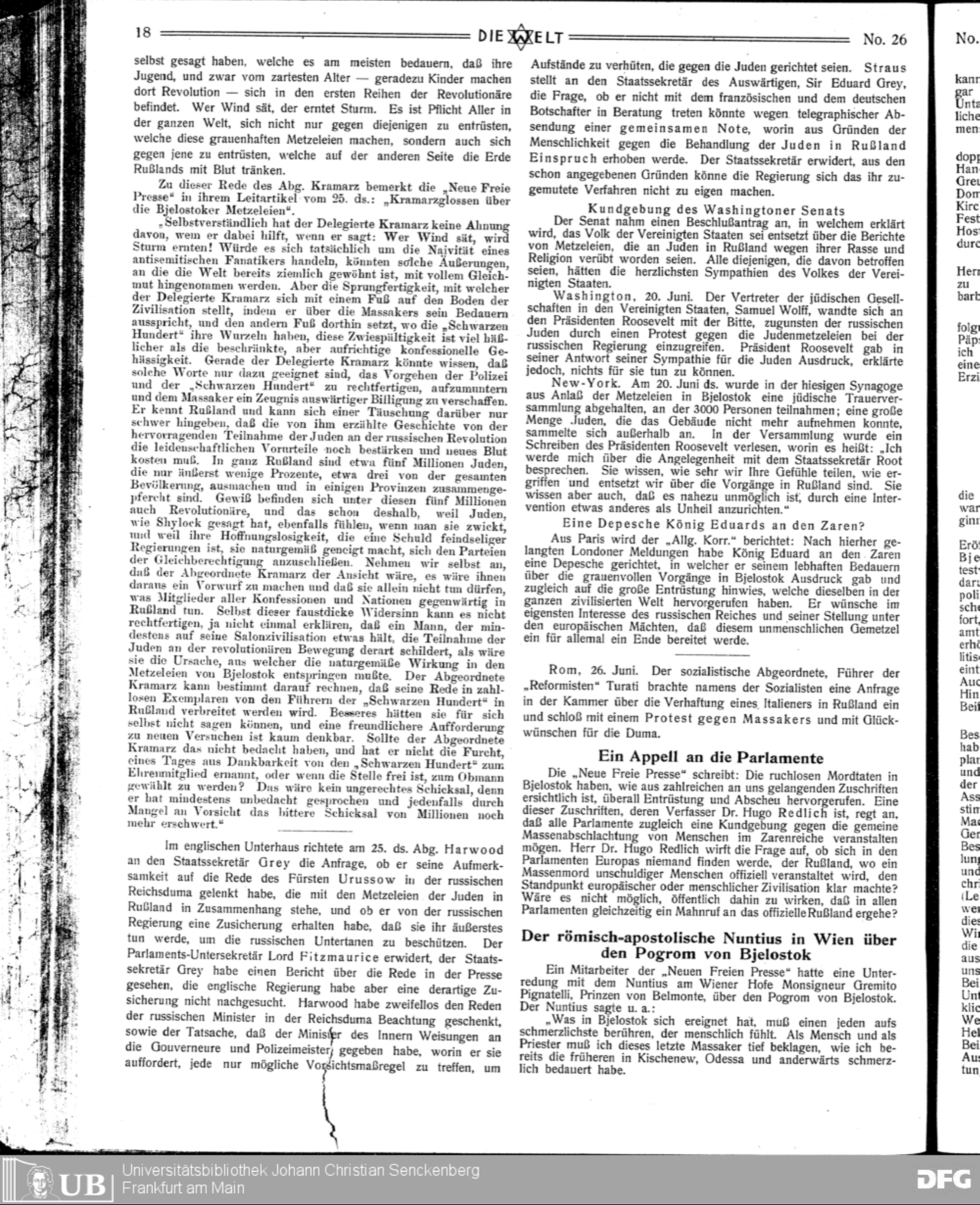
Page 18. — "Die Welt" — No. 26.
(continued from page 17)
…have themselves said, men who most regret that their youth, and that from the tenderest age — positively children are making revolution there — is to be found in the front ranks of the revolutionaries. He who sows the wind reaps the storm. It is the duty of all throughout the whole world to be indignant not only at those who perpetrate these horrible massacres, but also to be indignant at those who on the other side soak the soil of Russia with blood.
On this speech of Deputy Kramarz the "Neue Freie Presse" remarks in its leading article of the 25th inst.: "Kramarz's Glosses on the Bjelostok Massacres".
"Of course Delegate Kramarz has no notion whom he is helping when he says: He who sows the wind shall reap the storm! Were it really a matter of the naïveté of an antisemitic fanatic, such utterances, to which the world is by now fairly accustomed, could be accepted with complete equanimity. But the agility with which Delegate Kramarz plants one foot on the ground of civilisation, by expressing his regret over the massacres, and sets the other foot where the 'Black Hundreds' have their roots — this duplicity is far uglier than narrow but sincere confessional hatred. Delegate Kramarz, of all men, might know that such words are suited only to justify and encourage the proceedings of the police and of the 'Black Hundreds,' and to procure for the massacre a testimony of foreign approval. He knows Russia, and can hardly deceive himself as to the fact that the story he has told of the prominent participation of the Jews in the Russian revolution must further strengthen passionate prejudices and cost fresh blood. In the whole of Russia there are some five million Jews, who make up only an extremely small percentage, about three, of the total population, and are penned together in a few provinces. Certainly among these five millions there are also revolutionaries, and that if only because Jews, as Shylock said, also feel when they are pinched, and because their hopelessness, which is the fault of hostile governments, naturally inclines them to join the parties of equal rights. Let us even suppose that Deputy Kramarz were of the opinion that this is to be made a reproach to them, and that they alone may not do what members of all confessions and nations are at present doing in Russia. Even this gross absurdity cannot justify, nay, cannot even explain, that a man who sets at least some store by his drawing-room civilisation should describe the participation of the Jews in the revolutionary movement as though it were the cause from which the natural effect had to spring in the massacres of Bjelostok. Deputy Kramarz may count with certainty upon his speech being distributed in countless copies by the leaders of the 'Black Hundreds' in Russia. They could not have said anything better for themselves, and a friendlier invitation to fresh attempts is scarcely conceivable. Should Deputy Kramarz not have considered this, and has he no fear of being one day appointed, out of gratitude, an honorary member of the 'Black Hundreds,' or, if the post is vacant, elected their chairman? That would be no unjust fate, for he has at the least spoken thoughtlessly, and at all events, through want of caution, made the bitter fate of millions still harder."
In the English House of Commons on the 25th inst., Mr. Harwood asked Secretary of State Grey whether he had turned his attention to the speech of Prince Urussow in the Russian Imperial Duma relating to the massacres of the Jews in Russia, and whether he had received an assurance from the Russian Government that it would do its utmost to protect Russian subjects. The Parliamentary Under-Secretary, Lord Fitzmaurice, replies that Secretary of State Grey had seen a report of the speech in the press, but the English Government had not sought any such assurance. Harwood had no doubt paid attention to the speeches of the Russian Ministers in the Imperial Duma, as well as to the fact that the Minister of the Interior had issued instructions to the governors and chiefs of police in which he called upon them to take every possible precaution to prevent risings directed against the Jews. Straus asks the Secretary of State for Foreign Affairs, Sir Edward Grey, whether he could not enter into consultation with the French and the German Ambassadors with a view to the telegraphic dispatch of a joint note in which, on grounds of humanity, protest would be raised against the treatment of the Jews in Russia. The Secretary of State replies that, for the reasons already given, the Government could not adopt the course proposed to it.
Manifestation of the Washington Senate
The Senate adopted a resolution in which it is declared that the people of the United States is horrified at the reports of massacres perpetrated upon Jews in Russia on account of their race and religion. All those affected thereby have the heartiest sympathies of the people of the United States.
Washington, June 20. The representative of the Jewish societies in the United States, Samuel Wolff, applied to President Roosevelt with the request that he intervene on behalf of the Russian Jews by a protest to the Russian Government against the massacres of Jews. President Roosevelt in his reply gave expression to his sympathy for the Jews, but declared that he could do nothing for them.
New-York, On the 20th of June inst. a Jewish mourning assembly was held in the synagogue here on the occasion of the massacres in Bjelostok, in which 3000 persons took part; a great crowd of Jews, whom the building could no longer hold, gathered outside. At the assembly a letter of President Roosevelt was read, in which it is said: "I shall confer on the matter with Secretary of State Root. You know how deeply we share your feelings, how moved and horrified we are at the occurrences in Russia. But you know also that it is well-nigh impossible to accomplish anything but mischief by an intervention."
A Telegram from King Edward to the Tsar?
From Paris the "Allg. Korr." reports: According to London advices received here, King Edward is said to have addressed a telegram to the Tsar, in which he gave expression to his lively regret at the horrible occurrences in Bjelostok, and at the same time pointed to the great indignation which these have called forth in the whole civilised world. He wished, in the very own interest of the Russian Empire and of its position among the European Powers, that an end be put once and for all to this inhuman butchery.
Rome, June 26. The Socialist deputy Turati, leader of the "Reformists," brought in an interpellation in the Chamber in the name of the Socialists concerning the arrest of an Italian in Russia, and concluded with a protest against massacres and with congratulations to the Duma.
An Appeal to the Parliaments
The "Neue Freie Presse" writes: The infamous murders in Bjelostok have, as is evident from numerous letters reaching us, everywhere called forth indignation and abhorrence. One of these letters, whose writer is Dr. Hugo Redlich, suggests that all parliaments should simultaneously organise a manifestation against the base mass slaughter of human beings in the Empire of the Tsar. Dr. Hugo Redlich raises the question whether no one will be found in the parliaments of Europe to make clear to Russia, where a mass murder of innocent people is officially organised, the standpoint of European or human civilisation? Would it not be possible to work publicly to the end that a call of admonition should go forth simultaneously in all parliaments to official Russia?
The Roman Apostolic Nuncio in Vienna on the Pogrom of Bjelostok
A contributor to the "Neue Freie Presse" had an interview with the Nuncio at the Court of Vienna, Monsigneur Gremito Pignatelli, Prince of Belmonte, on the pogrom of Bjelostok. The Nuncio said, among other things:
"What has happened in Bjelostok must touch most painfully everyone who has human feeling. As a man and as a priest I must deeply deplore this latest massacre, as I have already painfully regretted the earlier ones in Kishineff, Odessa and elsewhere.