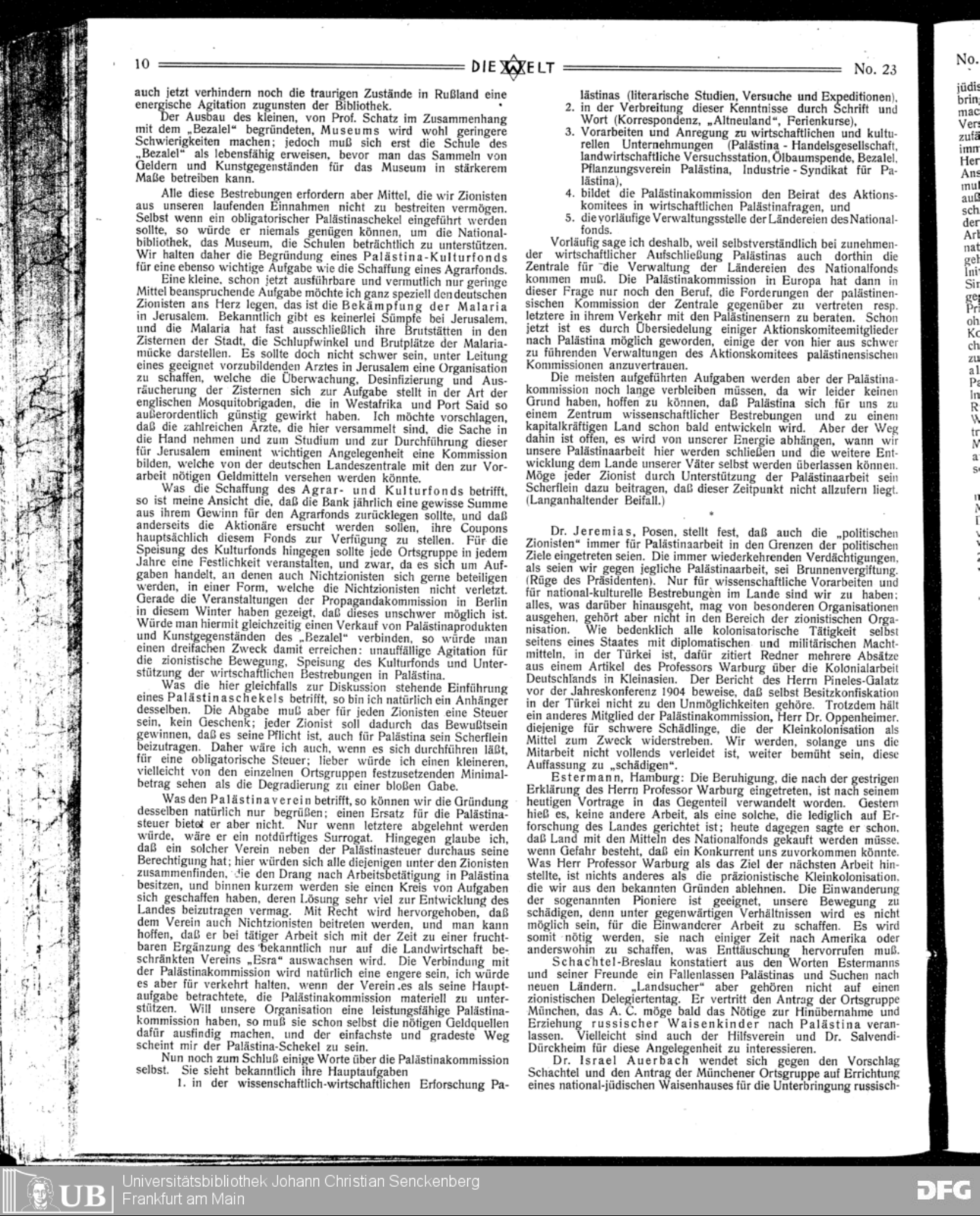
Page 10. — "Die Welt" — No. 23.
(continued from page 9)
…even now the sad conditions in Russia still prevent an energetic agitation on behalf of the Library.
The extension of the small museum founded by Prof. Schatz in connection with the "Bezalel" will probably cause fewer difficulties; but the school of the "Bezalel" must first prove itself viable before the collecting of money and works of art for the museum can be pursued on a larger scale.
All these endeavours, however, require means which we Zionists are unable to defray from our current revenues. Even if an obligatory Palestine shekel should be introduced, it could never suffice to give considerable support to the National Library, the museum and the schools. We therefore regard the founding of a Palestine Cultural Fund as a task quite as important as the creation of an Agrarian Fund.
One small task, practicable even now and presumably requiring only slight means, I should like to commend most particularly to the German Zionists: that is, the combating of malaria in Jerusalem. As is well known, there are no swamps whatever near Jerusalem, and malaria has its breeding-places almost exclusively in the cisterns of the city, which form the lurking-places and breeding-grounds of the malaria mosquito. It ought surely not to be difficult to create in Jerusalem, under the direction of a suitably trained physician, an organisation that should make it its task to supervise, disinfect and fumigate the cisterns, after the manner of the English mosquito brigades, which have had so extraordinarily beneficial an effect in West Africa and Port Said. I should like to propose that the numerous physicians assembled here take the matter in hand and form a commission for the study and carrying out of this matter, so eminently important for Jerusalem, which might be furnished by the German Federation with the funds necessary for the preliminary work.
As regards the creation of the Agrarian and Cultural Funds, my view is that the Bank should set aside a certain sum from its profits every year for the Agrarian Fund, and that, on the other hand, the shareholders should be requested to place their coupons chiefly at the disposal of this Fund. For the feeding of the Cultural Fund, on the other hand, every local group should arrange a festivity every year, and indeed — since it is a question of tasks in which non-Zionists too will gladly take part — in a form that does not offend non-Zionists. Precisely the functions arranged by the Propaganda Commission in Berlin this winter have shown that this is easily possible. If at the same time a sale of Palestine products and of works of art of the "Bezalel" were combined with this, a threefold purpose would be achieved: unobtrusive agitation for the Zionist movement, the feeding of the Cultural Fund, and support of the economic endeavours in Palestine.
As regards the introduction of a Palestine shekel, which is likewise under discussion here, I am naturally an adherent of it. But the levy must be a tax for every Zionist, not a gift; every Zionist is to gain thereby the consciousness that it is his duty to contribute his mite for Palestine as well. I should therefore also be in favour, if it can be carried out, of an obligatory tax; I would rather see a smaller minimum amount, perhaps to be fixed by the individual local groups, than its degradation to a mere gift.
As regards the Palestine Society, we can naturally only welcome its founding; but it offers no substitute for the Palestine tax. Only if the latter were to be rejected would it be a makeshift surrogate. On the other hand, I believe that such a society fully has its justification alongside the Palestine tax; here all those among the Zionists who feel the urge to active work in Palestine would come together, and within a short time they will have created for themselves a range of tasks whose solution may contribute a great deal to the development of the country. It is rightly emphasised that non-Zionists too will join the society, and one may hope that, by active work, it will in time grow into a fruitful complement to the "Esra" society, which, as is well known, is confined to agriculture alone. Its connection with the Palestine Commission will naturally be a closer one, but I should consider it wrong if the society regarded it as its chief task to support the Palestine Commission materially. If our organisation wishes to have an efficient Palestine Commission, it must itself find out the necessary sources of money for it, and the simplest and most direct way seems to me to be the Palestine shekel.
Now, in conclusion, a few words about the Palestine Commission itself. As is well known, it sees its chief tasks
-
in the scientific and economic exploration of Palestine (literary studies, experiments and expeditions),
-
in the dissemination of this knowledge by pen and word (correspondence, "Altneuland," holiday courses),
-
preliminary work and the stimulation of economic and cultural enterprises (Palestine Trading Company, agricultural experiment station, olive-tree donation, Bezalel, the planting society Palestine, Industrial Syndicate for Palestine),
-
the Palestine Commission forms the advisory council of the Actions Committee in economic questions concerning Palestine, and
-
the provisional administrative office for the lands of the National Fund.
I say provisional because, as a matter of course, with the increasing economic opening-up of Palestine, the centre for the administration of the lands of the National Fund must also move there. The Palestine Commission in Europe will then have in this question only the function of representing the demands of the Palestinian commission before the Centre, or of advising the latter in its dealings with the Palestinians. Already now, through the removal of some members of the Actions Committee to Palestine, it has become possible to entrust to Palestinian commissions some of the Actions Committee's administrative affairs that are difficult to conduct from here.
Most of the tasks enumerated, however, will have to remain with the Palestine Commission for a long time yet, since we unfortunately have no reason to be able to hope that Palestine will soon develop, for us, into a centre of scientific endeavour and into a country strong in capital. But the way thither is open; it will depend on our energy when we shall be able to close our Palestine work here and leave its further development to the land of our fathers itself. May every Zionist, by supporting the work for Palestine, contribute his mite to bringing it about that this moment may not be too far distant. (Long-continued applause.)
* * *
Dr. Jeremias, Posen, states that the "political Zionists" too have always stood for work in Palestine within the limits of the political aims. The constantly recurring insinuations that we are against all work in Palestine are a poisoning of the wells. (Reprimand from the President.) We are in favour only of scientific preliminary work and of national-cultural endeavours in the country: everything that goes beyond this may proceed from special organisations, but does not belong within the province of the Zionist Organisation. As to how hazardous all colonising activity in Turkey is, even on the part of a State with diplomatic and military means of power, the speaker quotes several paragraphs from an article by Professor Warburg on Germany's colonial work in Asia Minor. The report of Mr. Pineles-Galatz before the Annual Conference of 1904 proves that even the confiscation of property in Turkey is not among the impossibilities. Nevertheless, another member of the Palestine Commission, Dr. Oppenheimer, regards as grave noxious elements those who oppose small colonisation as a means to the end. So long as co-operation is not utterly spoiled for us, we shall continue to endeavour to "injure" this view.
Estermann, Hamburg: The reassurance that set in after yesterday's declaration by Professor Warburg has been turned into its opposite after his lecture to-day. Yesterday it was said: no other work than such as is directed solely to the exploration of the country; to-day, on the other hand, he already said that land must be bought with the means of the National Fund if there is danger that a competitor might forestall us. What Professor Warburg set up as the aim of the immediate work is nothing other than the pre-Zionist small colonisation, which we reject for the well-known reasons. The immigration of the so-called pioneers is calculated to harm our movement, for under present conditions it will not be possible to create work for the immigrants. It will thus become necessary, after some time, to send them to America or elsewhere, which must produce disappointment.
Schachtel-Breslau infers from the words of Estermann and his friends an abandonment of Palestine and a search for new countries. "Land-seekers," however, do not belong at a Zionist Delegates' Conference. He supports the motion of the Munich local group that the A. C. should soon take the necessary steps for the transfer of Russian orphan children to Palestine and their education there. Perhaps the Hilfsverein and Dr. Salvendi-Dürkheim might also be interested in this matter.
Dr. Israel Auerbach opposes Schachtel's proposal and the motion of the Munich local group for the establishment of a national-Jewish orphanage for the accommodation of Russian-