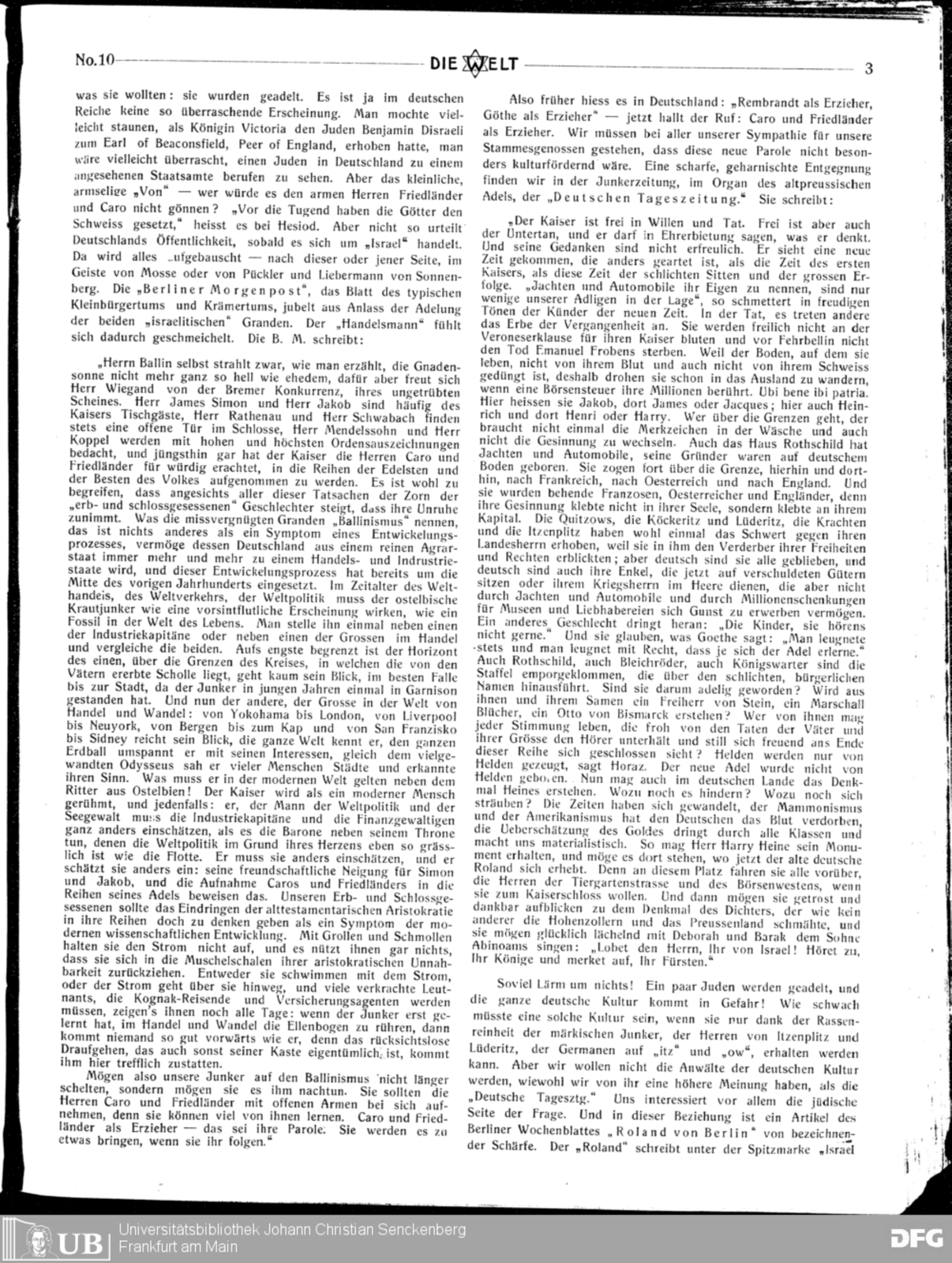
"Die Welt" — No. 10 — 3
(continued from page 2)
… what they wanted: they were ennobled. It is, after all, no such surprising phenomenon in the German Empire. One might perhaps have marvelled when Queen Victoria raised the Jew Benjamin Disraeli to be Earl of Beaconsfield, Peer of England; one would perhaps be surprised to see a Jew in Germany called to a respected office of State. But the petty, paltry "Von" — who would grudge it to the poor gentlemen Friedländer and Caro? "Before virtue the gods have set sweat," says Hesiod. But not so judges the public of Germany as soon as "Israel" is concerned. Then everything is blown up — in this direction or in that, in the spirit of Mosse or of Pückler and Liebermann von Sonnenberg. The "Berliner Morgenpost," the organ of the typical petty bourgeoisie and shopkeeperdom, rejoices on the occasion of the ennoblement of the two "Israelite" grandees. The "tradesman" feels himself flattered by it. The B. M. writes:
"Upon Herr Ballin himself, it is said, the sun of favour no longer shines quite so brightly as of old; but in its stead Herr Wiegand, of the Bremen competition, rejoices in its unclouded radiance. Herr James Simon and Herr Jakob are frequently the Emperor's guests at table, Herr Rathenau and Herr Schwabach always find an open door at the Palace, Herr Mendelssohn and Herr Koppel are favoured with high and the highest decorations, and lately the Emperor has even deemed Herren Caro and Friedländer worthy to be received into the ranks of the noblest and best of the people. It is easy to understand that in view of all these facts the wrath of the 'hereditary and castle-seated' families is rising, that their disquiet is increasing. What the disgruntled grandees call 'Ballinism' is nothing other than a symptom of a process of development by virtue of which Germany is becoming more and more, from a purely agrarian State, a commercial and industrial State; and this process of development had already begun about the middle of the last century. In the age of world trade, world traffic, world politics, the cabbage-squire from east of the Elbe must appear like an antediluvian phenomenon, like a fossil in the world of the living. Set him once beside one of the captains of industry or beside one of the great men of commerce, and compare the two. Narrowly bounded is the horizon of the one; his gaze scarcely goes beyond the bounds of the district in which lies the soil inherited from his fathers — at best as far as the town where the squire once stood in garrison in his young days. And now the other, the great man in the world of trade and traffic: from Yokohama to London, from Liverpool to New York, from Bergen to the Cape and from San Francisco to Sidney his gaze extends; he knows the whole world, he spans the whole globe with his interests; like the much-travelled Odysseus he has seen the cities of many men and learned their mind. What must he count for in the modern world beside the knight from east of the Elbe! The Emperor is extolled as a modern man, and in any case he, the man of world politics and of sea power, must rate the captains of industry and the lords of finance quite otherwise than do the barons beside his throne, to whom world politics is at the bottom of their hearts just as abhorrent as the fleet. He must rate them otherwise, and he does rate them otherwise: his friendly inclination towards Simon and Jakob, and the reception of Caro and Friedländer into the ranks of his nobility, prove it. Our hereditary and castle-seated gentry ought surely to take thought at this intrusion of the Old Testament aristocracy into their ranks, as a symptom of modern scientific development. With grumbling and sulking they will not stem the current, and it avails them nothing to withdraw into the shells of their aristocratic unapproachableness. Either they swim with the current, or the current passes over them; and many a broken-down lieutenant who has had to become a cognac traveller or an insurance agent shows them every day: once the squire has learned to use his elbows in trade and traffic, no one gets on so well as he, for the reckless dash which is in other respects peculiar to his caste stands him here in excellent stead.
"Let our squires, then, no longer rail at Ballinism, but let them imitate it. They should receive Herren Caro and Friedländer among them with open arms, for they can learn much from them. Caro and Friedländer as Educators — let that be their watchword. They will make something of themselves if they follow it."
So formerly the cry in Germany was: "Rembrandt as Educator, Göthe as Educator" — now the call resounds: Caro and Friedländer as Educators. We must confess, for all our sympathy with our kinsmen, that this new watchword would not be especially conducive to culture. A sharp, mailed rejoinder we find in the squires' paper, the organ of the old Prussian nobility, the "Deutsche Tageszeitung." It writes:
"The Emperor is free in will and deed. But free also is the subject, and he may say with reverence what he thinks. And his thoughts are not cheerful. He sees a new time come, of another nature than the time of the first Emperor, than that time of simple manners and of great successes. 'Only a few of our nobles are in a position to call yachts and automobiles their own' — so the herald of the new time trumpets forth in joyful tones. In truth, others are entering upon the heritage of the past. They, to be sure, will not bleed for their Emperor at the Veronese Klause, nor die the death of Emanuel Froben before Fehrbellin. Because the soil on which they live is not manured with their blood, nor yet with their sweat, they threaten forthwith to emigrate abroad when a Bourse tax touches their millions. Ubi bene ibi patria. Here they are called Jakob, there James or Jacques; here, too, Heinrich, and there Henri or Harry. He who goes over the frontier need not even change the marks in his linen, nor yet his sentiments. The House of Rothschild, too, has yachts and automobiles; its founders were born on German soil. They went away over the frontier, hither and thither, to France, to Austria and to England. And they became nimble Frenchmen, Austrians and Englishmen, for their sentiment did not cleave to their soul, but cleaved to their capital. The Quitzows, the Köckeritz and Lüderitz, the Krachten and the Itzenplitz did indeed once raise the sword against their sovereign, because they saw in him the destroyer of their liberties and rights; but German they all remained, and German too are their grandsons, who now sit upon mortgaged estates or serve their war-lord in the army, but who are not able to win favour by yachts and automobiles and by gifts of millions for museums and hobbies. Another race is pressing on: 'The children, they do not like to hear it.' And they believe what Goethe says: 'It was ever denied, and rightly denied, that nobility can ever be learned.' Rothschild, too, Bleichröder, too, Königswarter, too, have climbed the step that leads beyond the plain, burgher name. Have they therefore become noble? Will there arise from them and their seed a Freiherr von Stein, a Marshal Blücher, an Otto von Bismarck? Which of them may live in that mood which gladly entertains the hearer with the deeds of the fathers and their greatness, and, silently rejoicing, sees himself closing the end of this line? Heroes are begotten only by heroes, says Horace. The new nobility was not born of heroes. Now let the monument to Heine arise in the German land too. Why hinder it any longer? Why resist any longer? The times have changed; Mammonism and Americanism have corrupted the blood of the Germans; the over-valuation of gold penetrates all classes and makes us materialistic. So let Herr Harry Heine receive his monument, and may it stand where the old German Roland now rises. For past this spot they all drive, the gentlemen of the Tiergartenstrasse and of the Bourse West End, when they are bound for the Imperial Palace. And then let them look up, confident and grateful, at the monument of the poet who reviled the Hohenzollerns and the land of Prussia as no other did, and let them, smiling happily, sing with Deborah and Barak the son of Abinoam: 'Praise ye the Lord, ye of Israel! Hear, O ye kings, and give ear, O ye princes.'"
Much ado about nothing! A few Jews are ennobled, and the whole of German culture is put in jeopardy! How weak such a culture would have to be, if it could be preserved only thanks to the racial purity of the squires of the Mark, of the Herren von Itzenplitz and Lüderitz, the Teutons in "itz" and "ow." But we do not wish to become the advocates of German culture, although we hold a higher opinion of it than the "Deutsche Tagesztg." What interests us above all is the Jewish side of the question. And in this respect an article in the Berlin weekly "Roland von Berlin" is of characteristic sharpness. The "Roland" writes under the heading "Israel