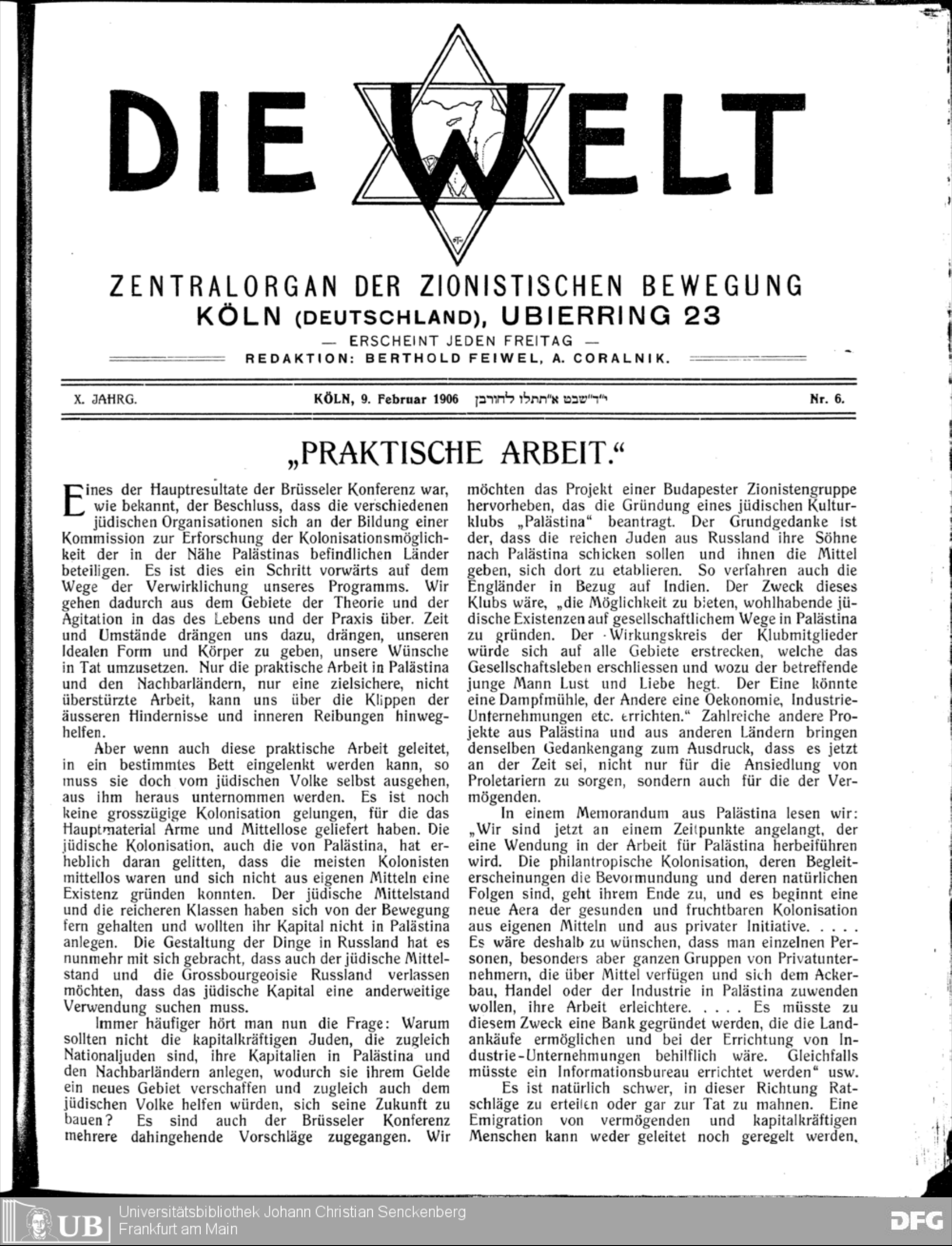
DIE WELT
CENTRAL ORGAN OF THE ZIONIST MOVEMENT
COLOGNE (GERMANY), UBIERRING 23
— PUBLISHED EVERY FRIDAY —
EDITORS: BERTHOLD FEIWEL, A. CORALNIK.
Vol. X | COLOGNE, 9 February 1906 י"ד שבט א'תתלו לחורבן | No. 6.
"PRACTICAL WORK."
One of the chief results of the Brussels Conference was, as is known, the resolution that the various Jewish organisations should take part in forming a commission to investigate the possibility of colonising the lands lying in the neighbourhood of Palestine. This is a step forward on the road to the realisation of our programme. By it we pass from the domain of theory and agitation into that of life and practice. Time and circumstance press us to it; they press us to give form and body to our ideals, to turn our wishes into deeds. Only practical work in Palestine and the neighbouring lands, only work that is sure of its aim and not precipitate, can carry us past the rocks of outward obstacles and inward frictions.
But although this practical work can be guided and turned into a definite channel, it must nevertheless proceed from the Jewish people itself and be undertaken from within it. No colonisation on a large scale has ever yet succeeded for which the poor and the destitute have furnished the chief material. Jewish colonisation, that of Palestine included, has suffered considerably from the fact that most of the colonists were without means and could not found an existence out of their own resources. The Jewish middle class and the wealthier classes have held aloof from the movement and were unwilling to invest their capital in Palestine. The course of affairs in Russia has now brought it about that the Jewish middle class and the upper bourgeoisie, too, would leave Russia, and that Jewish capital must seek some other employment.
The question is now heard ever more frequently: Why should not the Jews of large capital, who are at the same time national Jews, invest their capital in Palestine and the neighbouring lands, thereby opening a new field to their money and at the same time helping the Jewish people to build its future? Several proposals to this effect were also laid before the Brussels Conference. We would single out the project of a Budapest Zionist group, which proposes the founding of a Jewish cultural club, "Palestine." Its leading idea is that the rich Jews of Russia should send their sons to Palestine and give them the means to establish themselves there. The English proceed in just this way with regard to India. The purpose of this club would be "to afford the possibility of founding prosperous Jewish livelihoods in Palestine by social means. The sphere of activity of the members of the club would extend to every field which social life opens up and for which the young man in question has inclination and love. One might set up a steam mill, another a farm, industrial undertakings, etc." Numerous other projects from Palestine and from other countries give expression to the same line of thought: that the time has now come to provide not only for the settlement of proletarians but also for that of the well-to-do.
In a memorandum from Palestine we read: "We have now arrived at a moment which will bring about a turn in the work for Palestine. Philanthropic colonisation, whose attendant phenomena are tutelage and its natural consequences, is drawing to its end, and a new era is beginning of sound and fruitful colonisation out of private means and on private initiative. . . . It would therefore be desirable that the work of individual persons, but above all of whole groups of private entrepreneurs who possess means and wish to turn to agriculture, trade or industry in Palestine, should be made easier. . . . To this end a bank would have to be founded which would make the purchase of land possible and would lend assistance in the establishment of industrial undertakings. Likewise an information bureau would have to be set up," etc.
It is naturally difficult to give advice in this direction, or still more to exhort to action. An emigration of people of property and of large capital can be neither guided nor regulated,