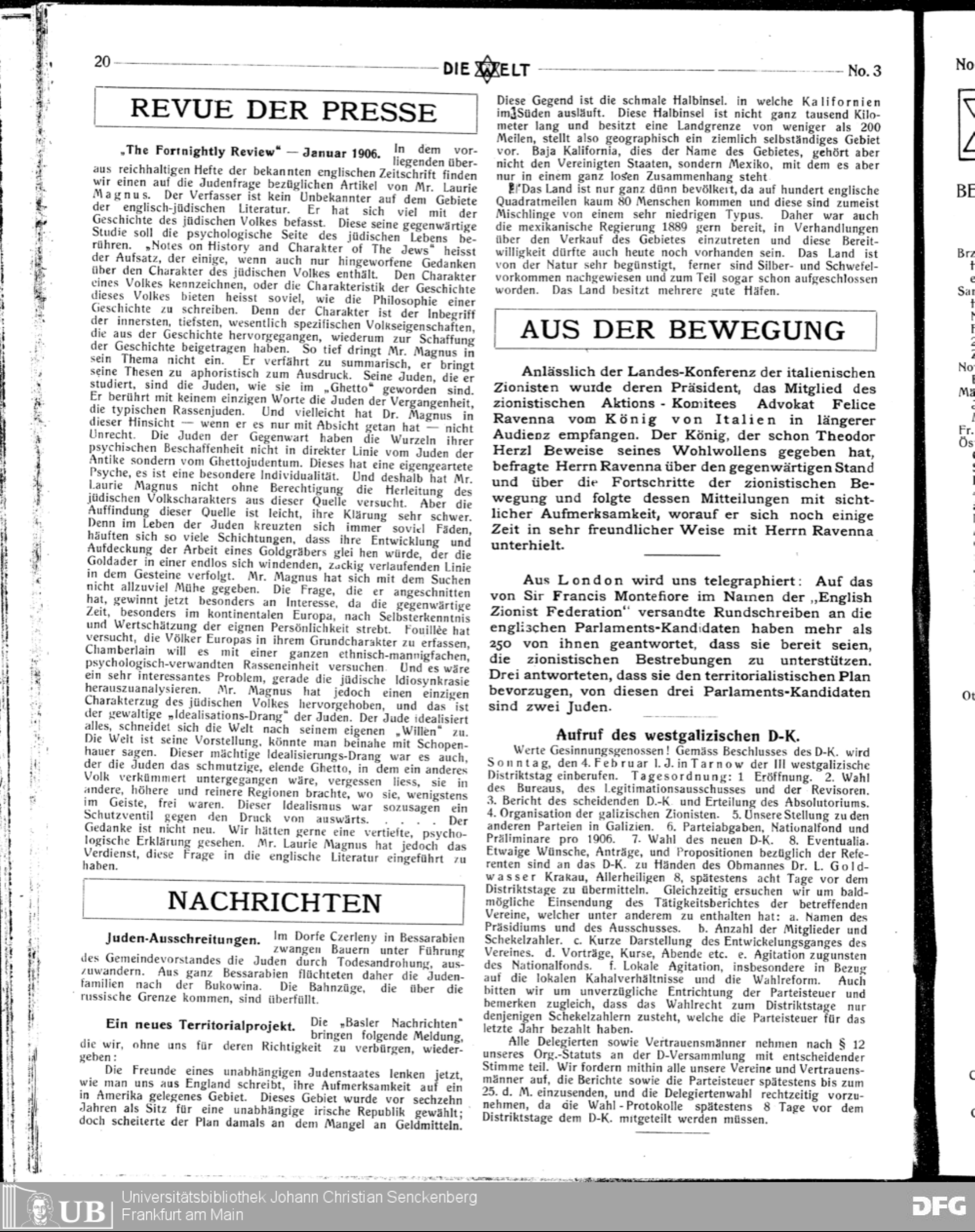
"Die Welt" — No. 3 — 20
REVIEW OF THE PRESS
"The Fortnightly Review" — January 1906. In the present exceedingly rich number of the well-known English review we find an article bearing on the Jewish question by Mr. Laurie Magnus. The author is no stranger in the field of Anglo-Jewish literature. He has occupied himself much with the history of the Jewish people. This present study of his is meant to touch upon the psychological side of Jewish life. "Notes on History and Charakter of The Jews" is the title of the essay, which contains some thoughts, if only thrown off in passing, on the character of the Jewish people. To delineate the character of a people, or to offer the characteristics of that people's history, is as much as to write the philosophy of a history. For character is the sum of the innermost, deepest, essentially specific qualities of a people, which, having issued from its history, have in turn contributed to the making of history. Mr. Magnus does not penetrate so deeply into his theme. He proceeds too summarily; he expresses his theses too aphoristically. His Jews, whom he studies, are the Jews as they have become in the "Ghetto." He touches with not a single word upon the Jews of the past, the typical Jews of race. And perhaps Dr. Magnus is not in the wrong in this respect — if only he did it by design. The Jews of the present do not derive the roots of their psychical constitution in a direct line from the Jew of antiquity, but from the Jewry of the Ghetto. This has a psyche of its own kind; it is a distinct individuality. And therefore Mr. Laurie Magnus has not without justification attempted to derive the national character of the Jews from this source. But to find this source is easy, to clarify it very hard. For in the life of the Jews so many threads have always crossed, so many strata have piled up, that to unravel and lay them bare would resemble the labour of a gold-digger who follows the vein of gold through the rock along an endlessly winding, jaggedly running line. Mr. Magnus has not given himself overmuch trouble with the search. The question he has broached gains particular interest just now, since the present age, especially on the continent of Europe, is striving after self-knowledge and a just valuation of its own personality. Fouillée has attempted to grasp the peoples of Europe in their fundamental character; Chamberlain would attempt it with a whole ethnically manifold, psychologically kindred racial unity. And it would be a very interesting problem to analyse out precisely the Jewish idiosyncrasy. Mr. Magnus, however, has brought out a single trait of the character of the Jewish people, and that is the mighty "impulse to idealise" of the Jews. The Jew idealises everything, cuts the world to the measure of his own "will." The world is his idea, one might almost say with Schopenhauer. It was this mighty impulse to idealise, too, that let the Jews forget the filthy, wretched Ghetto, in which another people would have withered and perished, and carried them into other, higher and purer regions, where they were free, in the spirit at least. This idealism was, so to speak, a safety-valve against the pressure from without. . . . The thought is not new. We should gladly have seen a deeper, psychological explanation. Mr. Laurie Magnus has, however, the merit of having introduced this question into English literature.
NEWS
Excesses against Jews. In the village of Czerleny in Bessarabia, peasants led by the head of the commune compelled the Jews, under threat of death, to emigrate. Jewish families are therefore fleeing from all over Bessarabia into the Bukovina. The trains coming across the Russian frontier are overcrowded.
A new territorial project. The "Basler Nachrichten" carries the following report, which we reproduce without vouching for its accuracy:
The friends of an independent Jewish state, as we are informed from England, are now turning their attention to a territory situated in America. This territory was chosen sixteen years ago as the seat of an independent Irish republic; but the plan came to grief at that time for want of funds. This region is the narrow peninsula in which California runs out to the south. This peninsula is not quite a thousand kilometres long and has a land frontier of less than 200 miles, and so presents, geographically, a fairly self-contained territory. Baja Kalifornia, such is the name of the territory, belongs, however, not to the United States but to Mexico, with which it stands in only a very loose connection.
The country is very thinly peopled, since there are scarcely 80 persons to a hundred English square miles, and these are mostly half-castes of a very low type. Hence the Mexican Government was also quite ready in 1889 to enter into negotiations for the sale of the territory, and this readiness is likely still to exist to-day. The country is greatly favoured by nature; moreover, deposits of silver and sulphur have been proved, and in part even already opened up. The country possesses several good harbours.
FROM THE MOVEMENT
On the occasion of the National Conference of the Italian Zionists, their President, Advocate Felice Ravenna, member of the Zionist Actions Committee, was received by the King of Italy in a lengthy audience. The King, who had already given Theodor Herzl proofs of his goodwill, questioned Signor Ravenna on the present state and on the progress of the Zionist movement and followed his communications with visible attention, after which he conversed for some time longer with Signor Ravenna in a very friendly manner.
We are telegraphed from London: In response to the circular sent by Sir Francis Montefiore in the name of the "English Zionist Federation" to the English Parliamentary candidates, more than 250 of them have replied that they are ready to support the Zionist aspirations. Three replied that they prefer the territorialist plan; of these three Parliamentary candidates, two are Jews.
Appeal of the West Galician District Committee
Esteemed fellow Zionists! By resolution of the D.C., the Third West Galician District Conference is convened at Tarnow for Sunday, the 4th of February of this year. Order of business: 1. Opening. 2. Election of the Bureau, of the Credentials Committee and of the Auditors. 3. Report of the retiring D.C. and grant of discharge. 4. Organisation of the Galician Zionists. 5. Our attitude towards the other parties in Galicia. 6. Party dues, National Fund, and estimates for 1906. 7. Election of the new D.C. 8. Any other business. Any wishes, motions and proposals regarding the speakers are to be forwarded to the D.C., care of the Chairman, Dr. L. Goldwasser, Cracow, Allerheiligen 8, not later than eight days before the District Conference. At the same time we request the earliest possible dispatch of the report of activity of the societies concerned, which is to contain among other things: a. Names of the Presidium and of the Committee. b. Number of members and of shekel-payers. c. A brief account of the course of the society's development. d. Lectures, courses, evenings, etc. e. Agitation on behalf of the National Fund. f. Local agitation, especially with reference to the local Kahal conditions and the electoral reform. We also ask for the immediate payment of the party tax, and remark at the same time that the right to vote at the District Conference belongs only to those shekel-payers who have paid the party tax for the past year.
All delegates as well as confidential agents take part in the D. Assembly with a deciding vote, in accordance with § 12 of our Org. Statutes. We therefore call upon all our societies and confidential agents to send in their reports and the party tax by the 25th inst. at the latest, and to hold the election of delegates in good time, since the election minutes must be communicated to the D.C. not later than 8 days before the District Conference.