No. 52. — "Die ✡ Welt" — Page 5.
(continued from page 4)
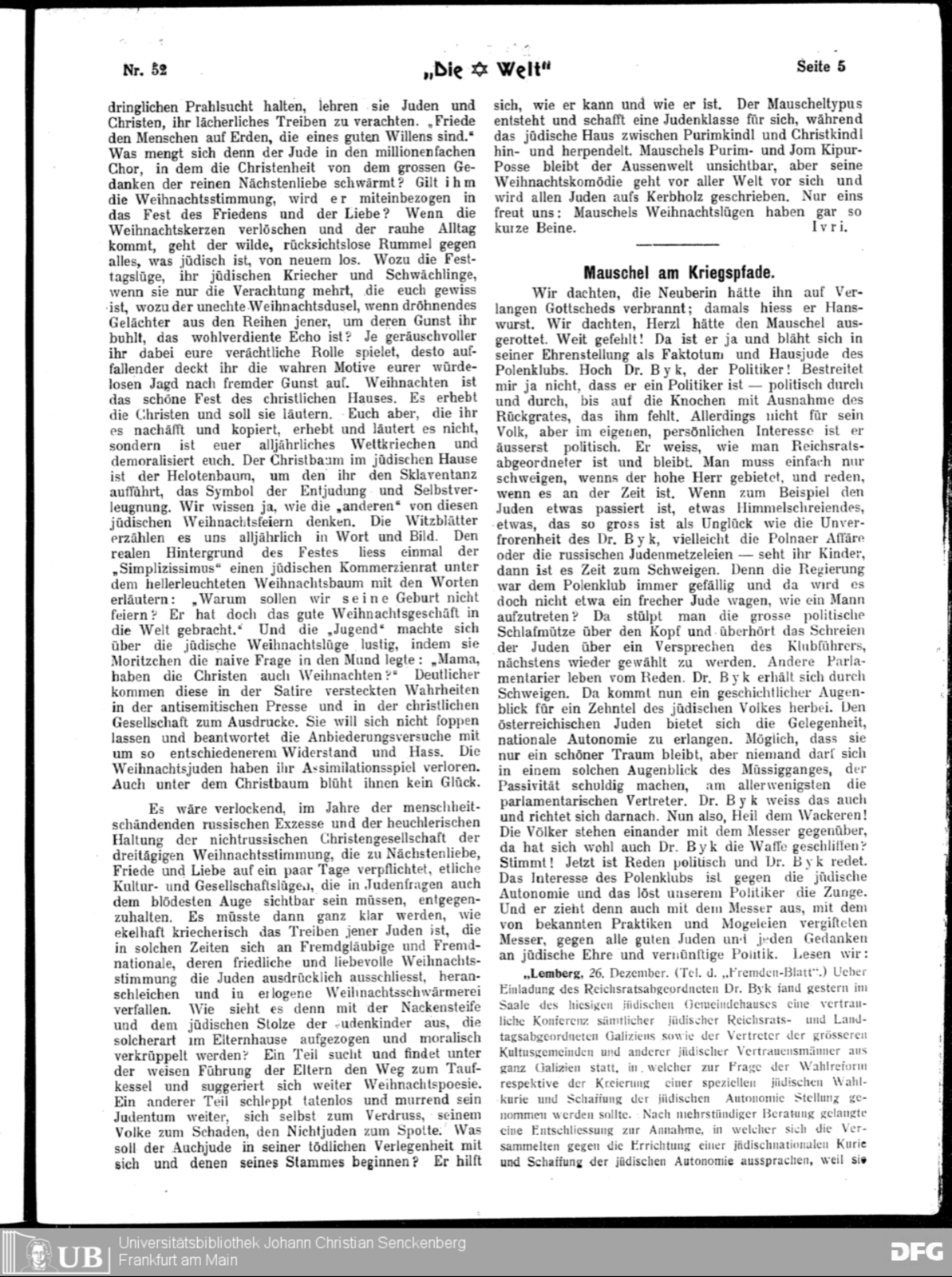
…dringlichen ostentation observe, they teach Jews and Christians alike to despise their ridiculous doings. "Peace on earth to men of good will." Why then does the Jew mingle in the chorus of millions in which Christendom rhapsodises over the great idea of pure love of one's neighbour? Is the Christmas spirit meant for him, is he included in the festival of peace and love? When the Christmas candles go out and harsh everyday life returns, the wild, ruthless uproar against everything that is Jewish breaks loose afresh. Why this holiday lie, you Jewish cringers and weaklings, when it only increases the contempt that is assuredly yours; why this spurious Christmas intoxication, when roaring laughter from the ranks of those whose favour you court is its well-deserved echo? The more noisily you play your contemptible part, the more glaringly you lay bare the true motives of your undignified chase after the favour of strangers. Christmas is the beautiful festival of the Christian home. It uplifts the Christians and is meant to purify them. But you, who ape and copy it, it neither uplifts nor purifies; it is rather your yearly cringing-match, and it demoralises you. The Christmas tree in the Jewish house is the tree of the helots, around which you perform the slaves' dance, the symbol of de-Judaisation and self-denial. We know well enough what the "others" think of these Jewish Christmas celebrations. The comic papers tell us of it every year in word and picture. The real background of the festival was once explained by the "Simplizissimus" through a Jewish Commercial Councillor beneath the brightly lit Christmas tree, in the words: "Why should we not celebrate his birth? After all, he brought the good Christmas trade into the world." And the "Jugend" made merry over the Jewish Christmas lie by putting into little Moritz's mouth the naïve question: "Mamma, do the Christians have Christmas too?" These truths, hidden in satire, find plainer expression in the antisemitic press and in Christian society. It will not be made a fool of, and answers the attempts at ingratiation with all the more decided resistance and hatred. The Christmas Jews have lost their game of assimilation. Even beneath the Christmas tree no happiness blossoms for them.
It would be tempting, in the year of the Russian excesses that have disgraced humanity and of the hypocritical attitude of non-Russian Christian society, to hold up against the three-day Christmas mood, which binds men for a few days to love of their neighbour, to peace and to love, a number of the lies of culture and of society which in Jewish questions must be visible even to the dullest eye. It would then become quite clear how loathsomely servile is the conduct of those Jews who at such times creep up to people of alien faith and alien nationality, whose peaceful and loving Christmas mood expressly excludes the Jews, and lapse into a mendacious enthusiasm for Christmas. And how stands it with the stiff neck and the Jewish pride of the Jewish children who are brought up and morally crippled in such fashion in their parents' house? One part seeks and finds, under the wise guidance of the parents, the way to the baptismal font, and goes on suggesting Christmas poetry to itself. Another part drags its Judaism along idly and grumbling, to its own vexation, to the injury of its people, and to the mockery of the non-Jews. What is the also-Jew, in his mortal embarrassment, to do with himself and with those of his stock? He helps
himself as he can and as he is. The Mauschel type arises and creates a class of Jews of its own, while the Jewish house swings to and fro between the Purimkindl and the Christkindl. Mauschel's Purim and Yom Kippur farce remains invisible to the outside world, but his Christmas comedy is played before all the world and is chalked up against all Jews. Only one thing gladdens us: Mauschel's Christmas lies have such very short legs.
Ivri.
Mauschel on the Warpath.
We thought that the Neuberin had burnt him at Gottsched's demand; in those days he was called Hanswurst. We thought that Herzl had rooted Mauschel out. Far from it! There he is, puffing himself up in his post of honour as factotum and house-Jew of the Polish Club. Long live Dr. Byk, the politician! Do not dispute that he is a politician — political through and through, to the very bone, with the exception of the backbone, which he lacks. Not, to be sure, on behalf of his people; but in his own personal interest he is political in the extreme. He knows how one becomes and remains a deputy to the Reichsrat. One need simply keep silent when the high master commands it, and speak when the time has come. When, for instance, something has befallen the Jews, something that cries to heaven, something as great a misfortune as Dr. Byk's effrontery is great, perhaps the Polna affair or the Russian massacres of the Jews — you see, children, then it is time to keep silent. For the Government was always obliging to the Polish Club, and surely no impudent Jew would dare to stand up like a man? So one pulls the great political nightcap over one's head and, for a promise from the leader of the Club to be re-elected next time, fails to hear the outcry of the Jews. Other parliamentarians live by speaking. Dr. Byk maintains himself by keeping silent. Now there comes a historic moment for a tenth of the Jewish people. The Austrian Jews are offered the opportunity of obtaining national autonomy. It may remain only a beautiful dream, but no one may make himself guilty of idleness, of passivity, at such a moment, least of all the parliamentary representatives. Dr. Byk knows this too, and acts accordingly. Well then, hail to the gallant man! The peoples stand facing one another knife in hand; so Dr. Byk too has no doubt whetted his weapon? Just so! Now speaking is politic, and Dr. Byk speaks. The interest of the Polish Club is against Jewish autonomy, and that loosens our politician's tongue. And so he does sally forth with the knife, the knife poisoned with well-known practices and trickeries, against all good Jews and against every thought of Jewish honour and sensible policy. Let us read:
"Lemberg, 26th December. (Telegram of the "Fremden-Blatt.") On the invitation of the Reichsrat deputy Dr. Byk there took place yesterday, in the hall of the Jewish community house here, a confidential conference of all the Jewish deputies of Galicia to the Reichsrat and the Diet, as well as of the representatives of the larger congregations and of other Jewish men of trust from the whole of Galicia, at which a position was to be taken on the question of electoral reform, or rather on the creation of a special Jewish electoral curia and the establishment of Jewish autonomy. After a deliberation of several hours a resolution was adopted in which those assembled declared themselves against the institution of a Jewish-national curia and the establishment of Jewish autonomy, because they