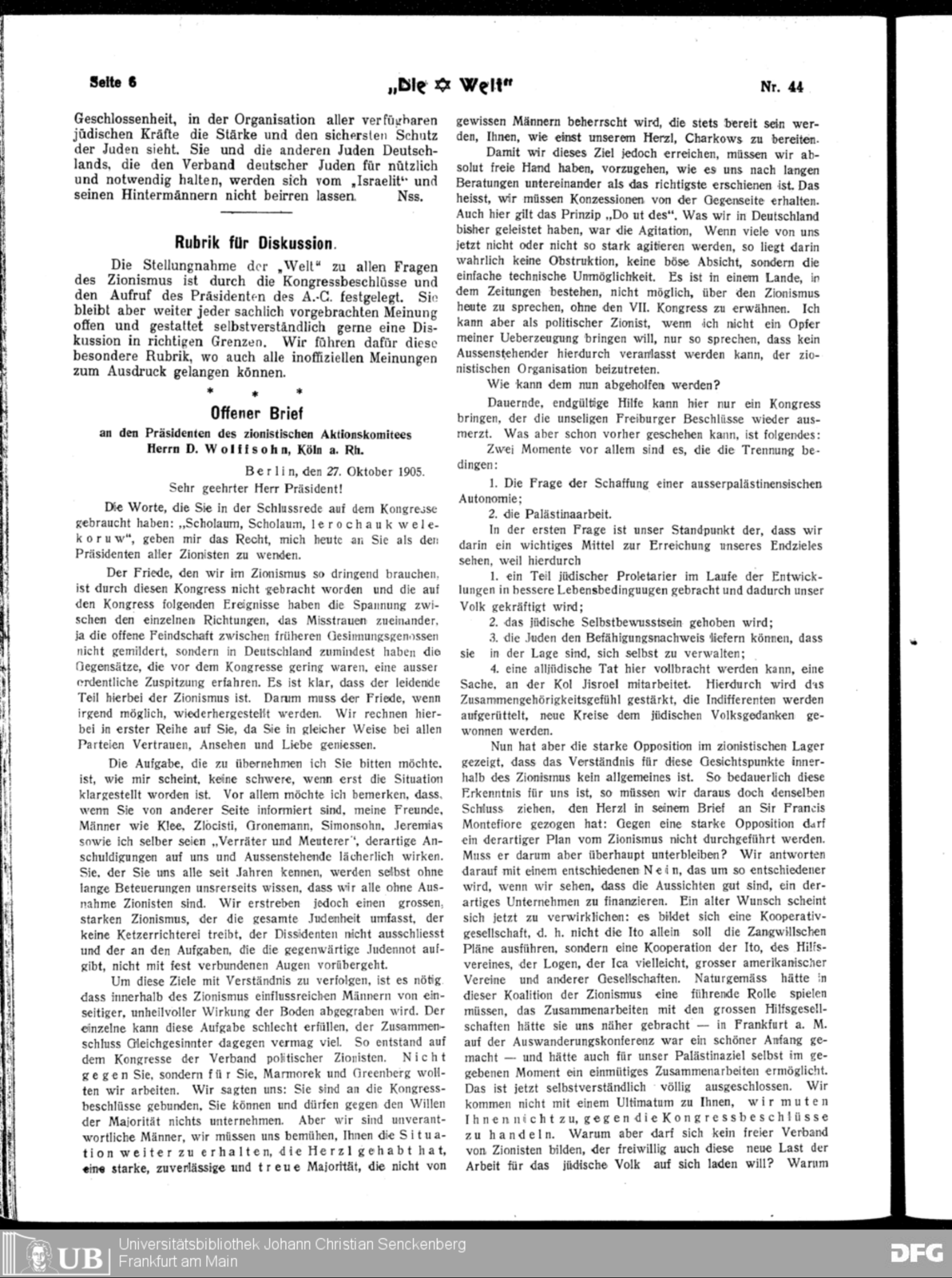
Page 6. — "Die Welt" — No. 44.
(continued from page 5)
...solidarity, in the organisation of all available Jewish forces, sees the strength and the surest protection of the Jews. They and the other Jews of Germany who hold the Union of German Jews to be useful and necessary will not let themselves be led astray by the "Israelit" and those behind it. Nss.
Column for Discussion.
The position of "Die Welt" on all questions of Zionism is fixed by the resolutions of the Congress and the proclamation of the President of the A.-C. It nevertheless remains open to every opinion objectively put forward, and of course gladly permits a discussion within proper limits. For this purpose we keep this special column, in which all unofficial opinions too may find expression.
* * *
Open Letter
to the President of the Zionist Actions Committee, Herr D. Wolffsohn, Cologne-on-Rhine.
Berlin, 27th October 1905.
Most honoured Mr. President!
The words which you used in your closing speech at the Congress, "Scholaum, Scholaum, lerochauk welekoruw," give me the right to address myself to you to-day as the President of all Zionists.
The peace which we so urgently need in Zionism has not been brought by this Congress, and the events following upon the Congress have not softened the tension between the several tendencies, the mistrust of one another, nay, the open enmity between former comrades in the cause; on the contrary, in Germany at least, the antagonisms, which before the Congress were slight, have undergone an extraordinary sharpening. It is clear that the suffering party in this is Zionism. Therefore peace must, if at all possible, be restored. In this we count in the first place upon you, since you enjoy in equal measure the confidence, esteem and affection of all parties.
The task which I should like to ask you to undertake is, as it seems to me, no difficult one, once the situation has been made clear. Above all I should like to remark that if you have been informed from another quarter that my friends, men such as Klee, Zlocisti, Gronemann, Simonsohn, Jeremias, as well as I myself, are "traitors and mutineers," such accusations strike us and outsiders as ridiculous. You, who have known us all for years, will know even without lengthy protestations on our part that we are all without exception Zionists. We strive, however, for a great, strong Zionism which embraces the whole of Jewry, which practises no heresy-hunting, which does not exclude dissenters, and which does not pass by with eyes tightly bound the tasks that the present distress of the Jews sets it.
In order to pursue these aims with understanding, it is necessary that the ground be cut from under influential men within Zionism whose effect is one-sided and baneful. The individual can fulfil this task but poorly; the union of like-minded men, on the other hand, can do much. Thus there arose at the Congress the Union of Political Zionists. Not against you, but for you, Marmorek and Greenberg did we wish to work. We said to ourselves: you are bound by the resolutions of the Congress, you can and may undertake nothing against the will of the majority. But we are men without responsibility; we must endeavour to preserve for you the situation which Herzl had, a strong, reliable and loyal majority which is not dominated by certain men who will always be ready to prepare Charkows for you, as once for our Herzl.
In order that we may attain this aim, however, we must have an absolutely free hand to proceed as has seemed to us most right after long deliberations among ourselves. That is to say, we must obtain concessions from the other side. Here too the principle "Do ut des" applies. What we have accomplished in Germany hitherto was agitation. If many of us will now not agitate, or not so vigorously, there truly lies in this no obstruction, no ill intent, but simple technical impossibility. In a country in which newspapers exist, it is not possible to speak of Zionism to-day without mentioning the VIIth Congress. But as a political Zionist, unless I wish to make a sacrifice of my conviction, I can speak only in such a way that no outsider can thereby be induced to join the Zionist Organisation.
How, then, can this be remedied?
Lasting, definitive help can be brought here only by a Congress which strikes out again the unhappy Freiburg resolutions. What can be done even before that, however, is the following:
Two factors above all are what bring about the separation:
- The question of the creation of an autonomy outside Palestine;
- the work in Palestine.
On the first question our standpoint is that we see in it an important means to the attainment of our final goal, because thereby
- a part of the Jewish proletarians will, in the course of developments, be brought into better conditions of life and our people thus strengthened;
- Jewish self-consciousness will be raised;
- the Jews can furnish the proof of capacity that they are in a position to govern themselves;
- an all-Jewish deed can here be accomplished, a cause in which Kol Jisroel works together. Thereby the feeling of belonging together will be strengthened, the indifferent will be roused, new circles will be won for the Jewish national idea.
Now, however, the strong opposition in the Zionist camp has shown that understanding of these points of view is not general within Zionism. Regrettable as this recognition is for us, we must nevertheless draw from it the same conclusion that Herzl drew in his letter to Sir Francis Montefiore: against a strong opposition, such a plan may not be carried out by Zionism. But must it therefore be left undone altogether? We answer this with a decided No, which becomes all the more decided when we see that the prospects are good of financing such an undertaking. An old wish seems now to be realising itself: a co-operative company is forming, that is to say, not the Ito alone is to carry out the Zangwill plans, but a co-operation of the Ito, the Hilfsverein, the Lodges, perhaps the Ica, great American societies and other associations. Naturally Zionism ought to have played a leading part in this coalition; working together with the great relief societies would have brought them nearer to us — at the emigration conference in Frankfort-on-Main a fine beginning had been made — and would also have made possible, at the given moment, a unanimous co-operation even for our Palestine goal itself. That is now, of course, entirely out of the question. We do not come to you with an ultimatum; we do not expect you to act against the resolutions of the Congress. But why may no free union of Zionists be formed which is willing of its own accord to take upon itself this new burden of work for the Jewish people as well? Why