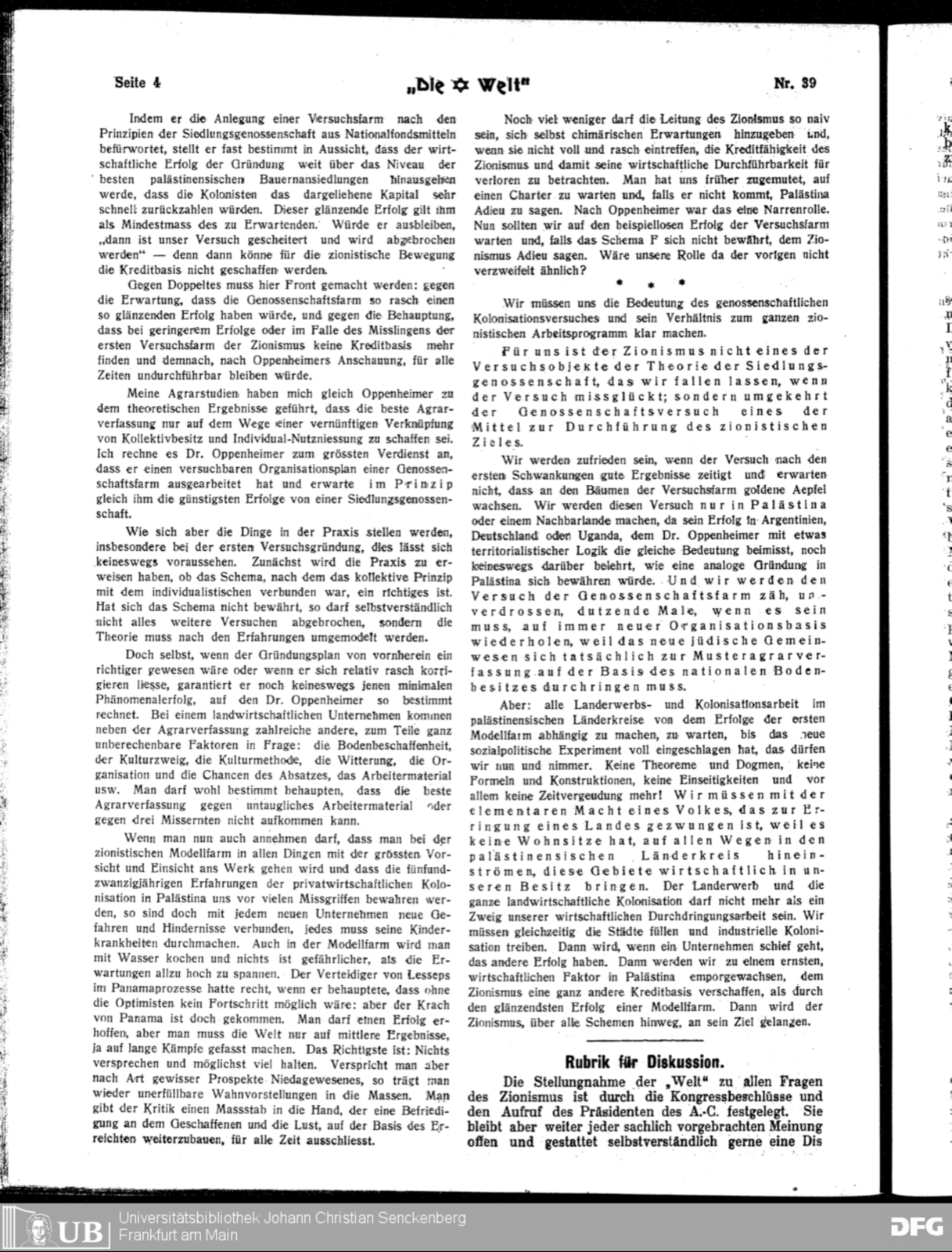
Page 4 — "Die Welt" — No. 39
In advocating the establishment of an experimental farm on the principles of the settlement co-operative out of National Fund means, he holds out an almost definite prospect that the economic success of the foundation will rise far above the level of the best Palestinian peasant settlements, and that the colonists will very quickly repay the capital lent them. This brilliant success counts with him as the minimum of what is to be expected. Should it fail to appear, "then our experiment has failed and will be broken off" — for then the basis of credit could not be created for the Zionist movement.
A stand must be made here against two things: against the expectation that the co-operative farm would have so brilliant a success so quickly, and against the assertion that, with a lesser success or in case of the failure of the first experimental farm, Zionism would no longer find a basis of credit and would accordingly, in Oppenheimer's view, remain impracticable for all time.
My agrarian studies have led me, like Oppenheimer, to the theoretical conclusion that the best agrarian constitution can be created only by way of a rational combination of collective ownership and individual usufruct. I count it as Dr. Oppenheimer's greatest merit that he has worked out a plan of organisation for a co-operative farm that can be put to trial, and in principle I, like him, expect the most favourable results from a settlement co-operative.
But how matters will turn out in practice, especially with the first experimental foundation, can by no means be foreseen. Practice will first have to show whether the scheme by which the collective principle was combined with the individualistic one is a correct one. If the scheme has not proved itself, then of course all further experiment must not be broken off; rather the theory must be remodelled in accordance with experience.
Yet even if the plan of foundation had been correct from the outset, or if it could be corrected relatively quickly, it still by no means guarantees that minimum of phenomenal success on which Dr. Oppenheimer so definitely reckons. In an agricultural undertaking, besides the agrarian constitution, numerous other factors, some of them quite incalculable, come into question: the nature of the soil, the branch of cultivation, the method of cultivation, the weather, the organisation and the chances of marketing, the human material of the labourers, etc. One may safely assert that the best agrarian constitution cannot prevail against unfit labourers or against three failed harvests.
Now even if one may assume that in the Zionist model farm all things will be set about with the greatest caution and insight, and that the twenty-five years' experience of private colonisation in Palestine will preserve us from many blunders, yet every new undertaking brings new dangers and obstacles with it; each must pass through its childhood ailments. In the model farm, too, they will cook with water, and nothing is more dangerous than to pitch expectations too high. The counsel for Lesseps in the Panama trial was right when he asserted that without the optimists no progress would be possible: but the Panama crash came all the same. One may hope for success, but one must prepare the world only for middling results, nay, for long struggles. The soundest course is: promise nothing and perform as much as possible. But if one promises, after the manner of certain prospectuses, things never seen before, one again carries unrealisable delusions into the masses. One puts into the hands of criticism a standard that rules out for all time any satisfaction with what has been created, and any desire to build further on the basis of what has been attained.
Still less may the leadership of Zionism be so naïve as to abandon itself to chimerical expectations and, if they are not fulfilled fully and quickly, to regard the creditworthiness of Zionism, and with it its economic practicability, as lost. Formerly it was expected of us that we wait for a Charter and, should it not come, bid Palestine adieu. According to Oppenheimer that was a fool's part. Now we are to wait for the unexampled success of the experimental farm and, should Schema F not prove itself, bid Zionism adieu. Would not our part then be desperately like the former one?
* * *
We must make clear to ourselves the significance of the co-operative colonisation experiment and its relation to the whole Zionist programme of work.
For us Zionism is not one of the experimental objects of the theory of the settlement co-operative, to be dropped if the experiment miscarries; but, on the contrary, the co-operative experiment is one of the means for carrying out the Zionist aim.
We shall be content if, after the first fluctuations, the experiment yields good results, and we do not expect golden apples to grow on the trees of the experimental farm. We shall make this experiment only in Palestine or a neighbouring country, since its success in Argentina, Germany or Uganda — to which Dr. Oppenheimer, with somewhat territorialist logic, attaches the same significance — would by no means teach us how an analogous foundation would prove itself in Palestine. And we shall repeat the experiment of the co-operative farm tenaciously, untiringly, dozens of times if need be, on ever new bases of organisation, because the new Jewish commonwealth must in fact struggle through to a model agrarian constitution on the basis of national ownership of the soil.
But: to make all the work of land acquisition and colonisation in the Palestinian group of countries dependent upon the success of the first model farm, to wait until the new socio-political experiment has fully succeeded — that we may never and nevermore do. No more theorems and dogmas, no more formulas and constructions, no more one-sidedness, and above all no more waste of time! With the elemental might of a people compelled to win a land because it has no dwelling-places, we must stream by every road into the Palestinian group of countries and bring these territories economically into our possession. Land acquisition and the whole of agricultural colonisation must be no more than one branch of our work of economic penetration. We must at the same time fill the towns and carry on industrial colonisation. Then, if one undertaking goes wrong, another will succeed. Then we shall have grown into a serious economic factor in Palestine and shall procure for Zionism quite another basis of credit than through the most brilliant success of a model farm. Then Zionism, passing over all schemes, will reach its goal.
Column for Discussion.
The position of "Die Welt" on all questions of Zionism is laid down by the resolutions of the Congress and the appeal of the President of the A.-C. It nonetheless remains open to every opinion put forward on its merits, and as a matter of course gladly permits a dis