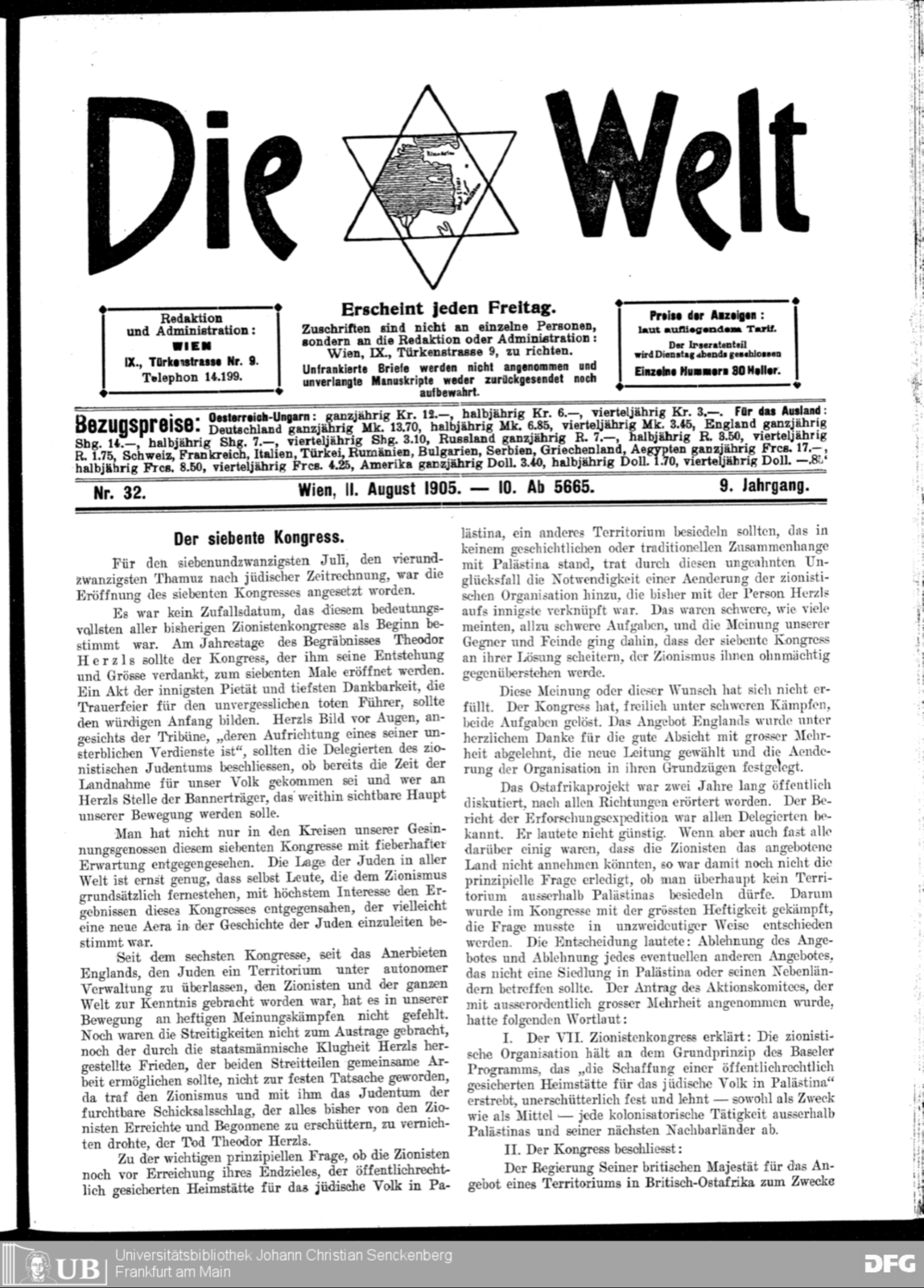
Die Welt
Editorial Office and Administration: Vienna, IX., Türkenstrasse No. 9. Telephone 14.199.
Published every Friday. Communications are to be addressed not to individual persons but to the Editorial Office or Administration: Vienna, IX., Türkenstrasse 9. Unstamped letters are not accepted, and unsolicited manuscripts are neither returned nor kept.
Advertisement rates: according to the tariff available on request. The advertising section closes on Tuesday evening. Single numbers 20 Heller.
Subscription rates: Austria-Hungary: yearly Kr. 12.—, half-yearly Kr. 6.—, quarterly Kr. 3.—. Abroad: Germany yearly Mk. 13.70, half-yearly Mk. 6.85, quarterly Mk. 3.45; England yearly Shg. 14.—, half-yearly Shg. 7.—, quarterly Shg. 3.10; Russia yearly R. 7.—, half-yearly R. 3.50, quarterly R. 1.75; Switzerland, France, Italy, Turkey, Roumania, Bulgaria, Servia, Greece, Egypt yearly Frcs. 17.—, half-yearly Frcs. 8.50, quarterly Frcs. 4.25; America yearly Doll. 3.40, half-yearly Doll. 1.70, quarterly Doll. —.85
No. 32. | Vienna, 11 August 1905. — 10 Ab 5665. | 9th Year.
The Seventh Congress.
The opening of the Seventh Congress had been fixed for the twenty-seventh of July, the twenty-fourth of Tammuz by the Jewish reckoning.
It was no chance date that had been appointed as the beginning of this, the most momentous of all Zionist Congresses hitherto held. On the anniversary of Theodor Herzl's burial the Congress, which owes him its origin and its greatness, was to be opened for the seventh time. An act of the most heartfelt piety and the deepest gratitude, the memorial service for the unforgettable departed leader, was to form its worthy beginning. With Herzl's image before their eyes, in sight of the tribune "the raising of which is one of his immortal merits", the delegates of Zionist Jewry were to resolve whether the time had already come for our people to take possession of a land, and who in Herzl's place should become the standard-bearer, the far-visible head of our movement.
Not only in the circles of our fellow Zionists was this Seventh Congress awaited with feverish expectation. The situation of the Jews throughout the world is grave enough that even persons who on principle stand aloof from Zionism looked forward with the keenest interest to the results of this Congress, which was perhaps destined to inaugurate a new era in the history of the Jews.
Since the Sixth Congress, since England's offer to cede to the Jews a territory under autonomous administration had been made known to the Zionists and to the whole world, there has been no lack of violent conflicts of opinion within our movement. The disputes had not yet been settled, the peace brought about by Herzl's statesmanlike wisdom, which was to make common work possible for both contending parties, had not yet become an established fact, when there fell upon Zionism, and with it upon Jewry, that terrible stroke of fate which threatened to shake, to annihilate all that the Zionists had hitherto achieved and begun — the death of Theodor Herzl.
To the weighty question of principle, whether the Zionists, even before attaining their final goal, the home in Palestine secured by public law for the Jewish people, should settle another territory which stood in no historical or traditional connection with Palestine, there was now added, through this unforeseen calamity, the necessity of altering the Zionist organisation, which had hitherto been most intimately bound up with the person of Herzl. These were heavy tasks — too heavy, as many thought — and the opinion of our opponents and enemies was that the Seventh Congress would founder upon their solution, and that Zionism would stand powerless before them.
This opinion, or this wish, has not been fulfilled. The Congress, though indeed amid hard struggles, has solved both tasks. The offer of England was declined by a large majority, with cordial thanks for the good intention; the new leadership was elected, and the alteration of the organisation was laid down in its main outlines.
The East Africa project had for two years been publicly discussed and examined in every direction. The report of the expedition of exploration was known to all the delegates. It was not favourable. But even though nearly all were agreed that the Zionists could not accept the land offered, the question of principle was not thereby settled, whether one might settle no territory whatever outside Palestine. Over this the Congress fought with the greatest vehemence; the question had to be decided in an unequivocal manner. The decision ran: rejection of the offer, and rejection of every other possible offer which should not concern a settlement in Palestine or its adjacent lands. The motion of the Actions Committee, which was adopted by an extraordinarily large majority, ran as follows:
I. The Seventh Zionist Congress declares: The Zionist Organisation adheres unshakeably to the fundamental principle of the Basle Programme, which strives for "the creation of a home in Palestine secured by public law for the Jewish people", and rejects — both as an end and as a means — all colonising activity outside Palestine and its nearest neighbouring lands.
II. The Congress resolves:
To the Government of His Britannic Majesty, for the offer of a territory in British East Africa for the purpose