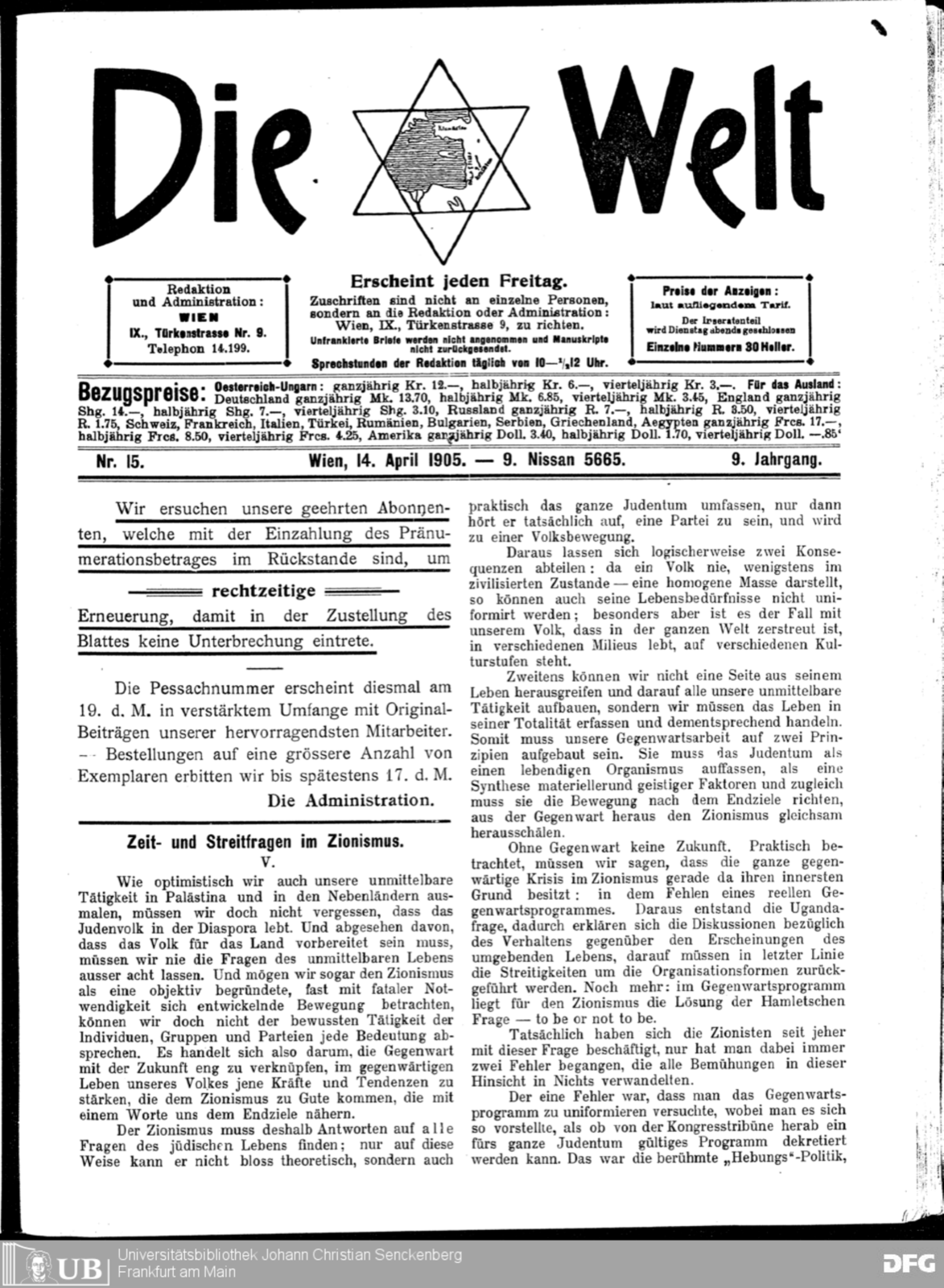
Die Welt
Published every Friday.
Editorial office and administration: VIENNA IX., Türkenstrasse No. 9. Telephone 14.199. Letters are to be addressed not to individual persons but to the editorial office or the administration: Vienna, IX., Türkenstrasse 9. Unstamped letters will not be accepted and manuscripts will not be returned. Editorial consulting hours daily from 10 to 1/2 12 o'clock. Advertising rates: according to the tariff available on request. The advertising section closes on Tuesday evenings. Single numbers 30 Heller.
Subscription prices: Austria-Hungary: yearly Kr. 12.—, half-yearly Kr. 6.—, quarterly Kr. 3.—. Abroad: Germany yearly Mk. 13.70, half-yearly Mk. 6.85, quarterly Mk. 3.45; England yearly Shg. 14.—, half-yearly Shg. 7.—, quarterly Shg. 3.10; Russia yearly R. 7.—, half-yearly R. 3.50, quarterly R. 1.75; Switzerland, France, Italy, Turkey, Roumania, Bulgaria, Servia, Greece, Egypt yearly Frcs. 17.—, half-yearly Frcs. 8.50, quarterly Frcs. 4.25; America yearly Doll. 3.40, half-yearly Doll. 1.70, quarterly Doll. —.85.
No. 15. — Vienna, 14 April 1905. — 9 Nissan 5665. — 9th Year.
We request those of our esteemed subscribers who are in arrears with the payment of their subscription to renew it
in good time
so that there may be no interruption in the delivery of the paper.
—
The Passover number will appear this time on the 19th inst., in enlarged form, with original contributions from our most distinguished collaborators. — We request that orders for larger numbers of copies reach us by the 17th inst. at the latest.
The Administration.
Questions and Controversies of the Day in Zionism.
V.
However optimistically we may picture our immediate activity in Palestine and in the neighbouring lands, we must not forget that the Jewish people lives in the Diaspora. And quite apart from the fact that the people must be prepared for the land, we must never leave out of account the questions of immediate life. And even though we may regard Zionism as a movement objectively grounded and developing with an almost fatal necessity, we cannot for that reason deny all significance to the conscious activity of individuals, groups and parties. The task, then, is to bind the present closely to the future, to strengthen in the present life of our people those forces and tendencies which are of benefit to Zionism, which, in a word, bring us nearer to the final goal.
Zionism must therefore find answers to all the questions of Jewish life; only in this way can it embrace the whole of Jewry not merely in theory but also in practice, only then does it in fact cease to be a party and become a national movement.
From this two consequences may logically be derived: since a people never, at least in the civilised state — presents a homogeneous mass, neither can its vital needs be reduced to uniformity; and this is especially the case with our people, which is scattered over the whole world, lives in different surroundings, and stands at different levels of culture.
Secondly, we cannot single out one side of its life and build all our immediate activity upon it; we must rather grasp life in its totality and act accordingly. Our work in the present must therefore be built upon two principles. It must conceive of Jewry as a living organism, as a synthesis of material and spiritual factors, and at the same time it must direct the movement towards the final goal, and, as it were, peel Zionism out of the present.
Without a present, no future. Viewed practically, we must say that the whole present crisis in Zionism has its innermost cause precisely here: in the lack of a real programme for the present. From this the Uganda question arose; this explains the discussions concerning our attitude towards the phenomena of the surrounding life; to this, in the last resort, the disputes over the forms of organisation must be traced back. More still: in the programme for the present lies for Zionism the solution of Hamlet's question — to be or not to be.
Zionists have indeed always occupied themselves with this question; only, two errors were invariably committed, which brought all efforts in this direction to nothing.
The first error was that the attempt was made to reduce the programme for the present to uniformity, it being imagined that a programme valid for the whole of Jewry could be decreed from the platform of the Congress. That was the celebrated policy of "elevation",