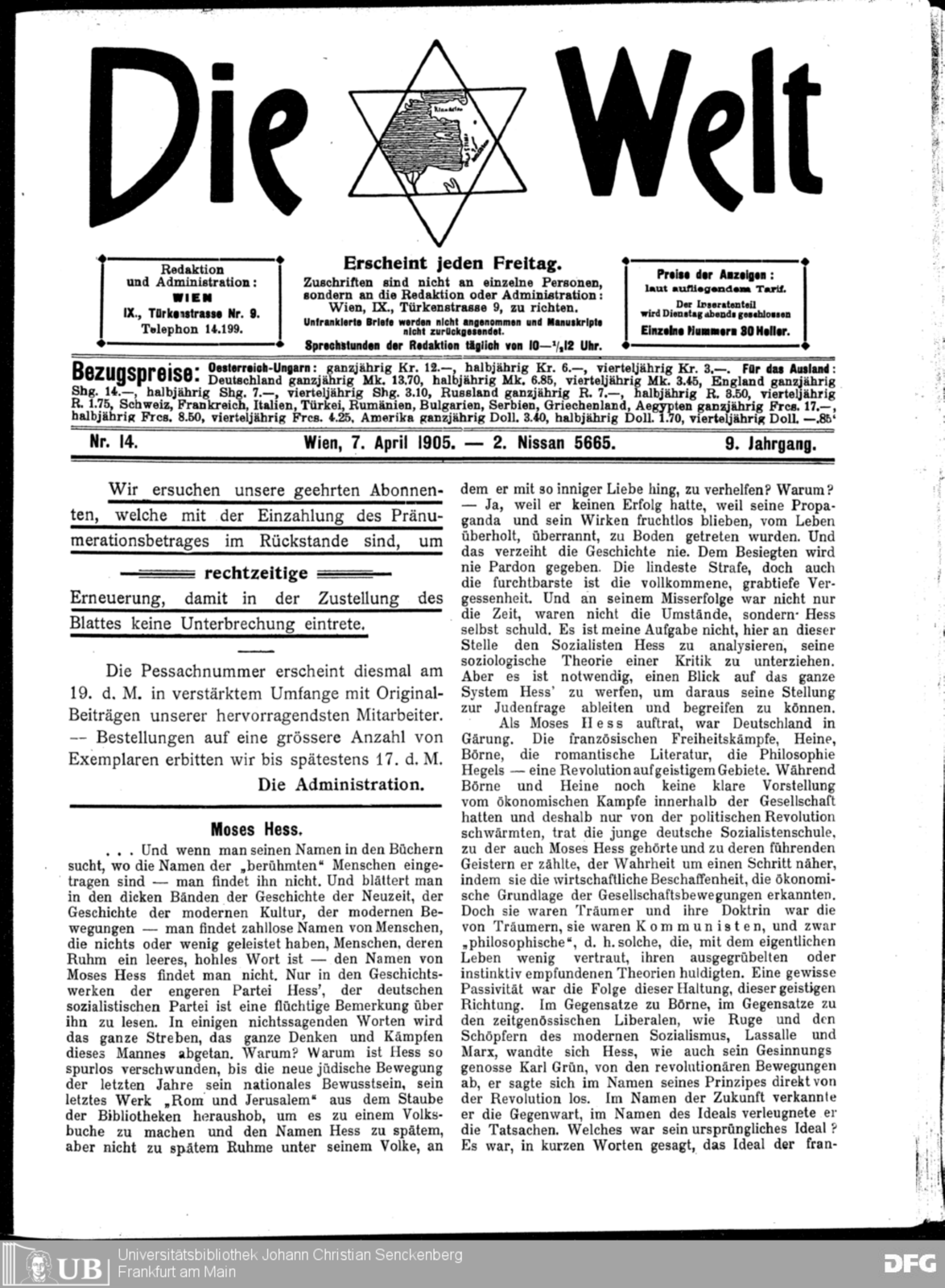
Die Welt
Editorial Office and Administration: Vienna, IX., Türkenstrasse No. 9. Telephone 14.199.
Published every Friday. Correspondence is to be addressed not to individual persons but to the Editorial Office or the Administration: Vienna, IX., Türkenstrasse 9. Unstamped letters are not accepted and manuscripts are not returned. The editors receive callers daily from 10 to half-past 11.
Advertising rates: according to the tariff available on request. The advertisement section closes on Tuesday evenings. Single numbers 30 Heller.
Subscription rates: Austria-Hungary: yearly Kr. 12.—, half-yearly Kr. 6.—, quarterly Kr. 3.—. Abroad: Germany yearly Mk. 13.70, half-yearly Mk. 6.85, quarterly Mk. 3.45; England yearly Shg. 14.—, half-yearly Shg. 7.—, quarterly Shg. 3.10; Russia yearly R. 7.—, half-yearly R. 3.50, quarterly R. 1.75; Switzerland, France, Italy, Turkey, Roumania, Bulgaria, Servia, Greece, Egypt yearly Frcs. 17.—, half-yearly Frcs. 8.50, quarterly Frcs. 4.25; America yearly Doll. 3.40, half-yearly Doll. 1.70, quarterly Doll. —.85.
No. 14. — Vienna, 7 April 1905. — 2 Nissan 5665. — 9th Year.
We request those of our esteemed subscribers who are in arrears with the payment of their subscription to make timely renewal, so that no interruption may occur in the delivery of the paper.
The Passover number will appear this time on the 19th inst., in enlarged form, with original contributions from our most distinguished collaborators. — Orders for a larger number of copies we request by the 17th inst. at the latest.
The Administration.
Moses Hess.
. . . And if one seeks his name in the books where the names of "famous" men are entered — one does not find it. And if one turns the pages of the thick volumes of the history of modern times, the history of modern culture, of the modern movements — one finds countless names of men who accomplished nothing or little, men whose fame is an empty, hollow word — the name of Moses Hess one does not find. Only in the historical works of Hess's own narrower party, the German Socialist party, is a fleeting remark about him to be read. In a few meaningless words the whole striving, the whole thinking and struggling of this man is disposed of. Why? Why did Hess vanish so without trace, until the new Jewish movement of recent years lifted his national consciousness, his last work "Rome and Jerusalem," out of the dust of the libraries, to make of it a book of the people and to help the name of Hess to a late, but not too late, fame among his people, to whom he clung with so fervent a love? Why? — Yes, because he had no success, because his propaganda and his labours remained fruitless, were overtaken, overrun, trodden to the ground by life. And that history never forgives. To the vanquished no quarter is ever given. The mildest punishment, yet also the most terrible, is complete oblivion, deep as the grave. And for his failure not only the times were to blame, not the circumstances, but Hess himself. It is not my task, here in this place, to analyse Hess the Socialist, to subject his sociological theory to criticism. But it is necessary to cast a glance over Hess's whole system, in order to be able to derive and comprehend from it his position on the Jewish question.
When Moses Hess came forward, Germany was in ferment. The French struggles for freedom, Heine, Börne, the Romantic literature, the philosophy of Hegel — a revolution in the realm of the mind. Whereas Börne and Heine had as yet no clear conception of the economic struggle within society and therefore raved only of political revolution, the young German Socialist school, to which Moses Hess also belonged and among whose leading spirits he was counted, came a step nearer the truth, in that they recognised the economic nature, the economic foundation, of the movements of society. But they were dreamers, and their doctrine was that of dreamers; they were Communists, and "philosophical" ones at that, that is, such as, little acquainted with real life, paid homage to their brooded-out or instinctively felt theories. A certain passivity was the consequence of this attitude, this intellectual tendency. In contrast to Börne, in contrast to the Liberals of the day, such as Ruge, and to the creators of modern Socialism, Lassalle and Marx, Hess, like his comrade in views Karl Grün, turned away from the revolutionary movements; in the name of his principle he renounced the Revolution outright. In the name of the future he misjudged the present, in the name of the ideal he denied the facts. What was his original ideal? It was, put in a few words, the ideal of the Fren-