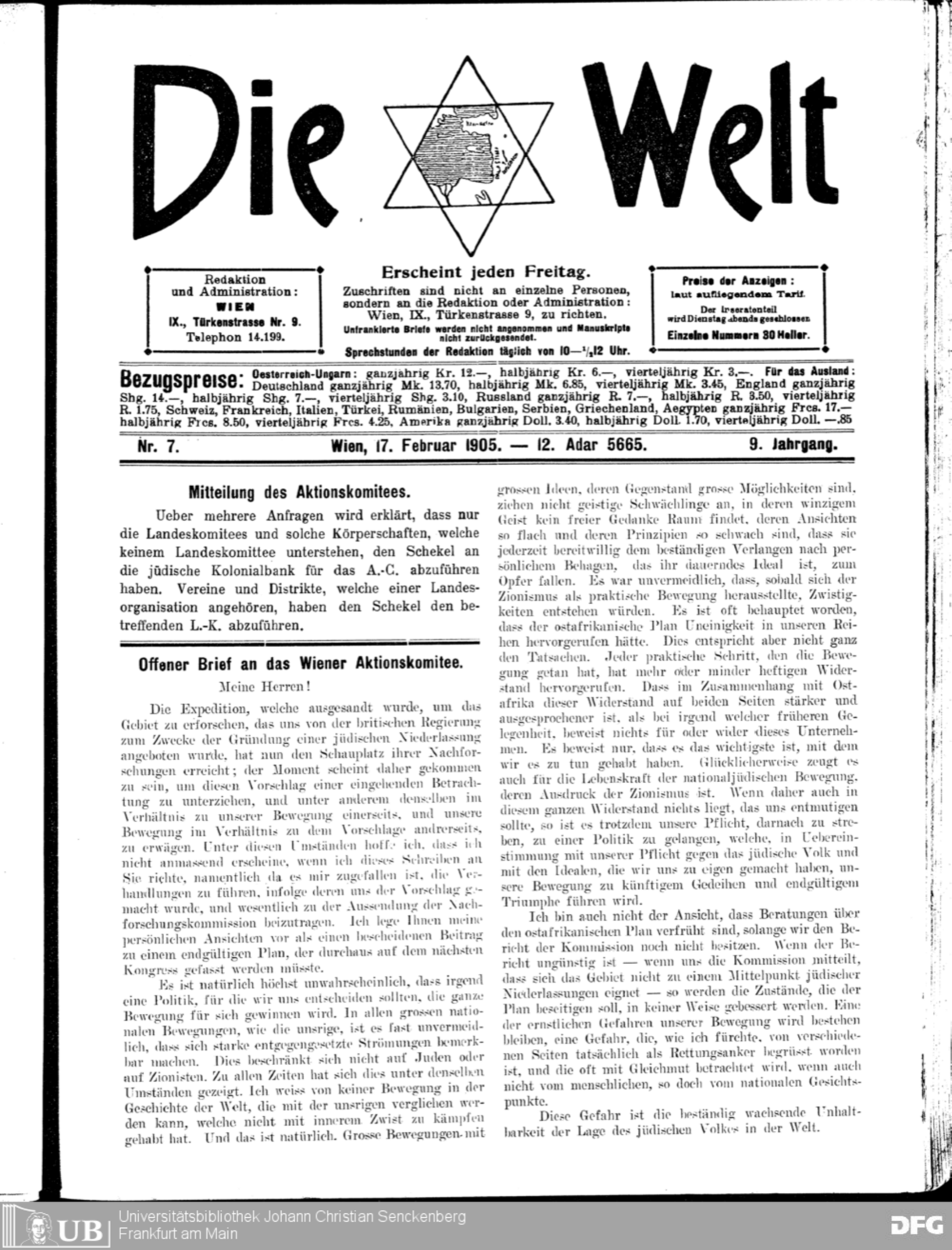
Die Welt
Editorial and Administrative Offices: VIENNA, IX., Türkenstrasse No. 9. Telephone 14.199. Appears every Friday. Communications are to be addressed not to individual persons, but to the Editorial Office or the Administration: Vienna, IX., Türkenstrasse 9. Unstamped letters are not accepted and manuscripts are not returned. Editorial office hours daily from 10 to half-past 11 o'clock. Advertisement rates: according to the published tariff. The advertisement section closes on Tuesday evening. Single numbers 30 Heller.
Subscription rates: Austria-Hungary: yearly Kr. 12.—, half-yearly Kr. 6.—, quarterly Kr. 3.—. Abroad: Germany yearly Mk. 13.70, half-yearly Mk. 6.85, quarterly Mk. 3.45; England yearly Shg. 14.—, half-yearly Shg. 7.—, quarterly Shg. 3.10; Russia yearly R. 7.—, half-yearly R. 3.50, quarterly R. 1.75; Switzerland, France, Italy, Turkey, Roumania, Bulgaria, Servia, Greece, Egypt yearly Frcs. 17.—, half-yearly Frcs. 8.50, quarterly Frcs. 4.25; America yearly Doll. 3.40, half-yearly Doll. 1.70, quarterly Doll. —.85
No. 7. / Vienna, 17 February 1905. — 12 Adar 5665. / 9th Year.
Communication of the Actions Committee.
In reply to several inquiries it is declared that only the National Committees, and such bodies as are subject to no National Committee, are to remit the shekel to the Jewish Colonial Bank for the A.C. Societies and districts which belong to a national organisation are to remit the shekel to the National Committees concerned.
Open Letter to the Vienna Actions Committee.
Gentlemen!
The expedition which was sent out to explore the territory offered to us by the British Government for the purpose of founding a Jewish settlement has now reached the scene of its investigations; the moment therefore seems to have come to subject this proposal to a searching examination, and, among other things, to consider it in its relation to our movement on the one hand, and our movement in its relation to the proposal on the other. In these circumstances I hope that I shall not appear presumptuous in addressing this letter to you, particularly as it fell to my lot to conduct the negotiations in consequence of which the proposal was made to us, and to contribute materially to the despatch of the Commission of Inquiry. I lay my personal views before you as a modest contribution towards a definitive plan, which ought by all means to be resolved upon at the next Congress.
It is, of course, highly improbable that any policy upon which we might decide will win the whole movement to itself. In all great national movements such as ours it is almost inevitable that strong opposing currents should make themselves felt. This is not confined to Jews or to Zionists. At all times this has shown itself in the same circumstances. I know of no movement in the history of the world that can be compared with ours which has not had to contend with internal dissension. And that is natural. Great movements with great ideas, whose object is great possibilities, do not attract intellectual weaklings, in whose puny minds no free thought finds room, whose views are so shallow and whose principles so feeble that they at any time fall a ready sacrifice to the constant craving for personal comfort which is their abiding ideal. It was inevitable that, as soon as Zionism proved itself a practical movement, dissensions would arise. It has often been asserted that the East African scheme has called forth disunion in our ranks. This, however, does not quite accord with the facts. Every practical step which the movement has taken has called forth more or less violent opposition. That in connection with East Africa this opposition is stronger and more pronounced on both sides than on any former occasion proves nothing for or against this undertaking. It proves only that it is the most important with which we have had to deal. Happily it testifies also to the vitality of the national Jewish movement, of which Zionism is the expression. If, therefore, there is nothing in all this opposition that should discourage us, it is nevertheless our duty to strive to arrive at a policy which, in accordance with our duty towards the Jewish people and with the ideals which we have made our own, will lead our movement to future prosperity and final triumph.
Nor am I of the opinion that deliberations upon the East African scheme are premature so long as we do not yet possess the report of the Commission. If the report is unfavourable — if the Commission informs us that the territory is not suited to be a centre of Jewish settlements — the conditions which the scheme is intended to remove will in no wise be bettered. One of the serious dangers of our movement will remain, a danger which, as I fear, has in various quarters actually been hailed as a sheet-anchor, and which is often regarded with equanimity, if not from the human, yet from the national point of view.
This danger is the constantly growing untenability of the position of the Jewish people in the world.