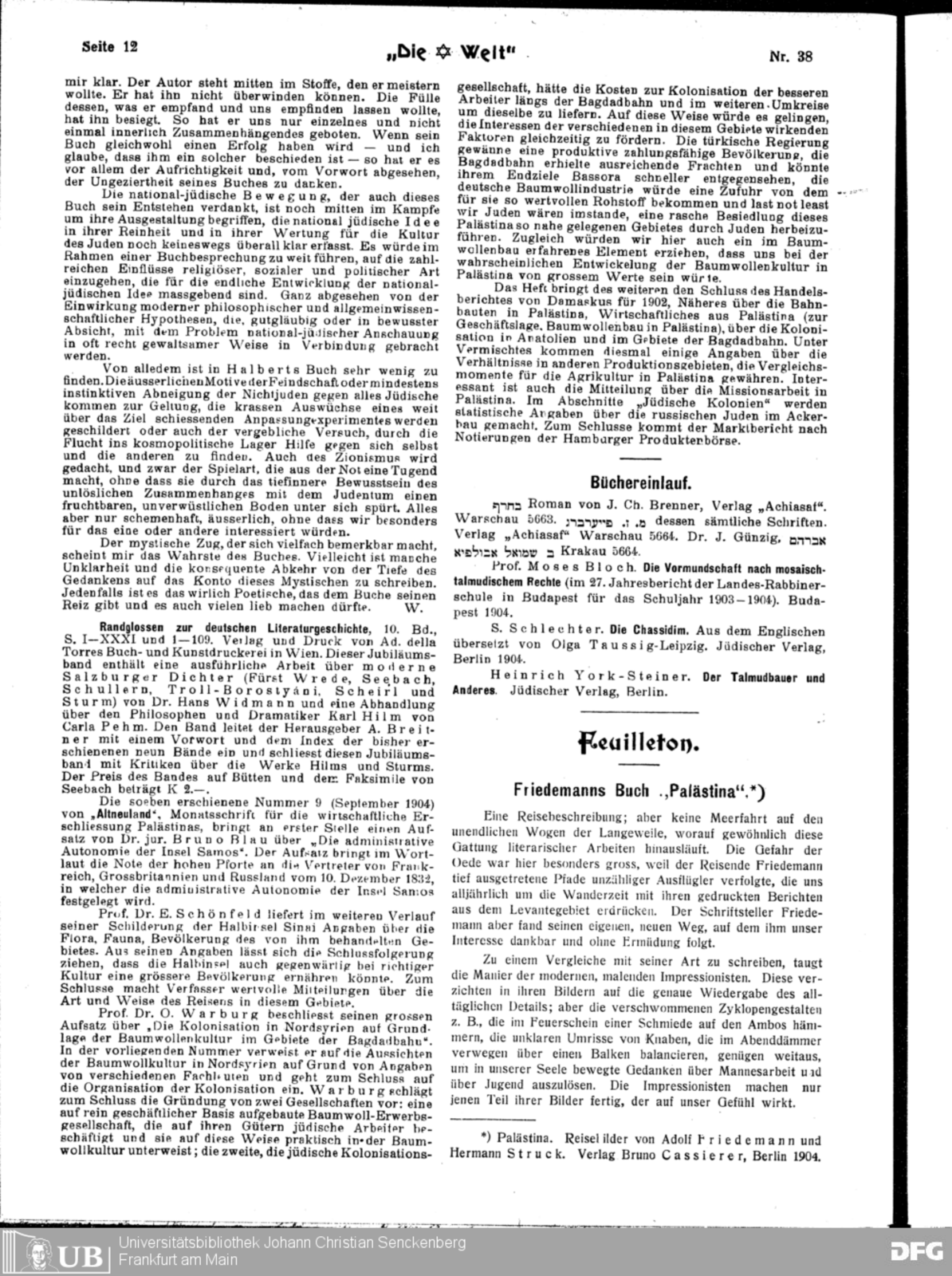
Page 12. — "Die Welt" — No. 38.
(continued from page 11)
... clear to me. The author stands in the midst of the material he wished to master. He has not been able to overcome it. The fulness of what he felt and wished to make us feel has defeated him. Thus he has offered us only fragments, and not even fragments inwardly connected. If his book nevertheless meets with success — and I believe that such is in store for it — he will owe it above all to the sincerity and, the preface apart, the unaffectedness of his book.
The national-Jewish movement, to which this book too owes its origin, is still in the midst of the struggle for its final shape; the national-Jewish idea in its purity and in its value for the culture of the Jew is by no means yet everywhere clearly grasped. It would lead too far, within the compass of a book review, to enter upon the numerous influences of a religious, social and political kind which are decisive for the ultimate development of the national-Jewish idea. Quite apart from the effect of modern philosophical and general scientific hypotheses, which, in good faith or with conscious intent, are brought into connection, often in very forcible fashion, with the problem of the national-Jewish outlook.
Of all this very little is to be found in Halbert's book. The external motives of the enmity, or at least the instinctive aversion, of non-Jews towards everything Jewish come into play; the crass excrescences of an experiment in assimilation that far overshoots its mark are depicted, or again the vain attempt to find help against oneself and against others by flight into the cosmopolitan camp. Zionism too is remembered, namely that variety of it which makes a virtue of necessity, without feeling beneath it a fruitful, indestructible soil through the profound inner consciousness of an indissoluble bond with Judaism. But all of it only shadowy, external, without our being especially interested in the one thing or the other.
The mystical strain, which makes itself felt in many places, seems to me the truest thing in the book. Perhaps many an obscurity and the consistent turning away from depth of thought are to be set down to the account of this mystical element. At all events it is the truly poetic quality that gives the book its charm and may well endear it to many. W.
Randglossen zur deutschen Literaturgeschichte (Marginal Notes on the History of German Literature), vol. 10, pp. I–XXXI and 1–109. Published and printed by Ad. della Torre's Book and Art Printing Works in Vienna. This jubilee volume contains a detailed study of modern Salzburg poets (Prince Wrede, Seebach, Schullern, Troll-Borostyáni, Scheirl and Sturm) by Dr. Hans Widmann, and an essay on the philosopher and dramatist Karl Hilm by Carla Pehm. The editor, A. Breitner, introduces the volume with a preface and the index of the nine volumes hitherto published, and closes this jubilee volume with critiques of the works of Hilm and Sturm. The price of the volume, on hand-made paper and with the facsimile of Seebach, is K 2.—.
The number 9 (September 1904) of "Altneuland", monthly for the economic development of Palestine, just published, brings in first place an article by Dr. jur. Bruno Blau on "The Administrative Autonomy of the Island of Samos". The article gives in full the text of the note of the Sublime Porte to the representatives of France, Great Britain and Russia of the 10th of December 1832, in which the administrative autonomy of the Island of Samos is laid down.
Prof. Dr. E. Schönfeld, in the further course of his description of the Sinai Peninsula, furnishes particulars on the flora, fauna and population of the region he treats. From his particulars the conclusion may be drawn that the peninsula, even at the present day, could support a larger population under proper cultivation. In conclusion the author makes valuable communications on the manner of travelling in this region.
Prof. Dr. O. Warburg concludes his great article on "Colonisation in Northern Syria on the Basis of Cotton-Growing in the Region of the Bagdad Railway". In the present number he points to the prospects of cotton cultivation in Northern Syria on the basis of statements by various experts, and in conclusion enters upon the organisation of the colonisation. Warburg proposes in conclusion the founding of two companies: a cotton-producing company built on a purely business basis, which would employ Jewish labourers on its estates and in this way instruct them practically in cotton cultivation; the second, the Jewish Colonisation Company, would have to furnish the costs of colonising the better labourers along the Bagdad Railway and in a wider circle around it. In this way it would be possible to further at the same time the interests of the various factors at work in this region. The Turkish Government would gain a productive, solvent population, the Bagdad Railway would receive sufficient freight and could look forward the sooner to its final goal of Bassora, the German cotton industry would obtain a supply of the raw material so valuable to it, and last not least we Jews would be in a position to bring about a rapid settlement by Jews of this region lying so near to Palestine. At the same time we should here also be training an element experienced in cotton-growing, which would be of great value to us in the probable development of cotton cultivation in Palestine.
The number further brings the conclusion of the commercial report of Damascus for 1902, particulars about railway construction in Palestine, economic matters from Palestine (on the state of business, cotton-growing in Palestine), and on colonisation in Anatolia and in the region of the Bagdad Railway. Under Miscellanea there appear this time some particulars on conditions in other producing regions, which afford points of comparison for agriculture in Palestine. Interesting too is the communication on missionary work in Palestine. In the section "Jewish Colonies" statistical particulars are given on the Russian Jews in agriculture. At the close comes the market report according to the quotations of the Hamburg Produce Exchange.
Books Received.
בחרף ("In Winter"), novel by J. Ch. Brenner, "Achiasaf" publishing house, Warsaw 5663. מ. י. פייערבערג, his collected writings. "Achiasaf" publishing house, Warsaw 5664. Dr. J. Günzig, אברהם ב' שמואל אבולפיה ("Abraham b. Samuel Abulafia"), Cracow 5664.
Prof. Moses Bloch. Die Vormundschaft nach mosaisch-talmudischem Rechte (Guardianship according to Mosaic-Talmudic Law) (in the 27th Annual Report of the National Rabbinical Seminary in Budapest for the school year 1903–1904). Budapest 1904.
S. Schlechter. Die Chassidim (The Chassidim). Translated from the English by Olga Taussig-Leipzig. Jüdischer Verlag, Berlin 1904.
Heinrich York-Steiner. Der Talmudbauer und Anderes (The Talmud Peasant and Other Pieces). Jüdischer Verlag, Berlin.
Feuilleton.
Friedemann's Book "Palestine".*)
A book of travels; but no sea-voyage upon the endless billows of tedium, which is what this class of literary work commonly comes to. The danger of dreariness was especially great here, because the traveller Friedemann followed the deeply trodden paths of countless excursionists who, every year about the season of wandering, overwhelm us with their printed reports from the Levant. But Friedemann the writer found his own new way, upon which our interest follows him gratefully and without fatigue.
For a comparison with his manner of writing, the method of the modern painting Impressionists will serve. In their pictures these forgo the exact rendering of everyday detail; but the blurred Cyclopean figures, for instance, hammering upon the anvil in the glow of a smithy, the indistinct outlines of boys daringly balancing upon a beam in the evening dusk, suffice amply to call forth in our soul stirring thoughts on man's labour and on youth. The Impressionists finish only that part of their pictures which acts upon our feeling.
*) Palästina. Reiselieder (Palestine. Travel Songs) by Adolf Friedemann and Hermann Struck. Published by Bruno Cassirer, Berlin 1904.