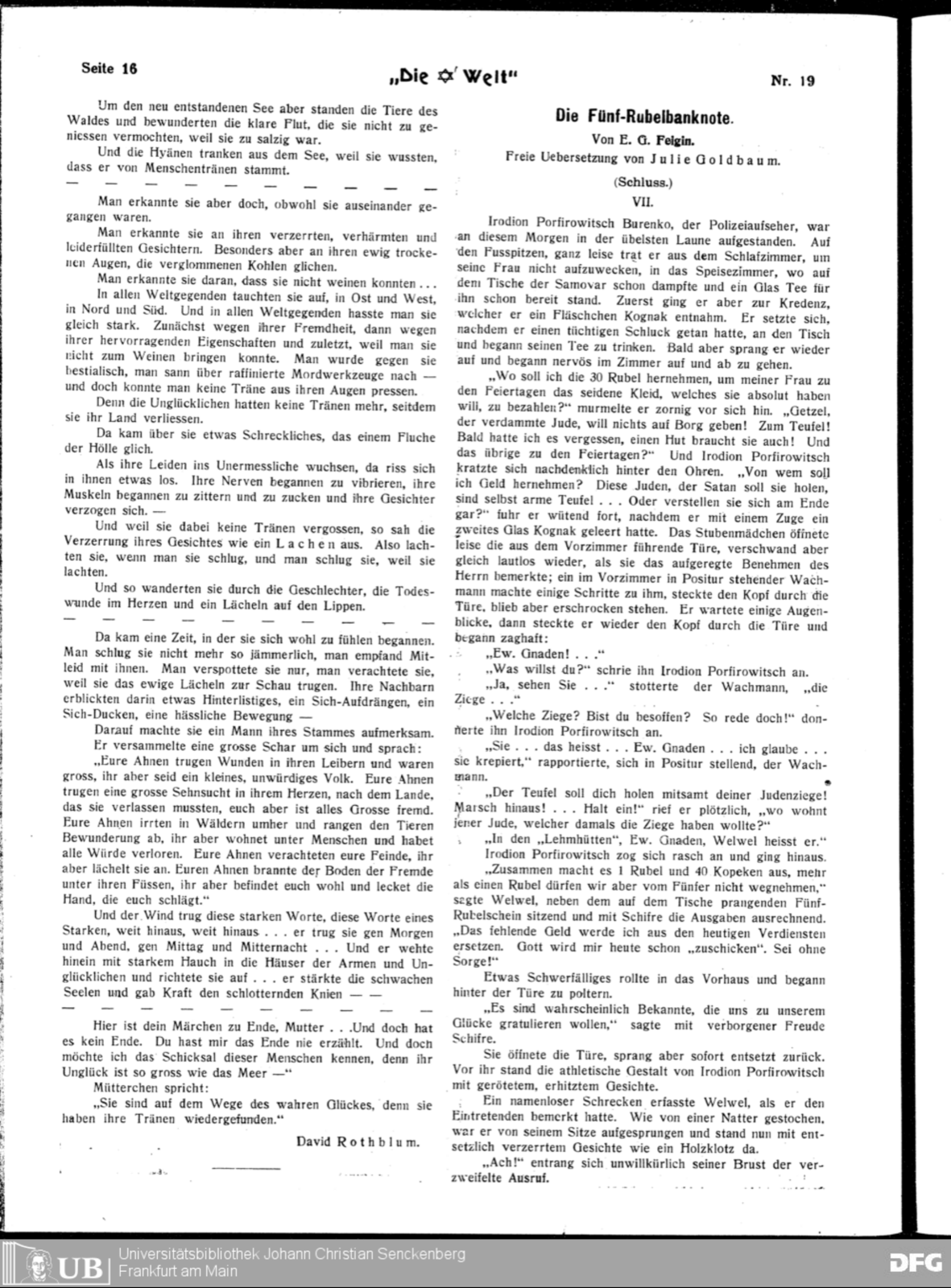
Page 16 — "Die ✡ Welt" — No. 19
But around the newly formed lake stood the beasts of the forest and marvelled at the clear flood, which they could not enjoy because it was too salt.
And the hyenas drank from the lake, because they knew that it came from human tears.
— — — — — — — — —
Yet they were recognised, although they had gone their separate ways.
They were recognised by their distorted, careworn and sorrow-laden faces. But above all by their eternally dry eyes, which were like burnt-out coals.
They were recognised by this, that they could not weep...
They appeared in every quarter of the globe, in east and west, in north and south. And in every quarter of the globe they were hated with equal force. First for their strangeness, then for their excellent qualities, and lastly because they could not be brought to weep. Men grew bestial towards them, men devised refined instruments of murder — and yet no tear could be pressed from their eyes.
For the unhappy ones had had no more tears since they left their land.
Then there came upon them something terrible, like a curse of hell.
When their sufferings grew beyond all measure, something broke loose within them. Their nerves began to vibrate, their muscles began to tremble and to twitch, and their faces became contorted. —
And because they shed no tears the while, the contortion of their faces looked like a laugh. So they laughed when they were beaten, and they were beaten because they laughed.
And so they wandered through the generations, the death-wound in their hearts and a smile upon their lips.
— — — — — — — — —
Then there came a time in which they began to feel at ease. They were no longer beaten so pitilessly; men felt compassion for them. They were only mocked, they were despised, because they wore the eternal smile for all to see. Their neighbours saw in it something underhand, a thrusting-forward, a cringing, an ugly movement —
A man of their own tribe drew their attention to this. He gathered a great throng about him and spoke:
"Your forefathers bore wounds in their bodies and were great, but you are a small, unworthy people. Your forefathers bore a great longing in their hearts for the land they had been forced to leave, but to you all that is great is foreign. Your forefathers wandered about in forests and wrung admiration from the beasts, but you dwell among men and have lost all dignity. Your forefathers despised your enemies, but you smile at them. The soil of the strange land burned beneath your forefathers' feet, but you are at your ease and lick the hand that strikes you."
And the wind carried these strong words, these words of a strong man, far away, far away . . . it carried them towards morning and evening, towards noon and midnight . . . And it blew with a mighty breath into the houses of the poor and unhappy and raised them up . . . it strengthened the feeble souls and gave power to the tottering knees — —
— — — — — — — — —
Here your fairy tale is at an end, Mother . . . And yet it has no end. You never told me the end. And yet I should like to know the fate of these people, for their misfortune is as great as the sea —"
Little Mother speaks:
"They are on the way to true happiness, for they have found their tears again."
David Rothblum.
The Five-Rouble Note.
By E. G. Feigin. Free translation by Julie Goldbaum.
(Conclusion.) VII.
Irodion Porfirowitsch Burenko, the police inspector, had got up that morning in the vilest of tempers. On tiptoe, quite softly, so as not to wake his wife, he stepped out of the bedroom into the dining-room, where the samovar was already steaming on the table and a glass of tea already stood ready for him. First, however, he went to the sideboard, from which he took a little bottle of cognac. Having taken a hearty gulp, he sat down at the table and began to drink his tea. But soon he jumped up again and began to pace nervously up and down the room.
"Where am I to get the 30 roubles to pay for the silk dress my wife absolutely insists on having for the holidays?" he muttered angrily to himself. "Getzel, the damned Jew, won't give anything on credit! The devil! I had nearly forgotten, she needs a hat too! And the rest for the holidays?" And Irodion Porfirowitsch scratched himself thoughtfully behind the ears. "From whom am I to get money? These Jews, Satan take them, are poor devils themselves . . . Or are they only shamming, after all?" he went on furiously, after emptying a second glass of cognac at one draught. The housemaid softly opened the door leading from the anteroom, but at once vanished again noiselessly on noticing her master's agitated behaviour; a watchman standing at attention in the anteroom took a few steps towards him, put his head through the door, but stopped short in fright. He waited a few moments, then put his head through the door again and began timidly:
"Your Honour! . . ."
"What do you want?" Irodion Porfirowitsch shouted at him.
"Well, you see . . ." stammered the watchman, "the goat . . ."
"What goat? Are you drunk? Speak up, then!" Irodion Porfirowitsch thundered at him.
"She . . . that is to say . . . Your Honour . . . I think . . . she's dying," reported the watchman, drawing himself up at attention.
"The devil take you and your Jew-goat together! Out with you! . . . Stop!" he cried suddenly, "where does that Jew live who wanted the goat that time?"
"In the 'Mud Huts', Your Honour; Welwel is his name."
Irodion Porfirowitsch dressed quickly and went out.
"Altogether it comes to 1 rouble and 40 kopecks, but we mustn't take more than one rouble from the five," said Welwel, sitting beside the five-rouble note that lay resplendent on the table and reckoning up the expenses with Schifre. "The money that's short I will make up from today's earnings. God will surely 'send' me something today. Don't you worry!"
Something heavy rolled into the entry and began to clatter behind the door.
"It's probably acquaintances who want to congratulate us on our good fortune," said Schifre with hidden joy.
She opened the door, but sprang back at once in horror. Before her stood the athletic figure of Irodion Porfirowitsch, his face flushed and heated.
A nameless terror seized Welwel when he caught sight of the man entering. As though stung by an adder, he had leapt up from his seat and now stood there like a block of wood, his face horribly distorted.
"Ah!" the despairing exclamation broke involuntarily from his breast.