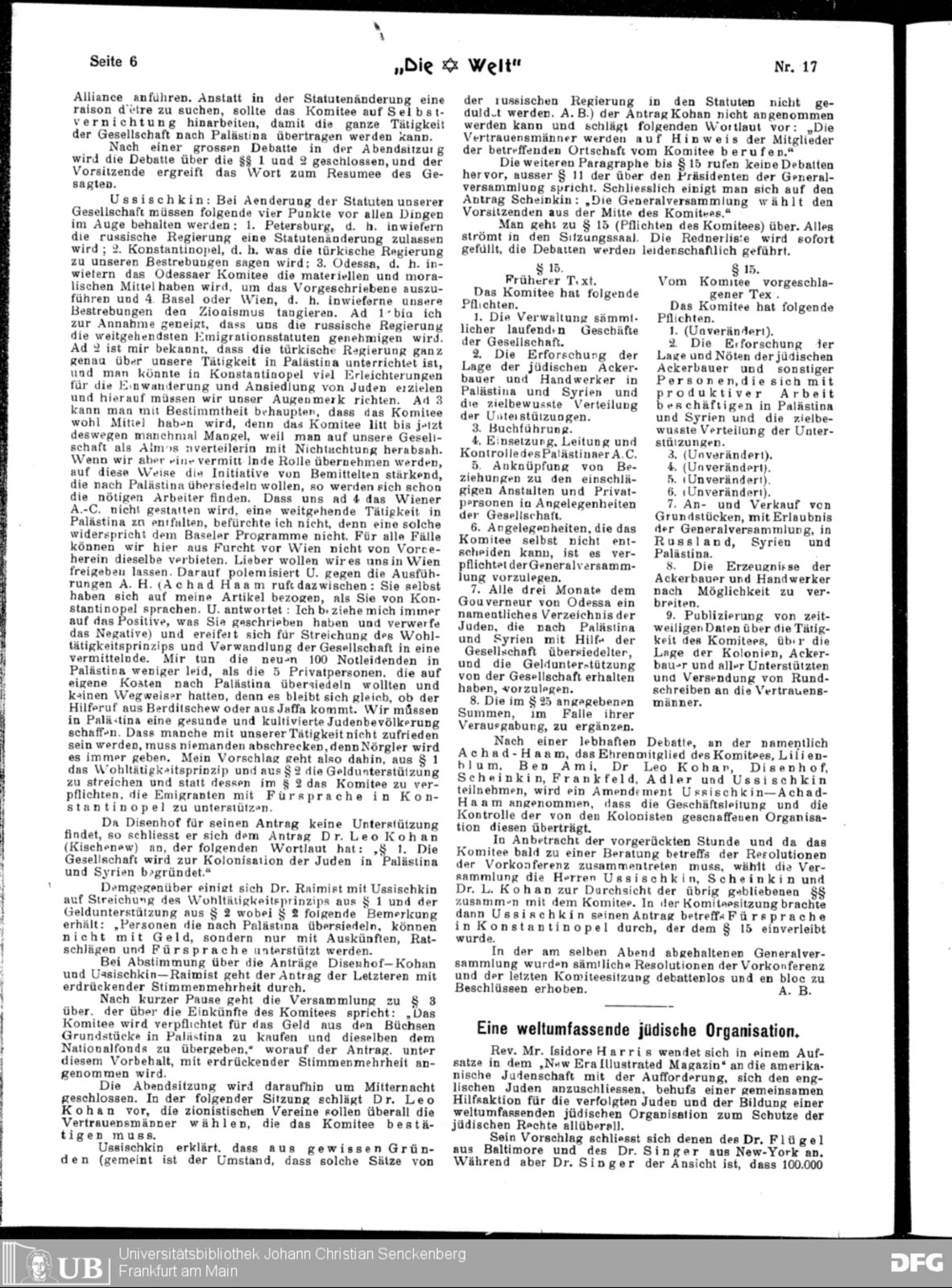
Page 6. — "Die Welt" — No. 17.
(continued from page 5)
…Alliance. Instead of seeking a raison d'être in the revision of the statutes, the Committee ought to work towards its own dissolution, so that the whole activity of the Society may be transferred to Palestine.
After a long debate in the evening sitting the debate on §§ 1 and 2 is closed, and the Chairman takes the floor to sum up what has been said.
Ussischkin: In revising the statutes of our Society the following four points must above all be kept in view: 1. St. Petersburg, that is, how far the Russian Government will permit a revision of the statutes; 2. Constantinople, that is, what the Turkish Government will say to our endeavours; 3. Odessa, that is, how far the Odessa Committee will have the material and moral means to carry out what is prescribed; and 4. Basle or Vienna, that is, how far our endeavours touch upon Zionism. As to 1, I am inclined to assume that the Russian Government will sanction for us the most far-reaching emigration statutes. As to 2, I know that the Turkish Government is quite precisely informed of our activity in Palestine, and many facilities for the immigration and settlement of Jews might be obtained in Constantinople, and to this we must direct our attention. As to 3, it may be asserted with certainty that the Committee will indeed have means, for the Committee has hitherto sometimes suffered want because our Society was looked down upon with disregard as a distributor of alms. But if we take up a mediating rôle, thereby strengthening the initiative of people of means who wish to settle in Palestine, the necessary workers will be found. That, as to 4, the Vienna A.-C. will not permit us to unfold a far-reaching activity in Palestine, I do not fear, for such activity does not contradict the Basle Programme. In any case we cannot here, out of fear of Vienna, forbid it from the outset. Let us rather have it released for us in Vienna. U. then argues against the statements of A. H. (Achad Haam interjects: You yourself referred to my articles when you spoke of Constantinople. U. replies: I always refer to the positive in what you have written and reject the negative) and speaks warmly for striking out the principle of charity and transforming the Society into a mediating one. I am less sorry for the ten new needy persons in Palestine than for the five private persons who wished to settle in Palestine at their own expense and had no one to show them the way, for it is all the same whether the cry for help comes from Berditschew or from Jaffa. We must create in Palestine a healthy and cultivated Jewish population. That some will not be satisfied with our activity need deter no one, for there will always be grumblers. My proposal, then, is to strike out the principle of charity from § 1 and monetary relief from § 2, and in their stead to oblige the Committee in § 2 to support the emigrants by intercession in Constantinople.
As Disenhof finds no support for his motion, he associates himself with the motion of Dr. Leo Kohan (Kischenew), which reads as follows: "§ 1. The Society is founded for the colonisation of the Jews in Palestine and Syria."
Against this, Dr. Raimist agrees with Ussischkin on striking out the principle of charity from § 1 and monetary relief from § 2, § 2 receiving the following note: "Persons who settle in Palestine may be supported not with money, but only with information, advice and intercession.
On the vote upon the motions Disenhof—Kohan and Ussischkin—Raimist, the motion of the latter is carried by an overwhelming majority.
After a short interval the meeting passes to § 3, which deals with the Committee's income: "The Committee shall be obliged to purchase plots of land in Palestine with the money from the collecting-boxes and to hand these over to the National Fund," whereupon the motion, subject to this proviso, is adopted by an overwhelming majority.
The evening sitting is thereupon closed at midnight. In the following sitting Dr. Leo Kohan proposes that the Zionist societies everywhere should elect the local representatives, whom the Committee must confirm.
Ussischkin declares that for certain reasons (what is meant is the circumstance that such clauses are not tolerated in the statutes by the Russian Government. A. B.) the Kohan motion cannot be adopted, and proposes the following wording: "The local representatives are appointed by the Committee on the recommendation of the members of the locality concerned."
The further paragraphs up to § 15 call forth no debates, except § 11, which deals with the President of the General Meeting. Agreement is finally reached on the Scheinkin motion: "The General Meeting elects the Chairman from among the members of the Committee."
The meeting passes on to § 15 (Duties of the Committee). Everyone streams into the hall. The list of speakers is filled at once; the debates are conducted with passion.
| § 15. Former text. | § 15. Text proposed by the Committee. |
|---|---|
| The Committee has the following duties. 1. The administration of all the current business of the Society. | The Committee has the following duties. 1. (Unchanged). |
| 2. The investigation of the condition of the Jewish agriculturists and artisans in Palestine and Syria and the purposeful distribution of relief. | 2. The investigation of the condition and needs of the Jewish agriculturists and other persons engaged in productive labour in Palestine and Syria and the purposeful distribution of relief. |
| 3. Book-keeping. 4. The appointment, direction and control of the Palestine A. C. 5. The establishment of relations with the appropriate institutions and private persons in matters concerning the Society. 6. Matters which the Committee cannot itself decide it is obliged to lay before the General Meeting. 7. To submit every three months to the Governor of Odessa a list by name of the Jews who have settled in Palestine and Syria with the help of the Society and who have received monetary relief from the Society. 8. To replenish the sums specified in § 25 in the event of their expenditure. | 3. (Unchanged). 4. (Unchanged). 5. (Unchanged). 6. (Unchanged). 7. The purchase and sale of plots of land, with the permission of the General Meeting, in Russia, Syria and Palestine. 8. To disseminate the products of the agriculturists and artisans as far as possible. 9. The publication from time to time of data on the activity of the Committee, on the condition of the colonies, of the agriculturists and of all those assisted, and the dispatch of circulars to the local representatives. |
After a lively debate, in which Achad-Haam, the honorary member of the Committee Lilienblum, Ben Ami, Dr Leo Kohan, Disenhof, Scheinkin, Frankfeld, Adler and Ussischkin in particular take part, an amendment Ussischkin—Achad-Haam is adopted, that the management and control of the organisation created by the colonists be transferred to them.
In view of the advanced hour, and since the Committee must shortly meet for a deliberation concerning the resolutions of the preliminary conference, the meeting elects Messrs. Ussischkin, Scheinkin and Dr. L. Kohan to revise the remaining §§ together with the Committee. In the Committee sitting Ussischkin then carried his motion concerning intercession in Constantinople, which was incorporated in § 15.
In the General Meeting held the same evening, all the resolutions of the preliminary conference and of the last Committee sitting were raised to decisions without debate and en bloc. A. B.
A World-Embracing Jewish Organisation.
The Rev. Mr. Isidore Harris, in an essay in the "New Era Illustrated Magazin", addresses American Jewry with the appeal to join with the English Jews for a common relief action on behalf of the persecuted Jews and for the formation of a world-embracing Jewish organisation for the protection of Jewish rights everywhere.
His proposal follows those of Dr. Flügel of Baltimore and Dr. Singer of New-York. But whereas Dr. Singer is of the opinion that 100,000