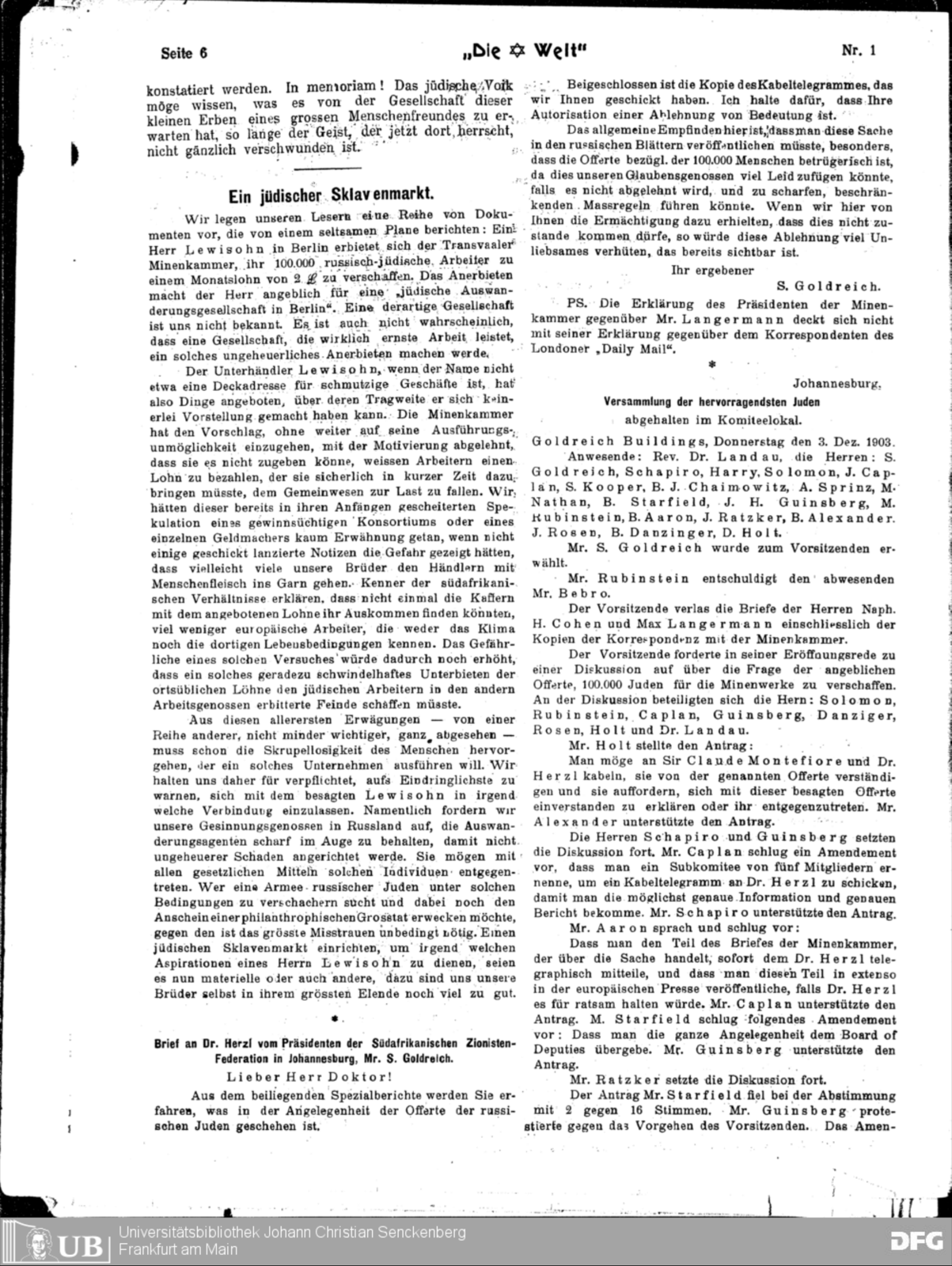
Page 6. — "Die Welt" — No. 1.
(continued from page 5)
…be placed on record. In memoriam! Let the Jewish people know what it has to expect from the society of these small heirs of a great philanthropist, so long as the spirit that now reigns there has not wholly vanished.
A Jewish Slave Market.
We lay before our readers a series of documents which tell of a strange plan: a Mr. Lewisohn in Berlin offers the Transvaal Chamber of Mines to procure for it 100,000 Russian-Jewish labourers at a monthly wage of £2. The gentleman makes the offer ostensibly on behalf of a "Jewish Emigration Society in Berlin." No such society is known to us. Nor is it probable that a society which does really serious work would make so monstrous an offer.
The negotiator Lewisohn, if the name be not perhaps a cover address for dirty dealings, has thus offered things of whose bearing he can have formed no conception whatever. The Chamber of Mines, without going further into the impossibility of carrying out the proposal, has declined it on the ground that it could not consent to pay white labourers a wage which must surely bring them within a short time to become a burden upon the community. We should scarcely have made mention of this speculation of a greedy consortium or of a single money-maker, which has already failed at its very outset, had not certain cleverly launched paragraphs shown the danger that many of our brethren might perhaps fall into the net of these dealers in human flesh. Those acquainted with South African conditions declare that not even the Kaffirs could make a living on the wage offered, much less European labourers, who know neither the climate nor the conditions of life there. The danger of such an attempt would be heightened still further by the fact that so downright fraudulent an undercutting of the wages customary in the locality must create for the Jewish labourers bitter enemies in their fellow-workers.
From these very first considerations alone — quite apart from a number of others no less important — the unscrupulousness of the man who would carry out such an enterprise must already be evident. We therefore consider ourselves bound to warn most urgently against entering into any connection whatever with the said Lewisohn. In particular we call upon our fellow Zionists in Russia to keep a sharp eye upon the emigration agents, lest enormous harm be done. Let them oppose such individuals with every lawful means. Towards one who seeks to barter away an army of Russian Jews under such conditions, and who would at the same time give it the appearance of a great philanthropic deed, the utmost mistrust is absolutely necessary. To set up a Jewish slave market in order to serve any aspirations of a Mr. Lewisohn, be they material or otherwise — for that our brethren, even in their deepest misery, are still far too good in our eyes.
*
Letter to Dr. Herzl from the President of the South African Zionist Federation in Johannesburg, Mr. S. Goldreich.
Dear Doctor,
From the enclosed special report you will learn what has taken place in the matter of the offer of the Russian Jews.
Enclosed is the copy of the cablegram which we sent you. I hold that your authorisation of a rejection is of importance.
The general feeling here is that this matter ought to be published in the Russian papers, and particularly that the offer concerning the 100,000 men is fraudulent, since, unless it be rejected, it might cause our co-religionists much suffering and lead to severe restrictive measures. If we here received authorisation from you to the effect that this must not come about, such a rejection would prevent much unpleasantness which is already visible.
Yours faithfully,
S. Goldreich.
P.S. The statement of the President of the Chamber of Mines to Mr. Langermann does not agree with his statement to the correspondent of the London "Daily Mail."
*
Johannesburg,
Meeting of the Most Prominent Jews
held in the Committee Rooms.
Goldreich Buildings, Thursday, 3rd Dec. 1903.
Present: Rev. Dr. Landau, Messrs.: S. Goldreich, Schapiro, Harry Solomon, J. Caplan, S. Kooper, B. J. Chaimowitz, A. Sprinz, M. Nathan, B. Starfield, J. H. Guinsberg, M. Rubinstein, B. Aaron, J. Ratzker, B. Alexander, J. Rosen, B. Danzinger, D. Holt.
Mr. S. Goldreich was elected Chairman.
Mr. Rubinstein excused the absent Mr. Bebro.
The Chairman read the letters of Messrs. Neph. H. Cohen and Max Langermann, together with the copies of the correspondence with the Chamber of Mines.
The Chairman in his opening speech invited a discussion on the question of the alleged offer to procure 100,000 Jews for the mines. Messrs. Solomon, Rubinstein, Caplan, Guinsberg, Danziger, Rosen, Holt and Dr. Landau took part in the discussion.
Mr. Holt moved:
That Sir Claude Montefiore and Dr. Herzl be cabled, informed of the said offer, and requested to declare their agreement with the said offer or to oppose it. Mr. Alexander seconded the motion.
Messrs. Schapiro and Guinsberg continued the discussion. Mr. Caplan moved an amendment that a sub-committee of five members be appointed to send a cablegram to Dr. Herzl, in order that the most exact information and an exact report might be obtained. Mr. Schapiro seconded the motion.
Mr. Aaron spoke and proposed:
That the part of the letter of the Chamber of Mines dealing with the matter be communicated at once to Dr. Herzl by telegraph, and that this part be published in extenso in the European press, should Dr. Herzl deem it advisable. Mr. Caplan seconded the motion. M. Starfield moved the following amendment: That the whole affair be handed over to the Board of Deputies. Mr. Guinsberg seconded the motion.
Mr. Ratzker continued the discussion.
Mr. Starfield's motion was lost on the vote by 2 to 16. Mr. Guinsberg protested against the procedure of the Chairman. The amend-